Generative AI in 2026 is less about dazzling demos and more about dependable, embedded intelligence that quietly runs products, workflows, and even parts of the economy. The shift from “chatbot” to “colleague, copilot, and autonomous agent” is now structural, not speculative. Successful GenAI has transformed working operations and business architectures of enterprises across different industries.
2026 GenAI Leaderboard (Latest Frontier Models)
|
Model |
Key Strength |
Notable Specs / Positioning |
|
Claude Opus 4.7 |
Agentic coding & long workflows |
Best-in-class coding reliability; excels in multi-hour autonomous tasks and tool orchestration; strong safety alignment |
|
Gemini 3.1 Pro |
Scientific reasoning + multimodal scale |
~1M+ token context; strong across text, image, audio, video; leading performance in science-heavy benchmarks and high-throughput inference |
|
Llama 4 Maverick |
Open-weight frontier performance |
MoE architecture; near-closed-model performance with full customization; optimized for enterprise-scale deployment |
|
GPT-5.5 |
General intelligence + planning |
Strongest composite reasoning; advanced tool use, self-correction, and multi-step task execution; leading “agent OS” capabilities |
|
Mistral Large 3 / Small 4 (Latest Stack) |
Efficient open-weight + modular AI |
Mistral Large 3: flagship multimodal MoE (41B active / 675B total params, ~256k context) Mistral Small 4 (2026): unified reasoning + vision + coding in a single efficient model (~119B total, sparse activation) |
What Defines the 2026 Frontier (Reality Check)
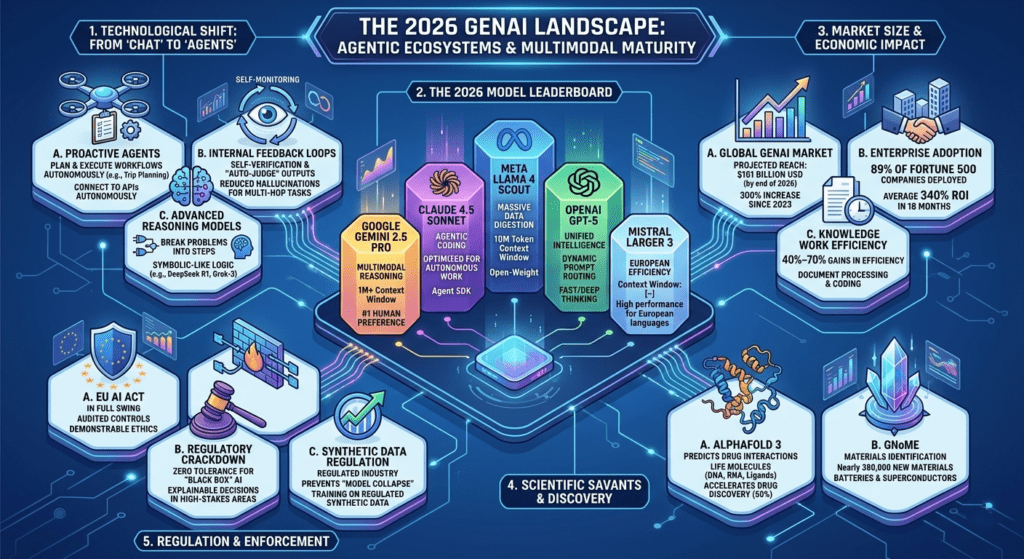
The 2026 GenAI landscape isn’t a race to build single smartest AI model, now it is building optimal AI stacks with strategic splits across capabilities, cost, and control. The leaderboard—featuring models like GPT-5.5, Gemini 3.1 Pro, Claude Opus 4.7, Llama 4 Maverick, and Mistral Large 3 makes that shift from AI models to AI systems business approach.
- Intelligence is now multi-dimensional, not absolute: There’s no universal #1 anymore. Some models dominate coding and agent workflows (Claude Opus 4.7), others lead in multimodal reasoning and scale (Gemini 3.1 Pro), while models like GPT-5.5 push general-purpose planning and tool use. “Best” depends entirely on the job.
- Agentic capability is the real battleground: Static Q&A is table stakes. The frontier is defined by models that can plan, execute, and iterate over hours, using tools, APIs, and memory. This is where GPT-5.5 and Claude Opus 4.7 are setting the pace—less chatbot, more autonomous system.
- Context windows have plateaued as a differentiator: With most frontier models comfortably operating at hundreds of thousands to million-token scale, raw context size no longer wins headlines. The shift is toward how effectively that context is used, not how large it is.
- Open vs closed is now a strategic decision: Models like Llama 4 Maverick and Mistral’s latest stack aren’t just alternatives and they represent a different philosophy of system control, customization, and on-prem deployment. Enterprises are increasingly choosing between capability (closed) and control (open-weight).
- Efficiency is overtaking raw power: Cost per token, latency, and hardware efficiency are now critical. Gemini 3.1 Pro and Mistral’s models show that price-performance ratio can outweigh marginal gains in benchmark scores—especially at scale.
- Multimodality is baseline, not premium: Text, image, audio, and video understanding are now expected. The frontier isn’t “can it see?”—it’s how seamlessly it reasons across modalities in real workflows.
- Model routing is replacing single-model dependence: The smartest systems no longer rely on one model. Instead, they dynamically route tasks using fast models for simple queries and deep reasoning models for complex ones. Top models are encouraging collaborative AI development and modular AI architectures.
We have evolved from Chatbots to Agentic Systems
Between 2023 and 2025, the big story was raw model capability; in 2026, it is end-to-end agency. Models don’t just generate content; they observe context, decide what to do, and act across tools and channels.
- Multi-modal and agentic systems are now the default baseline in serious deployments, blending text, images, speech, and structured data to complete workflows rather than single prompts.
- Multi-agent orchestration has moved from research papers into production, with coordinated AI “teams” handling tasks such as candidate screening, sales operations, or code refactoring pipelines.
- In developer ecosystems, CLI-first agents and integrated copilots are replacing parts of traditional IDE workflows, with reports of materially faster code delivery.
- Autonomous capabilities allow AI agents to now plan, initiate, and execute complex workflows (e.g., “Organize my business trip”) by communicating with other software APIs autonomously.
- Self-Verification feature enables models to “auto-judge” their own outputs using internal feedback loops. This 2026 feature has significantly reduced hallucinations in large AI models answers and hence made then more reliable, multi-hop automated tasks manager. Models like OpenAI o3, DeepSeek R1, and Grok-3 have moved the needle from statistical guessing to symbolic-like logic and advanced reasoning responses: breaking down massive problems into manageable steps.
- The AI models key design requirements for enterprises have changed from data curation, customer service, eliminate silos requisites to adaptive AI models having their own processes, quantified KPI, and auto-suggestion improvements.
Multimodal Models Grow Up
If 2024 was the year multimodal went mainstream, 2026 is the year it matured into infrastructure. Multimodal large language models (MLLMs) are now treated as general reasoning backplanes over heterogeneous inputs.
- State-of-the-art open-source models like GLM-4.5V combine expert-mixture (MoE) architectures with long-context handling (tens of thousands of tokens), enabling analysis of images, videos, and lengthy documents in a single session.
- “Thinking modes” that switch between fast inference and deep reasoning are becoming common, allowing systems to dynamically trade off latency and accuracy per request.
- Industry surveys on MLLMs emphasize that emergent skills—such as OCR-free math reasoning over images—are viewed as a plausible stepping stone toward more general forms of intelligence.
Practically, this shows up as CRMs that ingest call transcripts, emails, screenshares, and contracts together, then suggest next-best actions with a unified understanding of the account.
Enterprise Reality: Embedded, Vertical, and Governed
Generative AI in 2026 is no longer a “sidecar app”; it is a design layer inside core platforms. Vendors are retrofitting their CRMs, ERPs, HR systems, and commerce platforms with native generative and agentic capabilities.
- CRM platforms are evolving into intelligent customer partners: analyzing conversations, summarizing calls, inferring buying intent, drafting personalized outreach, and surfacing live recommendations inside sales workflows.
- Hyper-personalization has evolved into full-loop orchestration—systems that generate content, make decisions (e.g., who to contact, through which channel), trigger execution, and then learn from outcomes.
- Vertical and domain-specific models are increasingly favored over giant general LLMs, especially in regulated sectors like healthcare and finance, where synthetic data and structured generation help close data gaps while respecting privacy.
On the platform side, enterprise-grade agentic AI vendors emphasize multi-agent orchestration, cloud- and model-agnostic architectures, and strong governance as table stakes for scaling beyond pilot projects.
Governance, Economics, and the New Stack Regulations
As adoption has accelerated, the bottlenecks have shifted from “Can we build this?” to “Can we operate this safely, affordably, and at scale?” The 2026 AI stack reflects that reality.
- Analyst expectations put the generative AI market in the tens of billions of dollars by the end of 2026, with adoption spanning from startups to global enterprises across content, analytics, and process automation.
- Agentic AI platforms stress governance as a core differentiator: role-based access to agents, audit trails for actions taken on behalf of users, and policy engines that constrain which systems agents can touch.
- Economic pressure is driving a mix of small, specialized models for routine tasks and more capable multimodal or proprietary models for complex reasoning, orchestrated by routing layers that optimize cost vs. quality per call.
- The EU AI Act is in full swing to enforce regulation and ethical practices of AI for enterprises, and public. The act is to ensure companies to demonstrable tech vigilance and audit controls.
- The “Black Box” crackdown for regulators in the UK and US to show zero tolerance for unexplainable AI decisions in high-stakes areas like banking, taxation, healthcare and hiring.
- Synthetic Data is new currency for AI tech companies, as high-quality human data runs slim, the use of Synthetic Data for training large learning models and machine learning programs especially in the fields of science and robotics.
What Matters Now and What’s Next
For practitioners and leaders, a few priorities stand out in 2026 as both urgent and durable.
- Outcome-first design: Anchor generative AI initiatives to clear business KPIs, then back into model, data, and agent architecture decisions, rather than leading with benchmarks alone.
- Data and context strategy: Invest in high-quality, well-governed data, retrieval-augmented generation (RAG), and contextual grounding, since these still dominate real-world performance.
- Agent governance and safety: Define what your agents are allowed to see, do and present; implement robust approval flows, monitoring, and human-in-the-loop guardrails where stakes are high.
- Talent and operating models: Build cross-functional teams that pair domain experts with AI engineers and AI prompt designers with the focus on durable patterns over one-off prototypes.
- One of the most exciting developments in 2026 is the use of GenAI to build exceptional physical-world ‘scientific savants’like, AlphaFold 3 model predicts international among life molecules (DNA, RNA, ligands) with high accuracy, the AI model will accelerate drug development and biological confirmation methods. GNoMe is another worthy mention of 2026 GenAI innovation that has identified 380,000 new stable materials and has become a leading partner company in battery tech and superconductors industry.
The next frontier is less about a single breakthrough model and more about composability: networks of specialized, multimodal, and agentic systems that can be assembled like software components to solve new classes of problems. Proactive and practical use of GenAI can bring competitive edge to businesses looking for stable AI capabilities and segment their product, and processes, and culture ahead of their competitors.
Frequently asked questions
What defines the 2026 GenAI landscape?
The 2026 GenAI landscape focuses on building optimal AI stacks with strategic splits across capabilities, cost, and control.
How have AI models evolved by 2026?
AI models have evolved from simple chatbots to agentic systems that can observe context, decide actions, and execute workflows autonomously.
What is the significance of multimodal models in 2026?
Multimodal models have matured into infrastructure, enabling general reasoning over various inputs and enhancing workflow efficiency.