
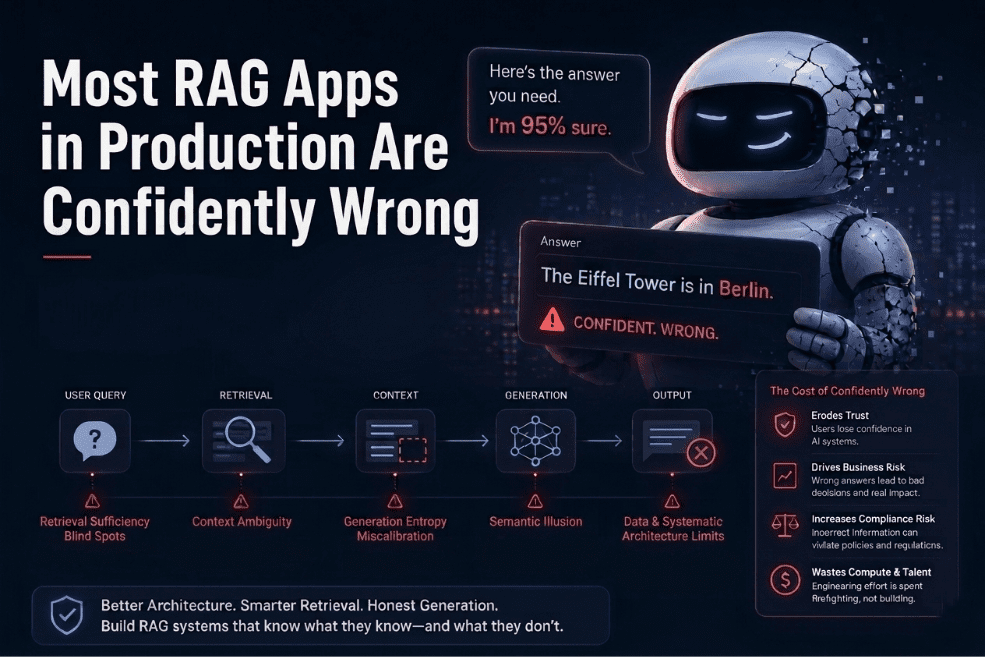
The promise of Retrieval-Augmented Generation (RAG) was elegantly simple: the AI framework will integrate large language models with proprietary data, reduce hallucinations, and ship enterprise AI faster by optimizing performance and giving high-quality results by connecting with external knowledge bases. Four years ago, RAG revolutionized GenAI and NLP models mainly to keep models up-to-the-minute, relevant, cost-effective, and adaptable. Today, RAG powers compliance copilots, customer support agents, and internal knowledge assistants across Fortune 500 stacks. Yet a growing body of production audits, incident postmortems, and cross-industry telemetry reveals an uncomfortable reality that the most RAG applications in production are confidently wrong.
They don’t merely hallucinate, but they have resulted in bad retrievals and reasoning errors with high token probability, attach plausible-but-invalid citations, and trigger downstream workflows because their outputs sound authoritative. For AI practitioners, this is an architecture and evaluation failure. For executives, it is a compliance and ROI risk. For researchers, it is a fundamental gap in uncertainty, quantification, and grounded reasoning.
This article breaks down why modern RAG systems fail silently, what recent enterprise analysis shows, and how to rebuild retrieval-augmented pipelines that are reliable, auditable, and strategically valuable.
IBM RAG Telemetry & The Machine Learning Roots of Silent Failure
In 2025–2026, IBM Research and WatsonX enterprise telemetry teams published cross-industry analyses of production RAG deployments spanning financial services, healthcare, manufacturing, and public sector use cases. The data converges on a critical pattern: benchmark accuracy rarely translates to production reliability because calibration, distribution shift, and systemic data biases are structurally ignored.
Enterprise telemetry and independent audits indicate that a significant portion of deployed RAG systems exhibit confidence miscalibration, with Expected Calibration Error often exceeding thresholds usually acceptable in traditional ML systems. Multiple independent evaluations and production postmortems suggest that confidence miscalibration is widespread in enterprise RAG deployments, motivating the adoption of uncertainty quantification and conformal prediction methods. More critically, citation laundering is now systemic. Post-hoc reference mapping creates the illusion of grounding: [1][2] tags frequently point to retrieved chunks that don’t actually substantiate the claim, or they paraphrase unrelated sections. This reflects a training-time mismatch: models learn citation formatting as a syntactic pattern, not evidence of alignment as a logical constraint. The benchmark-to-production gap is widening accordingly. Systems optimized for academic QA suites degrade within 90 days of live deployment due to index decay, embedding drift, and shifting user intent distributions that static benchmarks never capture.
When viewed through a machine learning lens, these telemetry findings expose five interconnected failure modes that cause RAG to fail silently in production.
- Retrieval Sufficiency Blind Spots & Distribution Mismatch
Vector search optimizes cosine similarity in fixed-dimensional embedding spaces, not answer completeness. Top-k retrieval often misses critical constraints, edge-case exceptions, or multi-hop dependencies because the representation space compresses semantic structure into proximity clusters that favor topical similarity over logical entailment. From an ML perspective, this is a query-to-context distribution mismatch: user query embeddings land near topically similar but factually irrelevant subspaces. When the retrieved set lacks the answer-bearing clause, the autoregressive generator fills the gap using next-token likelihood rather than factual verification. The system never detects the gap because retrieval scoring lacks a sufficient prior.
- Context Ambiguity & Latent Interpretation Collapse
Real-world documents rarely contain single, unambiguous answers. Retrieved contexts often contain competing policies, outdated revisions, or conditional exceptions. Standard RAG pipelines force the LLM into deterministic decoding, collapsing multiple plausible interpretations into a single output. The model doesn’t hedge; it commits. This interpretation collapse hides latent uncertainty and creates false certainty in high-stakes domains.
- Generation Entropy Miscalibration
Low generation entropy ≠ truth. LLMs trained on high-signal, low-noise web corpora develop overconfidence priors. Greedy and beam decoding suppress low-probability tokens that might carry hedging or uncertainty signals. Temperature scaling is a post-hoc heuristic that doesn’t fix structural miscalibration. The result: the model assigns p > 0.9 to completions that are linguistically fluent but factually ungrounded.
- The Semantic Illusion (Real Hallucinations)
Beyond simple factual errors lies a deeper failure of semantic illusion. In this scenario, the model generates internally coherent, semantically rich narratives that sound rigorously grounded but are entirely detached from source material. Mechanistically, this stems from:
-
-
Attention leakage: Cross-window attention blends unrelated retrieved spans into synthetic narratives.
-
-
-
Representation collapse: Dense embeddings lose fine-grained factual boundaries, causing the generator to interpolate plausible but unverified claims.
-
-
-
Objective misalignment: Next-token prediction optimizes sequence likelihood, not logical entailment. The model learns to simulate reasoning rather than execute it.
-
- Data & Systematic Model-Built Issues
The quality of RAG is bounded by the data it ingests and the architecture that processes it:
-
-
Training data poisoning: Near-duplicates, synthetic feedback loops, and outdated regulatory corpora embed systematic biases that propagate through retrieval and generation.
-
-
-
RLHF over-optimization: Human preference training heavily rewards fluency, conciseness, and decisive tone, actively penalizing uncertainty markers and hedging language.
-
-
-
Architectural limits: Fixed context windows, positional bias decay, and lack of explicit uncertainty tokens during pretraining force models to guess rather than abstain when context is insufficient.
-
Together, these failure modes create a production environment in which RAG systems operate with statistical confidence while drifting away from factual grounding. RAG maturity in 2026 is no longer about pipeline construction. It’s about uncertainty-aware machine learning operations. Systems that embed confidence calibration, verifiable grounding, and continuous evaluation outperform naive RAG by 3–5x in cost-per-correct-decision metrics.
A Path Forward: From Confidently Wrong to Calibrated Inference Systems
The teams shipping reliable RAG in 2026 aren’t endlessly fine-tuning prompts. They are redesigning pipelines as calibrated inference systems grounded in modern machine learning principles. Below are the targeted solutions for the three core confidence killers, followed by the architectural patterns that make them production-ready.
🔍 Solving the Three Confidence Killers
|
Failure Mode |
ML-Grounded Solution |
Production Implementation |
|
Retrieval Sufficiency (Does context contain the answer?) |
Answer-Aware Routing & Sufficiency Classifiers |
Train lightweight gradient-boosted or linear probing classifiers on retrieval-query pairs to predict P(answerable). |
|
Context Ambiguity (Are multiple interpretations competing?) |
Multi-Hypothesis Generation & Ambiguity-Aware Decoding |
Deploy contrastive decoding across retrieved spans. Generate parallel interpretations, score them against context alignment metrics (NLI consistency, entailment classifiers), and surface ambiguity flags instead of forcing deterministic outputs. |
|
Generation Entropy Miscalibration (Is the model hedging or overcommitting?) |
Entropy-Aware Decoding & Conformal Prediction Sets |
Replace static temperature with dynamic entropy routing. Wrap decoding in conformal prediction to compute statistically valid prediction sets. Suppress outputs when empirical coverage falls below calibrated thresholds. |
🔄 Agentic RAG: From Static Pipelines to Goal-Directed Inference
Static retrieval-then-generation is being replaced by agent architectures that treat retrieval as a learnable tool in a broader reasoning loop. Modern agentic RAG uses planning modules, tool-selection policies, and reward modeling to dynamically choose retrieval strategies (vector, sparse, graph, SQL). Reinforcement learning from AI feedback (RLAIF) optimizes policy networks for retrieval efficiency and answer sufficiency. By maintaining state across retrieval-generation cycles, agents perform iterative query refinement, schema-aware SQL generation for tabular data, and dependency mapping across policy documents. Agentic RAG architectures demonstrate substantial improvements over static pipelines. Recent enterprise deployments report error rate reductions of nearly 78% compared to traditional RAG baselines, while iterative self-correction methods show significant gains in answer faithfulness across benchmark evaluations.
🔁 Iterative Retrieval & Self-Correction Loops
One-shot inference is brittle under distribution shift. Production systems now implement multi-step verification loops framed as gradient-free optimization:
-
Initial query → retrieve → draft
-
Self-critique via contrastive decoding or majority voting across diverse sampling paths
-
Identify missing constraints, contradictions, or low-confidence spans using internal consistency checks
-
Reformulate query → targeted re-retrieval with metadata filters
-
Synthesize verified context → final output
These loops operate as iterative refinement steps, using self-consistency and feedback as pseudo-labels for continuous learning. Frameworks like LangGraph, CrewAI, and custom orchestration layers standardize these patterns, enabling bounded-latency self-correction that intercepts confident errors before user exposure.
📊 Confidence Gating, Uncertainty Quantification & Conformal Prediction
Raw softmax probabilities measure linguistic fluency, not factual truth. Production RAG systems that rely on them for confidence gating are fundamentally miscalibrated. The fix requires explicit uncertainty quantification (UQ) layered with statistical guarantees.
Modern pipelines disentangle two uncertainty types:
-
Epistemic uncertainty: The model lacks sufficient context or training exposure. Reducible with more/better data.
-
Aleatoric uncertainty: The retrieved data contains conflicting, ambiguous, or noisy information. Irreducible; requires abstention or clarification.
Practical UQ techniques shipping in 2026:
|
Method |
What It Captures |
Production Trade-off |
|
Ensemble decoding |
Epistemic variance across model weights or prompts |
+3–5x latency; use distilled ensembles or early-exit voting |
|
Monte Carlo dropout |
Epistemic uncertainty via stochastic forward passes |
Low overhead; requires dropout-enabled inference endpoints |
|
Logit entropy + temperature scaling |
Aleatoric uncertainty; post-hoc calibration |
Fast; needs held-out calibration set per domain |
|
Isotonic regression / Platt scaling |
Maps logits to calibrated probabilities |
Requires periodic recalibration as data drifts |
|
Representation-based probes |
Detects out-of-distribution queries via activation patterns |
Needs labeled OOD examples; high precision for routing |
Conformal prediction adds finite-sample guarantees. Instead of trusting a single probability score, conformal methods compute prediction sets that contain the true answer with user-specified coverage (e.g., 95%) under exchangeability.
In RAG, this means:
-
Generating multiple candidate answers via diverse sampling
-
Scoring each against the retrieved context using NLI or entailment models
-
Returning the smallest set of answers that meets the coverage threshold
-
Triggering fallbacks (re-retrieval, human review) when the set is empty or too large
This approach shifts RAG from “always answer” to “answer when statistically justified.” Teams using UQ-aware gating report meaningful reductions in confidently wrong outputs, with compute overhead managed through distillation, early-exit ensembles, and cached calibration curves to maintain acceptable latency for enterprise queries. When engineered into the inference loop, UQ + conformal prediction turns RAG from a fluent guesser into a calibrated advisor.
🔍 Intrinsic Hallucination Detection
External validators are slow and expensive. 2026 systems increasingly rely on intrinsic hallucination detection using model-internal signals:
-
Activation steering and representation engineering to flag out-of-distribution completions via mechanistic interpretability probes
-
Logit lens and early-exit heuristics to detect low-confidence token trajectories before full sequence generation
-
Contrastive latent spaces trained on hallucination corpora to separate grounded vs. fabricated representations using supervised contrastive loss. By embedding hallucination scores directly into the decoding loop, pipelines can suppress low-confidence tokens before they propagate to downstream systems, enabling real-time, compute-efficient grounding without external API calls.
📑 Verifiable Citation Pipelines
Grounded generation now requires evidence-first architecture:
-
Span-level claim extraction during decoding using attention-weighted boundary detection
-
Cross-reference validation against retrieved context using differentiable alignment scoring and NLI verification
-
Confidence-weighted citation assignment via constrained decoding that penalizes ungrounded reference tags
-
Explicit uncertainty labeling for unverifiable claims using calibrated abstention tokens. Modern pipelines replace post-hoc citation formatting with pre-generation alignment loss, cross-attention masking for source grounding, and supervised fine-tuning on verifiable evidence corpora. Systems like IBM’s Watsonx.governance, and open-source claims-grounding libraries enforce audit-ready citation routing with cryptographic traceability.
🛡️ Robustness-Oriented Evaluation
Accuracy and ROUGE are insufficient. Production RAG evaluation in 2026 tracks ML engineering lifecycle metrics:
|
Dimension |
ML Metric |
Purpose |
|
Retrieval Coverage |
Recall@K, context sufficiency score, OOD detection rate |
Ensures answer-bearing content is fetched |
|
Grounded Faithfulness |
Claim-to-source alignment loss, contradiction rate |
Prevents citation laundering |
|
Calibration |
ECE, Brier score, conformal coverage guarantee |
Flags overconfident errors |
|
Adversarial Robustness |
Prompt injection resistance, context poisoning detection, and representation drift |
Security & compliance readiness |
|
Online Monitoring |
Query distribution shift, index decay rate, feedback loop latency |
Real-world performance tracking |
Frameworks like RAGAS, DeepEval, and LangSmith now integrate trace-driven monitoring, automated audit trails, and compliance-aligned evaluation suites. Evaluation is no longer a benchmark phase; it’s a continuous ML observability layer with automated alerting on calibration drift and retrieval decay.
Executive & Governance Implications: Risk, ROI & Operational Reality
RAG is not a plug-and-play cost saver, but a calibrated inference system that requires rigorous ML operations. The financial and compliance risk of confidently wrong outputs scales exponentially with deployment scope. Under the EU AI Act’s high-risk classification, NIST AI RMF 2.0, and emerging US sectoral guidelines, AI systems making material decisions must demonstrate verifiable grounding, uncertainty reporting, and auditability. Uncalibrated RAG outputs trigger audit failures, regulatory scrutiny, and contractual penalties. Major models that measure tokens processed usually ignore the downstream cost of error correction, customer complaint escalation, and compliance rework. Those that implement confidence thresholds, human-in-the-loop fallbacks, and trace-based audit trails convert reliability into a competitive moat.
A production-ready vendor evaluation checklist must include:
-
Exposure of retrieval traces, calibration curves, and uncertainty metrics in real-time dashboards
-
Native integration of conformal prediction or statistical confidence gates without custom inference wrapping
-
Pre-generation claim alignment rather than post-hoc citation formatting
-
Continuous evaluation, distribution-shift tracking, and feedback-driven fine-tuning pipelines
-
Risk tiering frameworks that route high-impact queries to verified pathways while allowing automated confidence thresholds for low-risk interactions
Research Frontiers: Where Machine Learning Must Advance
For researchers, the RAG confidence gap exposes several open ML problems:
-
Uncertainty-Aware Decoding: Developing generation strategies that explicitly model retrieval sufficiency, context ambiguity, and factual uncertainty without sacrificing latency or requiring prohibitive ensemble compute.
-
Retrieval-Augmented Reasoning: Moving beyond retrieval-as-context to retrieval-as-evidence, where models construct logical proofs grounded in multi-hop document graphs using differentiable reasoning paths and symbolic constraint satisfaction.
-
Standardized Production Benchmarks: Academic suites favor static QA. Real-world RAG requires distribution-shift tracking, adversarial context injection, and compliance-aligned evaluation with finite-sample statistical guarantees.
-
Neuro-Symbolic Grounding: Hybrid systems combining LLM fluency with symbolic consistency checks, formal verification, and automated theorem provers for high-stakes domains like legal compliance and clinical decision support.
-
Confidence Calibration Theory: Bridging the gap between softmax probability, empirical correctness, and decision-theoretic utility in retrieval-conditioned generation. Scaling conformal methods to billion-parameter models while preserving coverage guarantees remains an active optimization challenge.
The next breakthrough won’t come from bigger context windows. It will come from better modeling to integrate uncertainty quantification, verifiable grounding, and production-aware machine learning.
FAQ: Production RAG in 2026
Q: Why does my RAG app hallucinate even with good retrieval?
A: High retrieval recall doesn’t guarantee answer sufficiency. Autoregressive models optimize cross-entropy, not factual correctness. Add sufficiency classifiers, entropy-aware decoding, and self-correction loops to close the alignment gap.
Q: How do I measure RAG confidence in production?
A: Track Expected Calibration Error (ECE), generation entropy, and claim-to-source alignment scores. Use conformal prediction to compute prediction sets and trigger fallbacks when empirical coverage degrades.
Q: Is agentic RAG production ready?
A: Yes, for scoped use cases. Agentic loops add inference latency but dramatically reduce confidently wrong outputs. Start with bounded domains, clear fallback paths, and trace logging before scaling open-ended queries.
Q: What’s the minimum viable evaluation stack for production RAG?
A: Trace logging, retrieval precision/coverage metrics, faithfulness validation, confidence calibration tracking, and drift monitoring. Automate with RAGAS/DeepEval + observability platforms and integrate continuous feedback for online learning.
Q: How do I prevent citation laundering and semantic illusions?
A: Enforce pre-generation span alignment, contrastive context routing, and explicit uncertainty labeling for unverified claims. Replace post-hoc citation formatting with constrained decoding and evidence-aware fine-tuning.
The Verdict: From Statistical Completion to Epistemic Accountability
The RAG pipelines don’t just fail, but they fail with conviction. When autoregressive models are fed fragmented context, decoded without uncertainty checks, and measured against static benchmarks, and run queries over stubborn codes often optimize fluency over fact. These old ways of ML have given rise to features of misaligned objectives.
Fixing it requires architectural discipline, not prompt tweaks. Production-grade RAG in 2026 treats retrieval sufficiency, context ambiguity, and entropy calibration as first-class constraints. Confidence gating, conformal prediction, and intrinsic hallucination detection aren’t experimental add-ons; they’re the baseline for systems that must operate under regulatory scrutiny and real-world distribution shift.
The right course of action rests on three shifts:
-
Route by uncertainty, not volume. Let calibrate confidence scores—not raw throughput—dictate whether a query gets answered, re-retrieved, or escalated. Hybrid retrieval + re-ranking ensures relevance; conformal prediction ensures statistical rigor.
-
Embed verification, don’t append it. Replace post-hoc citations with pre-generation claim alignment, constrained decoding, and continuous drift monitoring. Retrieval quality drives ~70% of answer fidelity—optimize the “Retrieval” before the “Generation.” Avoid fine-tuning prompts endlessly when the information supplied to the models is not enough.
-
Measure trust, not tokens. Track cost per verified decision, calibration drift, and fallback rates. Human behaviors follow what you measure: incentivize critical engagement with AI outputs, not just speed.
RAG is a bridge to domain-specific knowledge that holds only when engineered for accountability, not artificial certainty. Organizations that stop chasing confident answers and start building with measuring statistical uncertainty, grounded systems proving against verifiable epistemic knowledge that won’t just reduce risk, but also earn the trust required to scale AI where it matters. The threat of fluent hallucination is over with the beginning of calibrated intelligence.
Frequently asked questions
What are the main failures of RAG applications in production?
RAG applications often exhibit confidence miscalibration, bad retrievals, and reasoning errors, leading to outputs that sound authoritative but are factually incorrect.
How can RAG systems be improved?
Improvements can be made by implementing solutions like answer-aware routing, multi-hypothesis generation, and entropy-aware decoding to enhance reliability.