Coding assistants, RAG pipelines, agentic orchestrators, vector databases, no-code builders, design AI, and observability platforms I ran these categories of 2026 AI tools for my personal production project with real deadlines. The article covers AI productivity tools that have kept up with market demand for interactive and ambient AI.
It is rare to talk about the tools that did not work for them, but this teaches the reader and practitioner many things about the trend, strategies to adopt, and what not to repeat. The AI industry runs on announcements, benchmark leaderboards, and founder tweets that age into obsolescence. What it rarely produces is the far more useful story: the one about what you had open at 11 pm on a fine Thursday, three months after the launch, when the hype had cleared, and the real work is under your hand.
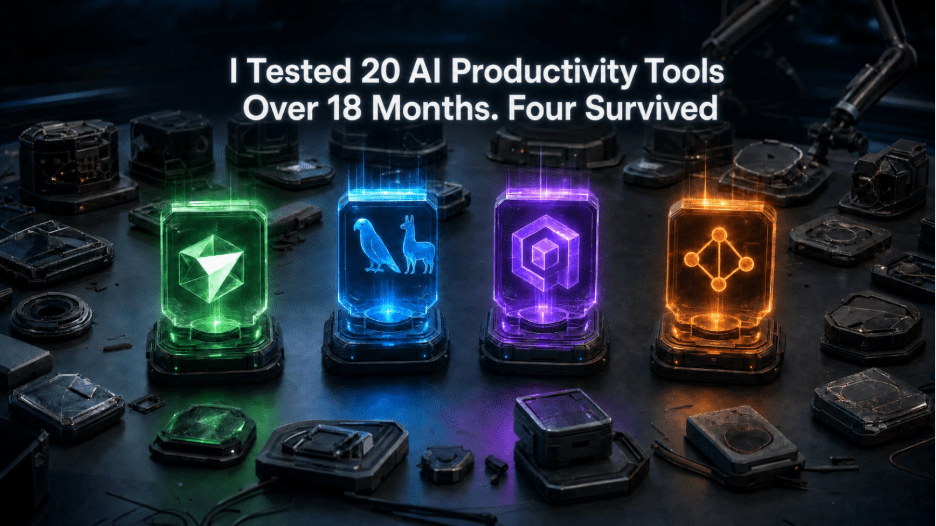
Over the past 18 months, I systematically evaluated more than 20 AI tools spanning every major category the industry has produced, including agentic coding environments, orchestration and workflow frameworks, vector databases and RAG-as-a-service platforms, no-code agent builders, UI design accelerators, LLM observability tools, autonomous code reviewers, local inference hardware, and real-time voice agent infrastructure. Each tool received weeks of genuine applications into my work routine.
The four that survived beyond our threshold; did have something in common that no amount of feature documentation prepared me to see in advance: they stopped being “tools I need to complete work” to “the tools working along me as my colleagues” The transition is about using AI to lighten work ambience and maintain interactivity are strong, practical, yet human sensitive measures of whether software has changed how you work rather than adding more friction to your workflow.
This article is for developers, founders, product managers, and research practitioners at every level of technical depth. You do need to know the techniques of a vector graph to work with the retrieval layer in an AI system. The chosen productive tools are resilient, realizable, and give you confident, accurate answers every time. The tools covered here touch everything from how code gets written to embedding enterprise knowledge. They support building modern workflows more organized, along with trusted vector retrievals. The stakes of building a superior AI stack are higher in 2026 than they have ever been.
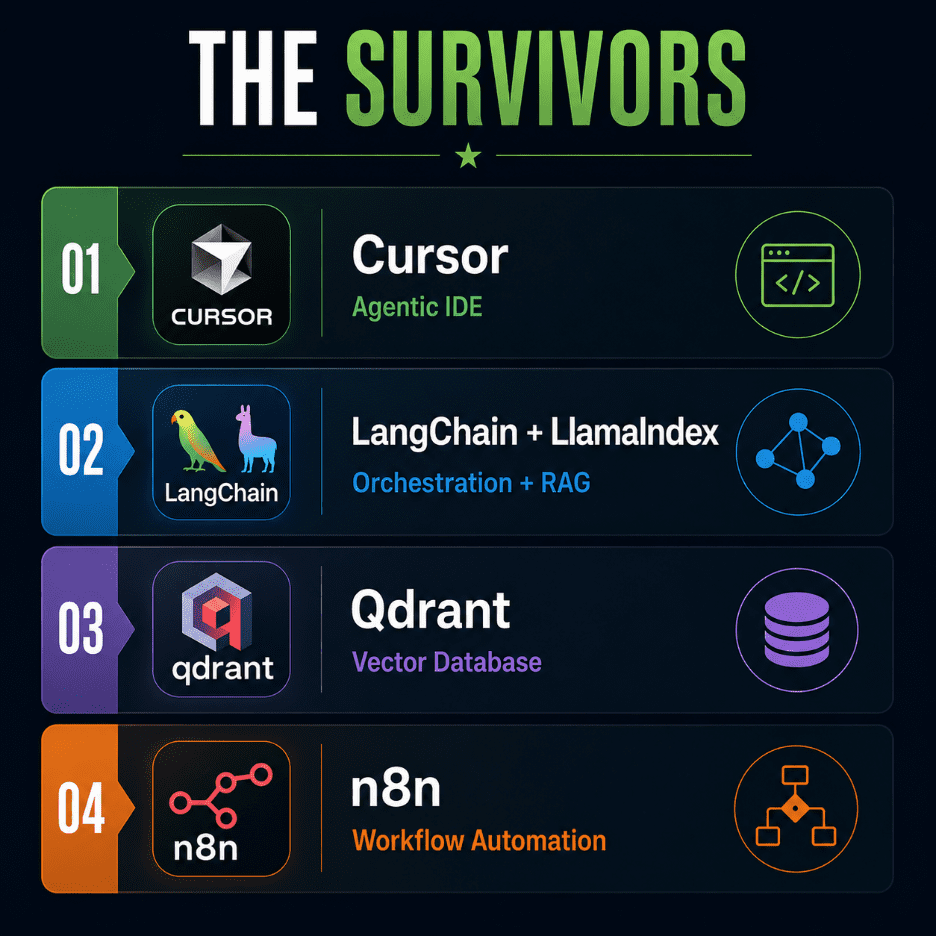
These categories of our survivors have received incredible and applauding investment from both the open-source community and enterprise vendors between late 2024 and mid-2026, the period during which agentic AI shifted from research demo to production expectation. If you are building AI systems today, you are almost certainly being asked to evaluate tools or at least understand these tools fundamentally.
1. Cursor: Stopped Feeling Like A Tool. That Is Why It Won.
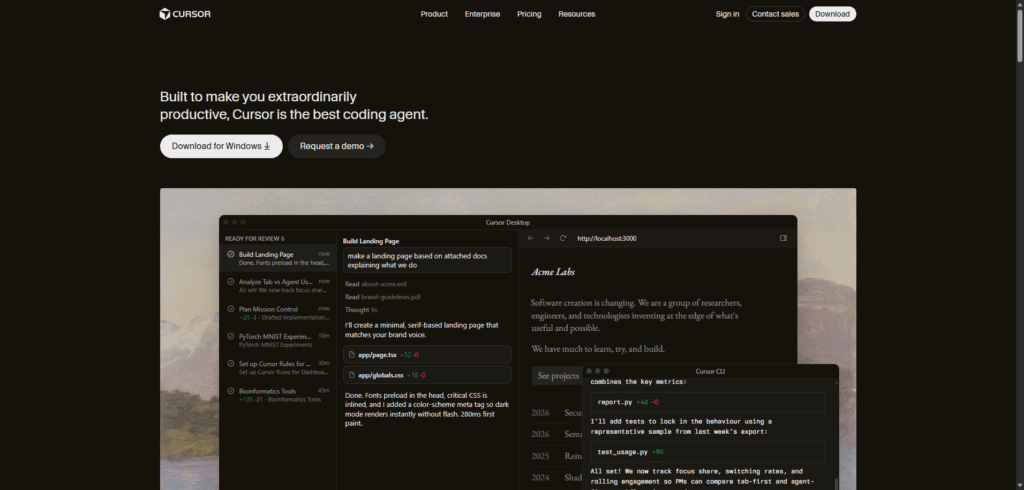
Cursor crossed that line sometime in early 2026 and never looked back. It started as a VS Code fork with smarter autocomplete. By version 2.0, it had become something categorically different: an agentic development environment where you describe what you want to build at a high level, and the system plans the architecture, writes across multiple files simultaneously, runs its own tests, interprets the errors, and proposes fixes, without requiring you to continuously monitor at every step. The Composer mode, introduced in late 2025, powers completing the majority of multi-file tasks in seconds using a purpose-built low-latency model. The March 2026 Automations release added the ability to trigger agents via Slack messages, codebase events, or timers, which means Cursor now operates on a schedule, not just when a developer is sitting in front of it.
Cursor
AI-native Development/ Agentic IDE / VS Code Fork/ Multi-agent
A complete rebuild of the IDE experience around agentic autonomy. Composer mode handles multi-file, multi-step engineering tasks from end-to-end. Context is managed via @mentions for codebase, documentation, and live web search. Version 2.0 introduced parallel multi-agent workflows where up to eight agents run simultaneously in isolated environments. Cloud Agents allow work to continue in the background after the developer steps away. The Automations system, launched March 2026, enables scheduled agents triggered by events, timers, or external messages, making Cursor the first IDE that genuinely works while you sleep.
Why It Survived: The only coding environment that crossed the threshold from assistant to infrastructure. Cursor Composer, Plan mode, and Cloud Agents became the default interface for AI engineering to work with, touching multiple files or requiring architectural decisions.
What Got Cut Alongside But Deserves A Try: Windsurf (combining Copilot and Agent Modes with ability to integrate Cursor settings or VS Code), Devin (autonomous cloud agent), CodeRabbit (interactive UI, gives priority to visualization and observability), Harness AI (solid CI, testing but redundant with the existing stack).
2. LangChain and LlamaIndex: Dependable Orchestration Framework and Retrieval Connectivity
There is a version of their evaluation where LangChain and LlamaIndex get dismissed as overhyped, with the argument that any competent developer could replace them with clean Python. I also believed in this declaration before I spent three weeks reinventing abstractions that LangGraph had already solved with production guarantees in 2024. The experience was educational in exactly the way expensive mistakes tend to be.
These frameworks are the layer between an LLM’s raw capability and a system that behaves reliably and consistently at production scale. LangGraph, LangChain’s agent-specific layer, automated workflows as explicit state machines with deterministic branching, logic, and human knowledge in support. This matters enormously the moment your AI system needs to handle an edge case gracefully rather than hallucinating through it. LlamaIndex, paired with LangGraph, handles the data retrieval side: ingesting your documents, chunking and indexing them intelligently, and ensuring that the model retrieves and outputs the right thing at the right moment.
LangChain + LangGraph
Orchestration Framework / Stateful Agent Workflows
LangChain provides the broad integration ecosystem of model connectors, prompt templates, document loaders, and tool integrations. LangGraph, its agent-specific layer, models workflows as graph-based state machines with explicit control over branching, retries, and state persistence. By 2026, it holds the widest verified enterprise deployment list of any open-source orchestration framework, running in production at Klarna, Uber, LinkedIn, JPMorgan, Replit, and BlackRock. Monthly search volume for LangGraph reached 27,100, more than double CrewAI’s 14,800, reflecting its position as the default for teams moving from prototype to production.
Why It Survived: For complex stateful workflows in regulated or high-stakes environments, nothing else provides comparable control and observability without requiring you to build the scaffolding yourself. The steep learning curve is real. So is the ceiling unlocked?
LlamaIndex
RAG Framework / Data Orchestration / Retrieval
The dominant open-source framework for building RAG pipelines at production scale. LlamaIndex specializes in data integration, intelligent chunking, semantic indexing, and retrieval accuracy. This is the engineering work that sits between raw documents and a model that can answer questions users can trust. The LlamaIndex plus LangGraph combination became the most common dual-framework architecture in new production agentic deployments through 2025 and 2026, precisely because they provide an adjacent solution to complementary AI stack designs.
Why It Survived: If your system needs to know about your data – your documents, your knowledge base, your internal records and you want to forget about token inefficiency and context drift. LlamaIndex is the retrieval layer that makes this achievable.
What Got Cut Alongside But Deserves A Try: The frameworks that did not survive in this category deserve an honest accounting. CrewAI makes multi-agent role-based systems remarkably fast to prototype: a researcher agent, a writer agent, a reviewer agent, all coordinating on a task with minimal setup. That is genuinely useful, and for teams building internal tools without dedicated engineering support, CrewAI is worth serious evaluation. AutoGen, merged with Microsoft’s Semantic Kernel in early 2026, brings enterprise-grade reliability with strong human-in-the-loop patterns. For .NET shops and Microsoft-stack organizations, it is the natural default. The reason neither survived in this particular evaluation is specific: the prototype-to-production gap required engineering work that LangGraph would have simply handled efficiently, and rebuilding halfway through a project is a cost that compounds badly.
Also Evaluated In This Category: Haystack, Mem0, Zep, and Mistral 7B as local inference backbone all received extended evaluation. Haystack is a strong alternative to LlamaIndex for teams that prefer a more opinionated pipeline structure, but it has limited scope, function limitations, and is Python-based with zero code visibility. Mem0 and Zep represent the most promising approaches to persistent agents’ memory, but neither yet provides the production reliability needed to run unattended at scale, showing some inference gaps and latency. Mistral 7B running locally on an NVIDIA GPU offers real value for latency-sensitive or air-gapped workloads, but today reportedly shows security vulnerabilities, narrow knowledge, and the occurrence of hallucinations. Nevertheless, watch this space closely as the hardware-software integration matures through 2026.
3. Qdrant: The Database That Solved The Problem You Did Not Know You Had
Most people who build AI applications understand, at least abstractly, that they need some kind of database. Fewer understand why the type of database matters as profoundly as it does when the application needs to retrieve information by meaning rather than by exact match. Traditional databases find the row where the customer ID equals 47382. A vector database finds the ten documents most semantically similar to a user’s question, even if none of them contain the exact words the user typed. That capability is the backbone of every AI system that does not hallucinate its way through enterprise knowledge.
The vector database market in 2025 and 2026 produced more serious contenders than almost any other AI infrastructure category. Pinecone, Weaviate, Vectara, Ragie, Redis with vector extensions, and Qdrant all received genuine evaluation time. Most of them are genuinely capable. The question that mattered was a different one: which one would I trust in a production system at 2 a.m. on a day I was not watching it? The answer, after months of filtered similarity search, hybrid retrieval benchmarks, and operational incident comparisons, was Qdrant. It was not particularly close.
Qdrant
Vector Database / RAG Pipelines / Semantic Search
An open-source vector database written in Rust, built for filtered similarity search at production scale. The architecture is composable and modular, designed so teams can tune the tradeoff between retrieval precision and throughput based on their specific data volume and latency requirements. The April 2026 cloud release added GPU-accelerated indexing, Multi-AZ clusters for high availability, and audit logging. This is a clear signal that the product has moved from a developer-friendly tool to enterprise-grade infrastructure. For datasets under 100 million vectors, it is the simplest, most performant, and most operationally honest choice in the category.
Why It Survived: Qdrant won because it behaved predictably under load, failed gracefully under stress, and required less specialist knowledge to operate correctly than every competing option at this tier. In production infrastructure, boring reliability is the most exciting feature of all. Qdrant has successfully adapted to market demand, moving past “store vectors” to hybrid retrieval, metadata filtering, multi-tenancy and production-scale vector search pipelines.
4. n8n: Compelling productivity tool waiting for you in plain sight
The uncomfortable truth about most AI workflow tools: they require you to write Python, understand LLM APIs, and manage infrastructure before you can build anything that connects to the applications your organization actually uses. That creates a productivity cliff where technically excellent tools remain inaccessible to the people who would benefit most from them: the operations manager who wants to automate a CRM update based on an AI summary of a customer call, the content team that wants to trigger a research pipeline from a Slack message, the finance team that wants document extraction to feed directly into a reporting workflow.
n8n solves the problem for this gap and does it without sacrificing the depth that technical users need. It arrived in this evaluation as a self-hostable Zapier alternative with a strong data sovereignty story. It survived as something considerably more interesting: a platform that added genuine AI agent nodes in 2025, creating a hybrid automation layer where deterministic integration steps and AI reasoning steps coexist in the same visual workflow. With the combination of 400-plus application connectors, a no-code visual builder, and native LLM agent nodes, produce workflows that would otherwise require significant custom engineering to build and maintain.
n8n
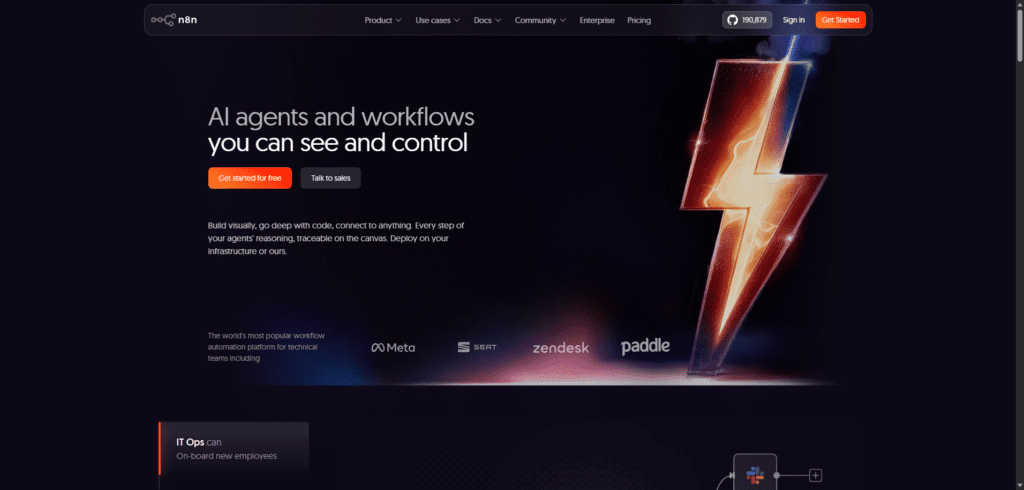
Workflow Automation / AI Agent Nodes / Self-hostable
Over 18 months of testing AI productivity software, I found that the biggest gains rarely came from generating text, writing code, or answering questions. They came from eliminating the repetitive work surrounding those activities: moving data between systems, triggering follow-up actions, updating records, monitoring events, routing information, and stitching together disconnected tools. That is where n8n stood apart.
Instead of acting as another destination where work happens, n8n became the infrastructure that made work happen automatically. New leads could be enriched, categorized, and routed without manual intervention. Research could be collected from multiple sources and delivered in structured formats. AI models could classify, summarize, and act on information the moment it arrives. Entire workflows that previously required dozens of clicks across multiple applications became invisible for background processes.
Why It Survived: The most consistently underestimated tool in the entire roundup, and the one with the widest applicable audience. If your team is building anything that combines structured integrations with AI reasoning, and in 2026, most teams are doing exactly that. n8n eliminates weeks of glue code and keeps the logic visible, auditable, and modifiable by non-engineers.
Sixteen Tools Did Not Survive
The tools that I gave up are not failures. Most of them are technically impressive and authentically useful within the right context, technical capabilities, and scope. What they failed to do was earn a permanent place in a working stack over 18 months of real-world pressure. These are notable mentions to understand the reason:
MindStudio & IBM watsonx
No-code Agent Builder / Enterprise AI Platform / Context-dependent
MindStudio’s REMY agent system meaningfully lowers the barrier to deploying AI agents for non-developers, and it is one of the most approachable agent-building experiences in the market. IBM Watson, paired with Confluent data pipelines and cloud integration tooling, remains a serious enterprise option with deep data governance credentials. Both were cut for the same reason: for teams with engineering capability and LangGraph in the stack, they add abstraction overhead without adding ceiling. For teams without that capability, MindStudio in particular deserves a serious look.
When To Use Them: MindStudio for product and operations teams that need AI agents without engineering support. watsonx for large enterprises with existing IBM contracts, complex data governance requirements, and the integration complexity that Confluent pipelines are designed to handle.
Uizard and Variant
AI UI / UX Design Tools / Niche
Uizard’s AI-powered mockup generation and Variant’s design iteration tooling both accelerate the wireframing and visual design process in legitimate ways. They earned genuine enthusiasm during evaluation, particularly for rapid prototyping of product concepts. The reason they did not survive in this roundup is specific to workflow, not quality: the design bottleneck they address was not the bottleneck in this particular stack. For product designers and early-stage founders doing frequent design iteration, the evaluation would likely conclude differently.
Best For: Non-designers who need to prototype UI quickly, and design-led teams that want to compress the iteration cycle between concept and testable mockup. Not a replacement for Figma at production design scale.
Pinecone and Vectara
Rag-as-a-Service / Managed Vector Databases / Good Alternatives
This entire category is strong and improving rapidly. Pinecone offers the best managed experience for teams that want zero infrastructure overhead. Weaviate’s graph-native capabilities position it well alongside Neo4j and Amazon Neptune for knowledge-graph and relational-retrieval workloads. Vectara and Ragie are mature enough to run serious RAG pipelines without custom engineering. The category collectively lost to Qdrant on the specific combination of filtered-query performance, operational simplicity, self-hosting flexibility, retrieval quality, and cost efficiency.
The Honest Opinion: Choose Pinecone if you want to manage and do not have an MLOps function. Pick Vectara when you want a quick, optimized retrieval layer where search relevance is more important than agent complexity, and you do not have retrieval engineers; Qdrant if you want production-grade performance with the option to self-host. All three are defensible choices in 2026.