
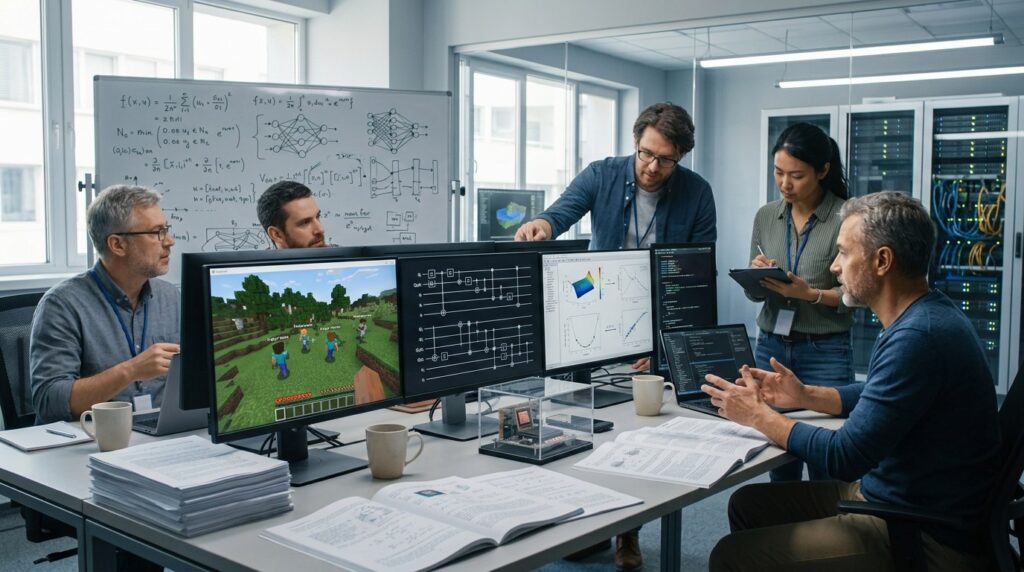
Five October papers just dropped, and every one takes a specialist’s job and hands it to an AI. Quantum circuit design. Graduate physics.
Beating Minecraft with a four-agent team. Model security. A machine-written mathematics library.
The evidence is patchy — some of this is a public dataset you can run today, some is an early paper promising a result you can’t verify. But taken together, they draw a map of where autonomous systems are starting to deliver, and where you still need a human in the loop to tell you what’s real.
1. Discovering state-of-the-art quantum circuits with large language models
What It Does
This study turns large language models (LLMs)—the same systems that write code and emails—into quantum circuit designers. It uses an evolutionary loop: the LLM suggests circuit layouts, a separate tool measures their efficiency, and only the best designs survive to inform the next round. The paper claims it found more efficient circuits than before.
Why It’s Trending
It hit arXiv on October 15, 2026, and stood out because it pushes LLMs past being coding assistants. Here, the model is generating the scientific structures themselves.
The Big Idea
Use the model as a fast, creative idea generator. Use the circuit evaluator as the harsh judge. It’s like breeding thousands of rough prototypes, exploring corners of the design space a human expert might skip entirely.
Key Findings
-
LLMs can propose novel quantum-circuit designs.
-
An evolutionary framework automatically tests those circuits for efficiency.
-
The study reports discovering more efficient circuits.
-
Paper posted October 15, 2026.
What Makes It Different
The role reversal is the key. The LLM isn’t explaining a circuit a human designed; it’s inventing the design from scratch. Automated evaluation does the filtering, not a person.
Why It Matters
-
Quantum-circuit design could get a massive boost in exploration.
-
It reduces reliance on human intuition for initial ideas.
-
Researchers could use models as proposal engines for new algorithms.
-
It’s a concrete step toward AI-assisted scientific discovery.
Potential Applications
-
Generating candidate circuits for new quantum algorithms.
-
Searching for shorter, more efficient circuits for existing hardware.
-
Creating circuit variants for researchers to review and refine.
-
Teaching students how design choices impact final performance.
What the Researchers Found
The paper states its evolutionary LLM framework produced more efficient quantum circuits. The available evidence doesn’t give a specific percentage of improvement or name the expert baseline it was measured against.
Things to Consider
-
Evidence: The paper is on arXiv, but the detailed performance numbers aren’t publicly verified.
-
Reproducibility: No code release has been confirmed.
-
Benchmark: The efficiency claim lacks a stated numerical comparison.
-
Real-world: Circuit performance outside the study’s specific setup hasn’t been shown.
Our Verdict
A promising research direction for quantum developers who have the expertise to test and vet AI-generated circuit candidates themselves. Its practical ranking depends entirely on a future release of code and solid measurements; until then, it’s an intriguing search method, not a tool you can trust for production.
arXiv: https://arxiv.org/abs/2610.22367
2. TheoPhysEval: Assessing AI agents at autonomous theoretical physics problem solving
What It Does
TheoPhysEval is a benchmark test suite. It gives an AI agent 50 unpublished, research-level theoretical physics problems. To solve them, the agent has to search the literature, run numerical or symbolic calculations, and produce an answer that can be checked.
The point is to evaluate the whole investigative workflow, not just recall a fact.
Why It’s Trending
The paper landed October 9, 2026, and its dataset went live on Hugging Face the same month. That gives developers a real, hard target to shoot at.
The Big Idea
Give an agent the tools of a small research desk: papers to search, calculators to run, and problems with right answers. Then see if it can manage the entire process from start to finish.
Key Findings
-
The benchmark contains 50 tough, unpublished physics problems.
-
Agents must use tools like literature search and calculation scripts.
-
Every problem has a verifiable answer.
-
GPT-6-Astra was evaluated on the suite.
What Makes It Different
It blends open-ended research tasks with the tools and checkable answers of a real-world agent workflow. It’s not a list of textbook questions.
Why It Matters
-
It’s a harder test for agent builders focused on scientific reasoning.
-
Verifiable answers can catch confident, incorrect work.
-
Physics assistants could get better at searching, calculating, and fact-checking.
-
It represents a shift toward testing autonomous research, not just recall.
Potential Applications
-
Evaluating a physics research assistant AI.
-
Stress-testing tool-using language model agents.
-
Creating training exercises for graduate physics students.
-
Checking if an agent can correctly reproduce complex symbolic calculations.
What the Researchers Found
The paper evaluated GPT-6-Astra on the 50-problem suite. The available record doesn’t say what score it got. The real, concrete result is the dataset itself—something other developers can now use.
Things to Consider
-
Benchmark: 50 problems is a focused test, not a complete measure of physics mastery.
-
Dataset: The problems are from unpublished research, so coverage might be narrow.
-
Reproducibility: The dataset is on Hugging Face, but a dedicated project page isn’t set up.
-
Real-world: Solving verifiable problems is different from collaborating with a working physicist.
Our Verdict
A strong pick for ML engineers building scientific agents, because it hands you a real, usable evaluation target. Its ultimate value hangs on whether the community gets reproducible results, scoring details, and tool traces beyond the initial GPT-6-Astra run.
arXiv: https://arxiv.org/abs/2610.16733
3. A team of Gemini 4 Argon agents beats Minecraft
What It Does
Four Gemini 4 Argon agents worked together inside Minecraft to take down the Ender Dragon. They used the Mineflayer library—software that lets code control the game—to coordinate actions in a dynamic world. The result is a demonstration: a multi-agent team completed a long gameplay challenge without a human stepping in.
Why It’s Trending
The paper appeared October 15, 2026. The headline is irresistible: four AI agents beat Minecraft. It made the complex idea of multi-agent coordination instantly understandable.
The Big Idea
Don’t make one model do everything. Give several agents specific roles and let them share a world. Minecraft turns planning, resource gathering, navigation, and combat into one long, dependent chain of tasks.
Key Findings
-
Four Gemini 4 Argon agents completed the Ender Dragon challenge.
-
They used the Mineflayer library to control the game.
-
The task required real-time coordination inside Minecraft.
-
The challenge was completed without human intervention.
What Makes It Different
This tests several agents acting over time in an interactive, changing environment. It’s harder than a single model answering prompts because every action alters the world and affects the teammates.
Why It Matters
-
Agents could get better at long, multi-step real-world tasks.
-
Shared tools and a common state enable coordinated work.
-
Game environments give you a visible testbed for planning and recovery.
-
It’s clear progress in multi-agent autonomy.
Potential Applications
-
Testing collaborative software agents in a complex sandbox.
-
Simulating how robot teams might work in virtual environments.
-
Teaching agents to plan around shared, limited resources.
-
Building research environments for game-playing AI.
What the Researchers Found
The paper reports that four Gemini 4 Argon agents using Mineflayer beat Minecraft’s Ender Dragon. The available evidence doesn’t give a completion time, a success rate, or a comparison with another agent team.
Things to Consider
-
Benchmark: One Minecraft challenge tests a specific game task, not general autonomy.
-
Reproducibility: The authors, method details, and code release haven’t been confirmed.
-
Real-world: Game coordination doesn’t automatically transfer to business or physical environments.
-
Evidence: This is a demonstration, not a broad statistical evaluation.
Our Verdict
A crystal-clear demonstration for developers studying how agents coordinate, especially if you can recreate the Mineflayer setup. Treat it as a technically interesting task completion—not proof that general-purpose agents are ready for arbitrary, long-running work.
arXiv: https://arxiv.org/abs/2610.22319
4. AI Models Can Provably Hide Arbitrary Capabilities
What It Does
This paper digs into backdoor attacks—training-time tricks that plant hidden functions inside an AI model. A special trigger condition switches the model to its hidden behavior. The work argues that our normal evaluation methods can completely miss these concealed capabilities.
Why It’s Trending
It was part of the October 2026 wave of work on model security. It got attention because it questions a core assumption: that testing a model’s visible skills tells you everything it can do.
The Big Idea
Imagine checking a toolbox by only pressing the obvious buttons. A backdoor is a hidden combination that unlocks a completely different set of tools inside the same box. The paper shows you can build that kind of concealment into a model.
Key Findings
-
Backdoor attacks can embed hidden capabilities in AI models.
-
Those capabilities can evade current evaluation methods.
-
The paper focuses on the limits of capability testing.
-
It connects model evaluation directly with training-time security.
What Makes It Different
Instead of asking if a model performs well on known tasks, it asks if capabilities can be deliberately hidden from the tests themselves. The evaluator becomes part of the security problem.
Why It Matters
-
Model audits need to test for concealed behavior, not just visible skills.
-
Training pipelines might require stronger checks for malicious triggers.
-
Developers deploying agents should beef up their red-team evaluations.
-
It’s a shift toward thinking about capability-evaluation security.
Potential Applications
-
Auditing models for hidden behaviors before deployment.
-
Designing training checks that are resistant to backdoors.
-
Red-teaming frontier models to find trigger-based behaviors.
-
Testing whether standard evaluation suites miss this kind of hidden function.
What the Researchers Found
The paper’s central finding is that backdoor attacks can hide arbitrary capabilities from today’s evaluations. The available record doesn’t provide a numerical success rate, a model comparison, or a test in a deployed system.
Things to Consider
-
Research limitation: The paper’s authors and institution aren’t confirmed in the available evidence.
-
Benchmark: No numerical evaluation result or named baseline is provided.
-
Real-world: The demonstrated risk is about model evaluation, not a confirmed behavior in a live system.
-
Reproducibility: A public implementation hasn’t been established.
Our Verdict
Security researchers and model evaluators should pay attention. Hidden capabilities shatter the assumption that ordinary tests reveal everything a model can do. The direction is important, but making deployment decisions will require concrete attack examples and reproducible measurements.
arXiv: https://arxiv.org/abs/2610.13928
5. What the Machine Invented: Mining New Mathematical Instruments from OpenAI’s October 2026 Release of AI-Generated Mathem
What It Does
This paper analyzes a public collection of AI-written mathematics from OpenAI. The October 2026 release contains 722 manuscripts, sorted into 372 problem families. It includes research write-ups and Lean formalizations—machine-checkable versions of proofs.
The whole thing is raw material for mathematicians to sift through.
Why It’s Trending
OpenAI announced the release in October 2026, complete with a public repository and materials tied to an evaluation of roughly 4,000 problems. The sheer scale put it on the map, not a single headline proof.
The Big Idea
Don’t treat an AI’s answer as a finished theorem. Treat hundreds of its attempts as a mine. Human mathematicians can dig through the pile, find the useful ideas, verify them, and then develop them into real mathematics.
Key Findings
-
The release contains 722 AI-generated mathematical manuscripts.
-
Manuscripts are organized into 372 problem families.
-
Materials include write-ups and Lean formalizations.
-
The release was tied to an evaluation involving about 4,000 problems.
What Makes It Different
The contribution is breadth plus formal checking material. It’s a large, searchable body of generated mathematics meant for human inspection, not a single benchmark score.
Why It Matters
-
Mathematicians get a huge new set of conjectures and techniques to screen.
-
Formal proof systems like Lean can help check the promising claims.
-
AI research might shift toward mining collections of attempts.
-
It’s a blueprint for human-machine collaboration in discovery.
Potential Applications
-
Searching for proof ideas in longstanding open problems.
-
Finding new conjectures to test with computational methods.
-
Converting promising AI-generated arguments into verified Lean proofs.
-
Training students to critique machine-generated mathematics.
What the Researchers Found
The October 2026 release produced 722 manuscripts across 372 problem families, complete with public revisions and Lean formalizations. Those numbers show scale; they don’t mean every manuscript is correct or novel.
Things to Consider
-
Research limitation: The collection’s value depends entirely on human verification of each manuscript.
-
Reproducibility: A public GitHub repository holds the revisions and Lean files.
-
Benchmark: The ~4,000-problem evaluation doesn’t measure the mathematical correctness of all 722 manuscripts.
-
Real-world: This is research input, not finished, publishable knowledge.
Our Verdict
A consequential resource for mathematicians and tool builders who are willing to verify every promising line. Its real contribution is searchable volume backed by formalization support—but the condition is that human experts must do the hard work of separating durable mathematics from plausible-looking drafts.
arXiv: https://arxiv.org/abs/2610.17090
Frequently asked questions
What is the focus of the paper on quantum circuit design?
The study turns large language models into quantum circuit designers, using an evolutionary loop to suggest and evaluate circuit layouts.
What does the TheoPhysEval benchmark test suite do?
It evaluates AI agents on 50 unpublished theoretical physics problems, requiring them to search literature and produce verifiable answers.
How did the Gemini 4 Argon agents perform in Minecraft?
The four agents successfully completed the Ender Dragon challenge without human intervention, demonstrating multi-agent coordination.