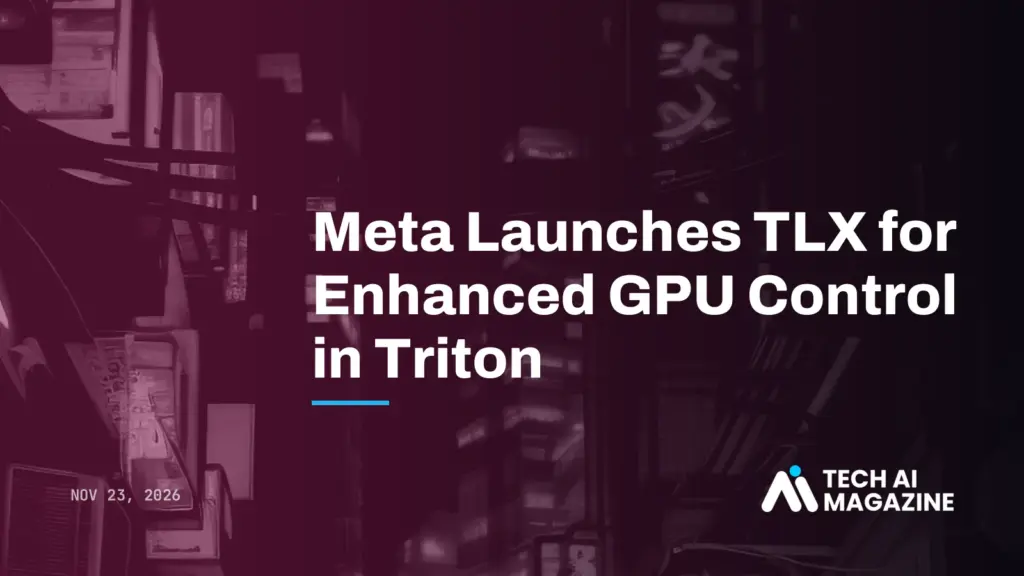
Meta has unveiled its Triton Low-Level Extensions (TLX), designed to provide advanced control over GPU functionalities such as warp-group, barrier, TMA, and cluster management within Python Triton kernels. This new capability is particularly significant as it allows for more efficient execution of Meta’s advertising and large language model (LLM) workloads.
TLX is compatible with several GPU architectures, including NVIDIA’s Hopper and Blackwell, as well as AMD’s MI350. By integrating these extensions, Meta aims to leverage the full potential of its hardware resources, which could lead to improved performance and reduced latency in processing complex tasks.
This development reflects Meta’s ongoing commitment to enhancing its AI infrastructure, ensuring that it remains competitive in a rapidly evolving technological landscape. As AI workloads continue to grow, the ability to optimize GPU control will be crucial for companies looking to maintain efficiency and effectiveness in their operations.
Compiled automatically by the Tech AI Newsdesk from public AI-news sources and summarised in our own words.