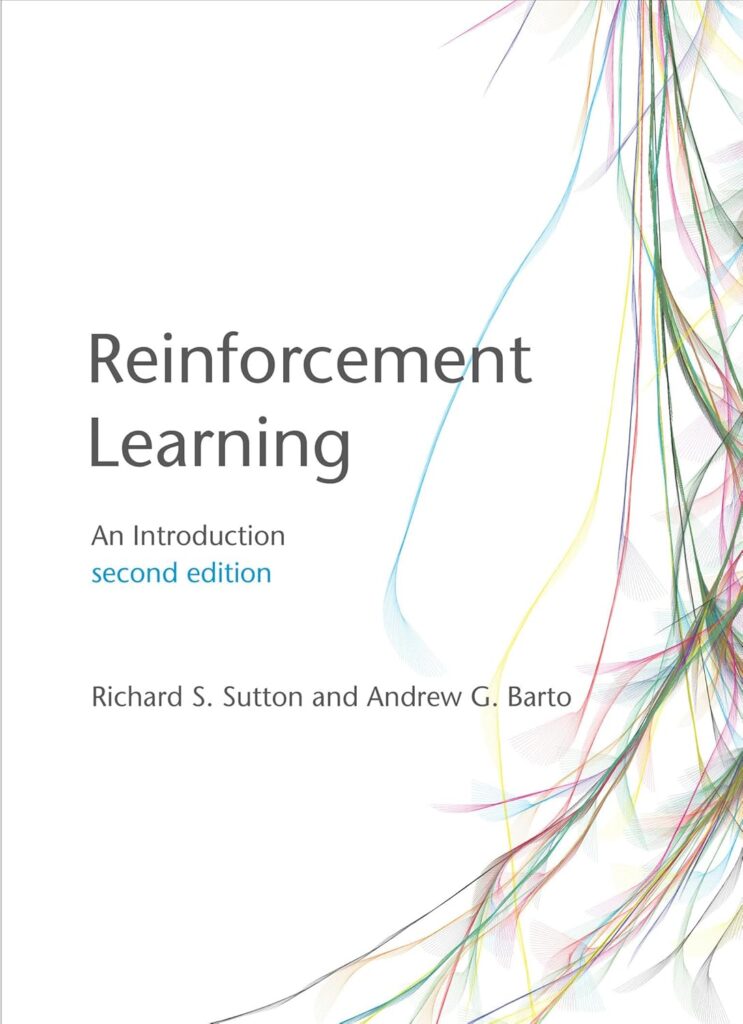
Reinforcement Learning, Second Edition: An Introduction
This work is a comprehensive textbook on reinforcement learning algorithms, a pivotal area of machine learning focusing on how agents ought to take actions in an environment to maximize cumulative reward. The second edition updates the foundational material from the first edition, incorporating contemporary advancements and expanded discussions to reflect the rapid progress in the field of deep reinforcement learning techniques.
The book is structured methodically, starting with the fundamentals of reinforcement learning including key concepts such as the agent-environment interface, rewards, policies, value functions, and the Markov decision process (MDP) framework. Subsequent chapters introduce the core algorithms and theoretical underpinnings of RL, examining dynamic programming methods, Monte Carlo methods, temporal-difference learning, and eligibility traces with rigorous formalism and illustrative examples.
Advanced topics feature prominently, addressing function approximation in reinforcement learning, policy gradient methods for reinforcement learning, and integration with deep learning paradigms for continuous action spaces, which facilitate handling high-dimensional and continuous state and action spaces. The text also covers the theoretical properties of the algorithms, including convergence and optimality, offering proofs and detailed analyses to substantiate the presented methods.
Sections on exploration-exploitation trade-offs in reinforcement learning, model-based learning, and hierarchical methods deepen the treatment of the challenges and strategies in reinforcement learning. The book concludes with discussions on recent innovations and open research questions, framing reinforcement learning’s evolving landscape and future AI trends.
Throughout, the authors maintain a clear, precise, and systematic narrative that balances accessibility for newcomers with depth suitable for advanced researchers and practitioners. The second edition enhances pedagogical elements, including improved explanations, extended examples, and updated references.
This textbook serves as a definitive source for understanding the principles and practice of reinforcement learning, thoroughly grounding readers in both the theoretical and algorithmic dimensions essential for research or application development in adaptive machine learning systems.
For purchase on Amazon, see: https://www.amazon.com/Reinforcement-Learning-Introduction-Adaptive-Computation/dp/0262039249
Frequently asked questions
What is the focus of 'Reinforcement Learning, Second Edition'?
'Reinforcement Learning, Second Edition' focuses on reinforcement learning algorithms and how agents take actions to maximize cumulative reward.
What advanced topics are covered in the book?
The book covers advanced topics such as function approximation, policy gradient methods, and integration with deep learning paradigms.