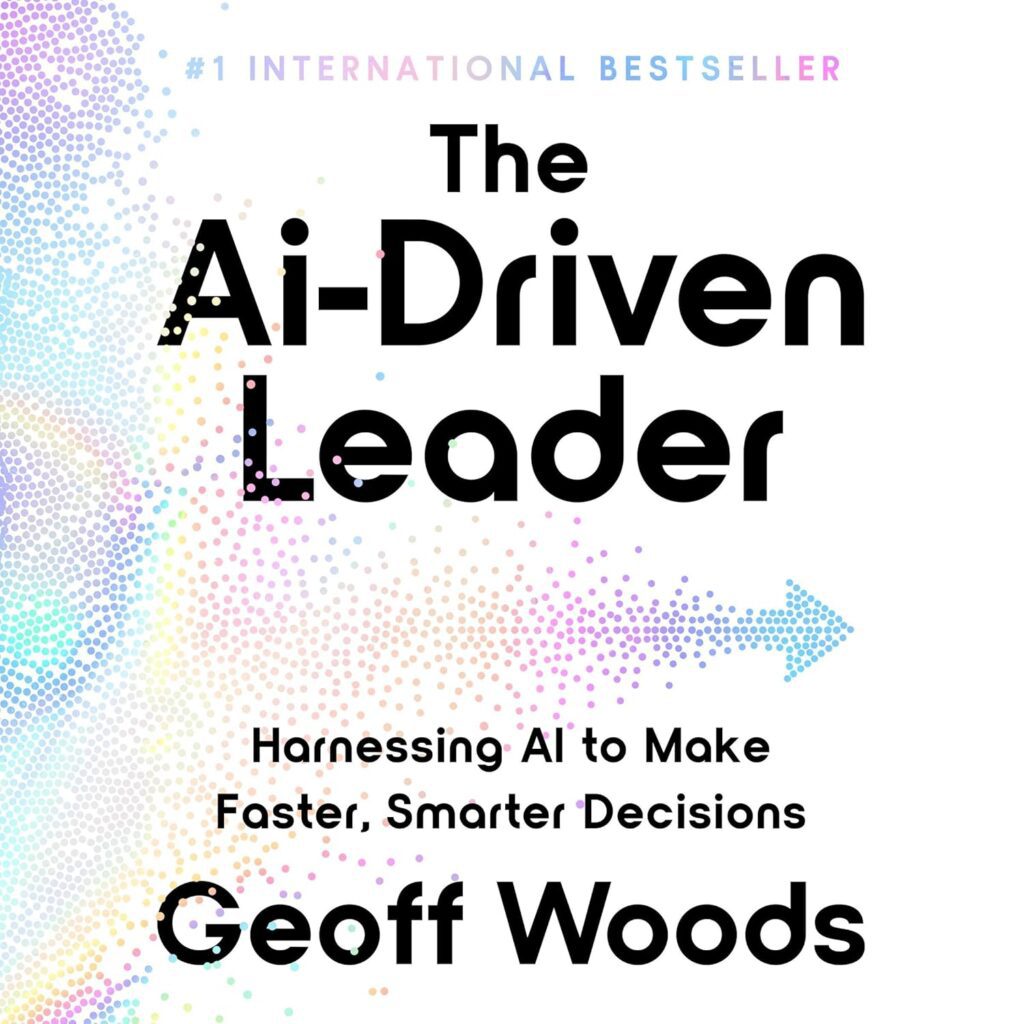
The AI-Driven Leader: Harnessing AI to Make Faster, Smarter Decisions
-By Geoff Woods
In today’s business environment, the difference between accelerating growth and facing obsolescence often comes down to one core factor: strategic thinking. Yet many leaders struggle to carve out the time to make long-term decisions, especially those in operationally intense roles. The growing complexity of markets, pressure to deliver quarterly results, and rising employee expectations compound this challenge. And now, the transformative potential of artificial intelligence (AI) particularly large language models (LLM) has further widened the gap between those who adapt and those who fall behind.
At Tech AI Magazine, we’re seeing more executives grappling with this shift. How do you lead effectively in a world being reshaped by AI? Geoff Smart’s The AI-Driven Leader addresses this issue head-on. It is a practical, timely resource for executives, founders, and managers who recognize the promise of AI but feel overwhelmed by their day-to-day responsibilities. Smart makes a compelling case: leaders who fail to adopt AI today risk falling irreversibly behind, not because of a lack of intelligence or effort, but because of misplaced priorities and outdated decision-making models.
Rather than offering a technical deep dive, the book presents a leadership-focused framework. The AI-Driven Leader demonstrates how to use AI as a strategic partner, not a buzzword, through real-world case studies, chapter-based prompts, and tactical strategies. The result is a guide that shows leaders how to think better, decide faster, and execute smarter starting now.
Why It Matters
AI is no longer an experimental tool for innovation labs. It is actively reshaping how businesses operate—from marketing automation to supply chain optimization to real-time customer insights. Yet despite widespread awareness of AI’s power, many leadership teams remain at a standstill. According to Smart, the reason is not technological hesitation but strategic inertia.
Most leaders operate under relentless pressure to deliver results, often stuck in operational triage. This limits their ability to see the bigger picture or to test forward-thinking tools like AI. Smart identifies this tension early in the book, arguing that “operational overwhelm” is one of the most significant barriers to strategic clarity. The first few chapters are dedicated to helping leaders recognize this pattern and break free of it.
More importantly, the AI-Driven Leader places AI adoption squarely in the context of business survival. AI is not framed as an optional enhancement—it is described as the new baseline. Competitors leverage AI to reduce time-to-decision, automate redundant tasks, and scale customer engagement. Organizations that delay adoption risk not just falling behind but becoming irrelevant. In this sense, Smart positions AI as a leadership imperative, not a technical upgrade.
In one of the book’s most impactful claims, Smart points out that companies can no longer afford to “wait and watch” while others test the waters. The time to act is now, and the cost of inaction is growing daily.
Helpfulness to the Audience
The strength of The AI-Driven Leader lies in its utility. It is not a speculative text or theoretical treatise. Instead, it’s a guide designed for immediate application, written in a style that respects the time constraints and cognitive load of its target audience—busy executives.
The book is structured around key leadership outcomes. Each chapter connects a common leadership challenge to a specific AI-driven solution. Every chapter includes actionable prompts and examples, making it easy for readers to apply the content directly to their team or organization. These aren’t abstract concepts, but practical steps such as how to prompt generative AI tools to draft reports, analyze customer feedback, or model risk scenarios based on real executive workflows.
Another standout feature is the book’s commitment to results. Smart avoids common pitfalls like tech evangelism or vague motivational language. Instead, the guidance is grounded in outcomes: faster decisions, sharper strategy, better execution. The tools and frameworks are designed to generate tangible impact, not in months or years, but within days or weeks of adoption.
The endorsements included in the book underscore this emphasis on performance. After applying Smart’s guidance, leaders from companies like Jindal Steel & Power, Costco, and Medtronic offer testimonials of significant gains, from market cap growth to time savings. These real-world outcomes strengthen the book’s credibility and reinforce its central message: AI isn’t a disruption to fear—it’s an advantage to embrace.
In a particularly notable insight, Smart distinguishes between using AI as a tool and positioning AI as a “Thought Partner.” This concept encourages leaders to integrate AI into their strategic thinking process—not as a replacement for human judgment, but as a multiplier of insight, speed, and perspective. It redefines how executives approach problems, test ideas, and scale solutions.
The book also respects AI’s broader ethical and cultural implications, though it does not dwell heavily on them. It encourages leaders to implement AI in a way that aligns organizational values, transparency, and human judgment. In this way, it avoids the trap of AI absolutism and presents a balanced view: use AI to lead smarter, not blindly.
Conclusion
The AI-Driven Leader offers a compelling, pragmatic, and urgently needed playbook for today’s business leaders. Geoff Smart turns what many see as a complex and technical challenge into a manageable, strategic opportunity. By framing AI as a leadership asset—rather than a future disruption, the book empowers decision-makers to act now, with clarity and confidence.
Smart’s message is clear in an era of volatility and acceleration: the future will not wait for leaders to catch up. AI is already changing the game. The question is not whether to engage with it, but how and how soon.
With its concise structure, actionable chapters, and proven strategies, The AI-Driven Leader is well-positioned to become a staple in the modern executive toolkit. It is a book to read and implement one prompt, one process, and one strategic win at a time.
For leaders seeking to move beyond awareness and into execution, this book is not just helpful, it is essential.
Frequently asked questions
What is the main focus of The AI-Driven Leader?
The AI-Driven Leader focuses on how leaders can harness AI to make faster, smarter decisions and navigate the complexities of modern business.
How does the book address the challenges leaders face with AI adoption?
The book identifies 'operational overwhelm' as a barrier to strategic clarity and provides actionable strategies to help leaders integrate AI into their decision-making processes.