

The hard part is no longer finding an AI course. It is picking the one worth your evenings. This month’s list covers the stack, from neural network fundamentals and language model theory up to production agents and reasoning systems.
The ranking favors courses that leave developers with something concrete to build. Time, prerequisites, and credential value are treated as practical constraints, not footnotes.
1. Neural Networks: Zero to Hero
What It Teaches
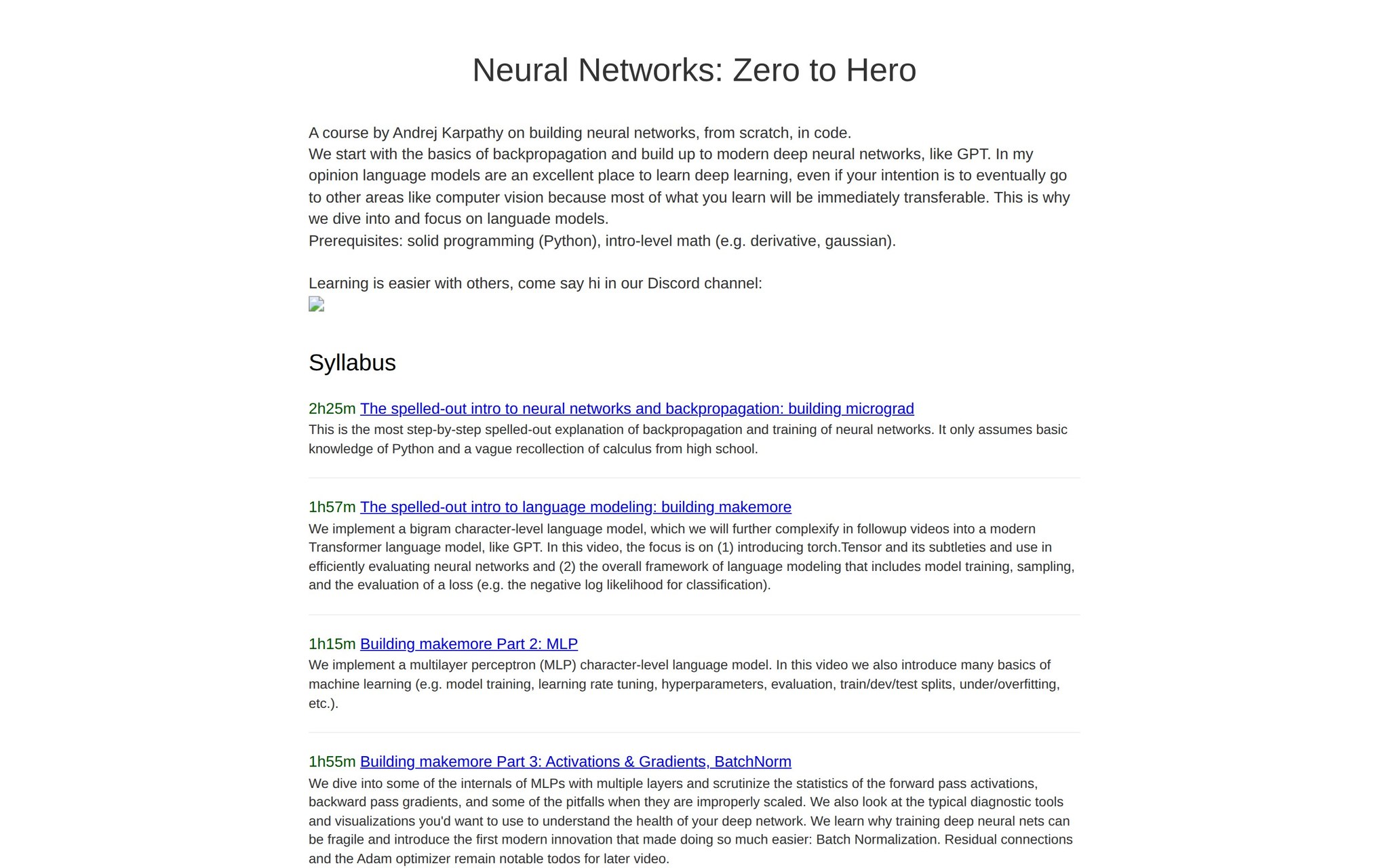
Andrej Karpathy teaches you to build neural networks from the ground up in Python. The course starts with backpropagation and moves through to modern architectures like GPT, showing you what model training actually does instead of treating frameworks as black boxes.
Why It's Trending
Its official page went live in October 2026, and the course remains a definitive practical guide to neural networks. The attention it gets comes from depth. You don't just watch lectures; you implement the machinery.
Key Learning Areas
- Backpropagation — implement the core training mechanism for neural networks
- Neural networks from scratch — construct models in Python and inspect their learning
- GPT-style deep networks — connect foundational components to today’s language models
Best For
- Developers building intuition for model behavior below the API layer
- Students learning neural-network concepts through implementation
- AI professionals refreshing core training concepts before tackling larger systems
What Makes It Different
The course forces you to construct networks in code first, long before you touch a high-level library. It is more technically revealing than a general AI survey, but it trades direct application focus for that clarity.
Things to Consider
- Prerequisites: solid Python and introductory-level math are mandatory
- Course freshness: the official page dates to October 2026
- Time commitment: no fixed duration is listed; plan for the depth of the material
Our Verdict
A strong fit for developers who want to understand what language models are doing beneath familiar frameworks, provided they already write Python and can tolerate an undefined time commitment. Beginners seeking a fast path to an application should look elsewhere.
Course: https://karpathy.ai/zero-to-hero.html
2. NLP with Deep Learning
What It Teaches
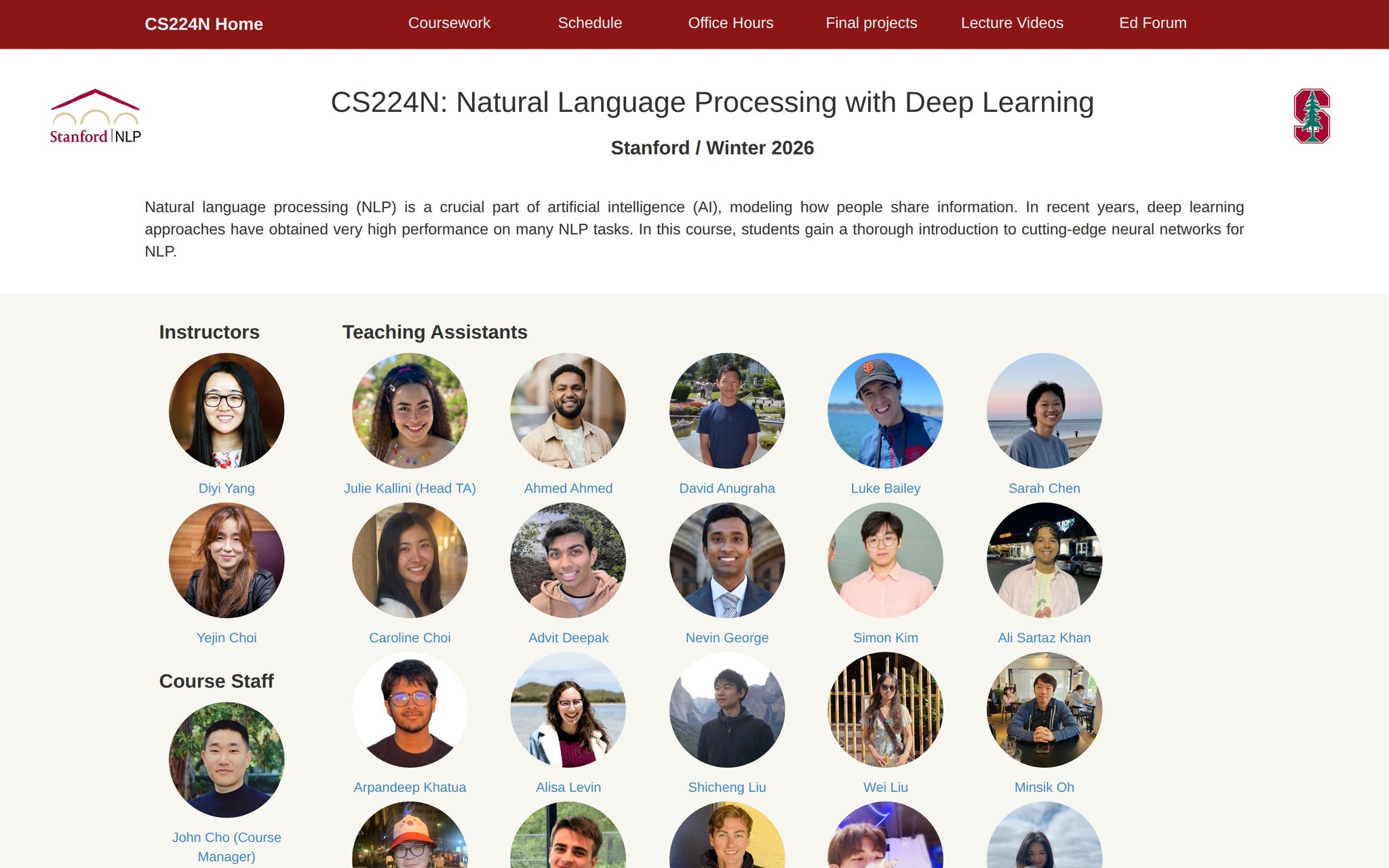
Stanford’s CS224N explains how deep learning works for language. It covers word vectors, recurrent neural networks, transformers, machine translation, and large language models. You finish with a foundation for designing and evaluating language systems, not just calling an LLM endpoint.
Why It's Trending
The Stanford Online page was updated in July 2025, and the class was offered in Winter 2026. That term is now past relative to November 2026, but the course earns attention as the substantial academic route into NLP and LLM theory.
Key Learning Areas
- Word vectors — represent language numerically for downstream models
- RNNs and transformers — compare major architectures for processing text
- LLMs and machine translation — connect language-model methods to practical NLP systems
Best For
- Students building university-level NLP and deep-learning foundations
- Developers learning the architectures behind language applications
- AI professionals strengthening technical vocabulary for LLM design and evaluation
What Makes It Different
Lectures, assignments, and a final project give it more structure than a lecture-only introduction. Its academic breadth is the advantage. The tradeoff is that you must translate the material into a deployable agent workflow yourself.
Duration & Format
Live academic course, online materials — Winter 2026 term, with lectures, assignments, and a final project
Things to Consider
- Time commitment: the course spans a full academic term with assignments and a project
- Practical component: the final project requires work beyond watching lectures
- Course freshness: the listed Winter 2026 term has passed; check enrollment before planning
Our Verdict
A serious choice for students and developers who want the theory behind modern language systems, especially when assignments and a final project fit their schedule. It is less suitable for learners whose immediate goal is deploying an agent rather than understanding NLP deeply.
Course: https://web.stanford.edu/class/cs224n/
3. Develop Agents with Agent Development Kit (ADK)
What It Teaches
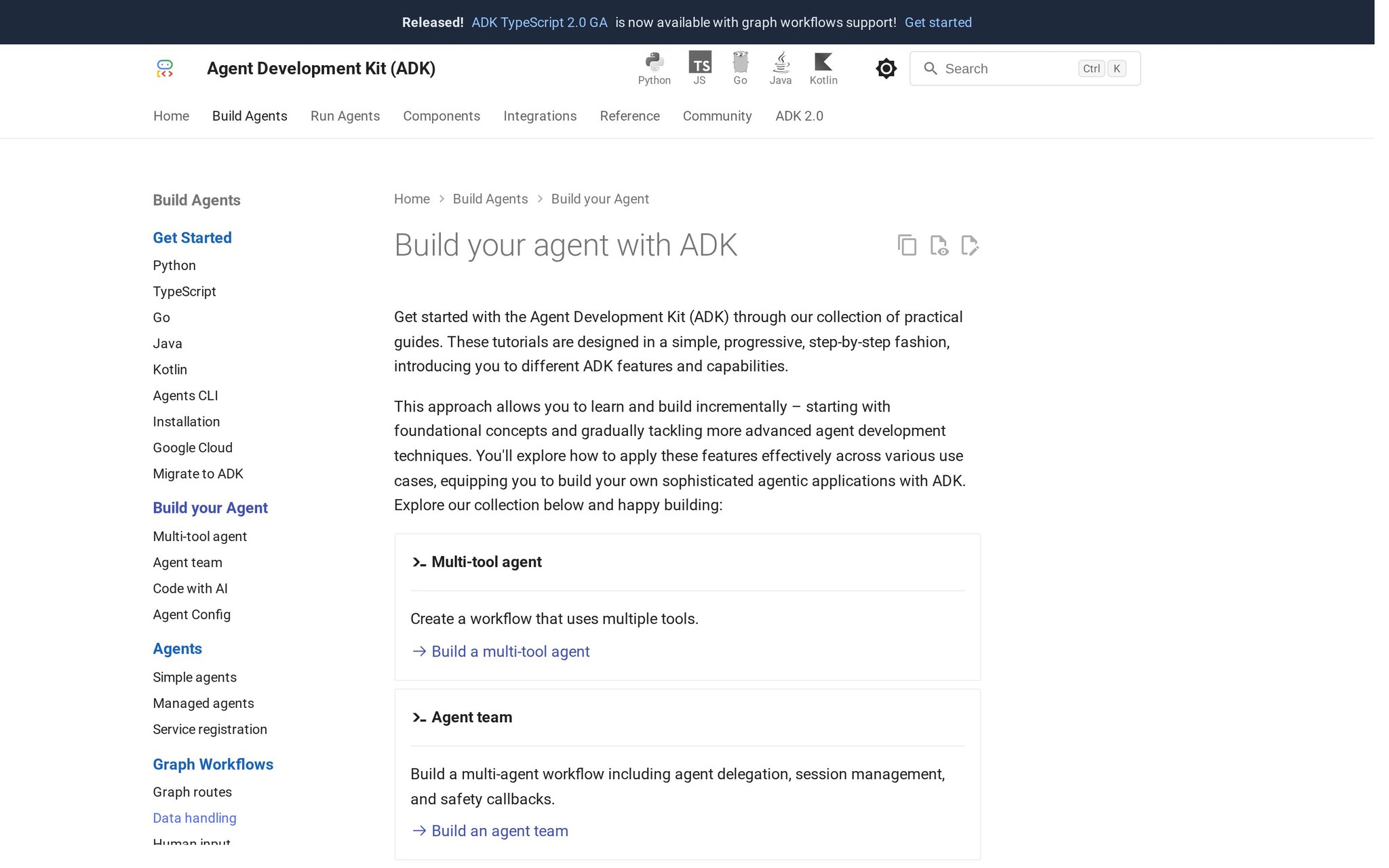
Google’s ADK training shows a structured way to build production-ready, secure AI agents on Google Cloud. You work toward agent systems that use a workflow runtime and task-collaboration model from ADK 2.0, moving past a basic prototype into coordinated agent behavior.
Why It's Trending
The introductory course page is dated October 2026, with ADK 2.0 release context from July 2026. That timing puts production-oriented, multi-agent development in front of developers now. The material is a course template, not a standalone certificate program.
Key Learning Areas
- Production-ready agents — design agent systems intended for more than a demo
- Secure agent development — account for security on Google Cloud
- Workflow runtimes and collaboration — coordinate tasks through ADK 2.0’s structured model
Best For
- Developers moving an agent prototype toward a structured runtime
- AI professionals exploring multi-agent task collaboration
- Business leaders understanding production concerns behind agent deployments
What Makes It Different
It is directly aligned with Google’s ADK and the ADK 2.0 workflow model. That specificity helps Google Cloud teams. It narrows the value for developers committed to another stack.
Things to Consider
- Practical component: the training centers on building production-ready agents, but the found page is an introductory course template
- Course freshness: the page dates to October 2026 and references July 2026 ADK 2.0 context
- Certification value: it is not presented as a standalone paid certificate
Our Verdict
A practical starting point for Google Cloud developers who need a structured path from agent prototype to production concerns, provided the ADK ecosystem fits their stack. It is a weaker choice for learners seeking transferable, vendor-neutral agent engineering.
Course: https://adk.dev/tutorials/
4. AI Engineering from Scratch
What It Teaches
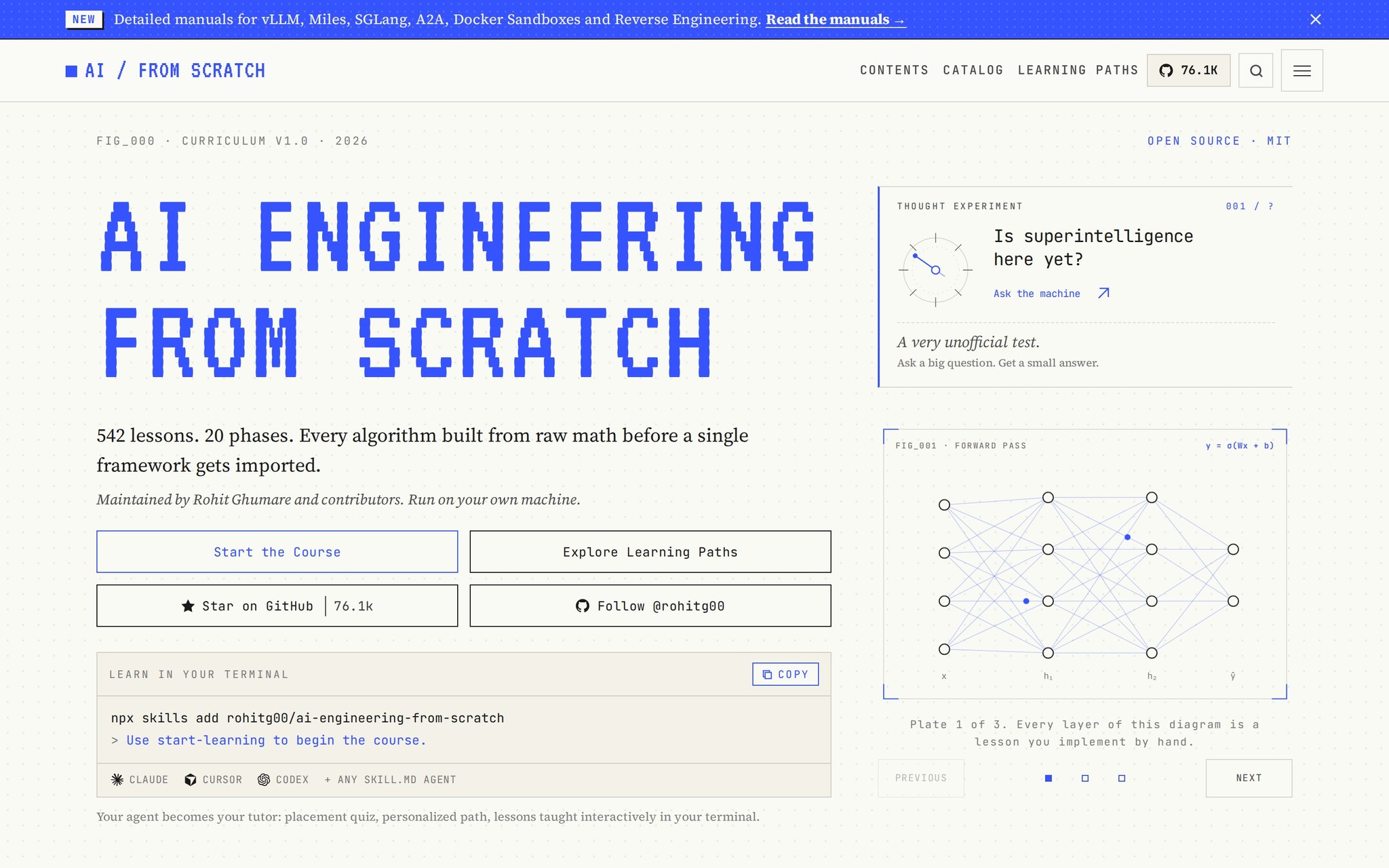
This open-source curriculum is a large AI-engineering learning path, not a single short course. Its stated scope—542 lessons across 20 phases—gives you a staged education in AI engineering. The available description does not identify the individual technical topics.
Why It's Trending
This is a slow-burn pick. Its place here comes from scale: 542 lessons across 20 phases appeals to learners looking for a long-form route instead of a narrowly focused tutorial.
Key Learning Areas
- AI engineering — follow a broad curriculum organized around the field
- Twenty-phase progression — move through a staged learning path
- Long-form study — navigate 542 lessons as an extended education plan
Best For
- Beginners finding a structured starting point for broad AI-engineering study
- Students organizing sustained independent learning
- Developers building a wider foundation beyond one framework or model
What Makes It Different
The scale and open-source format separate it from compact courses built around one project. That breadth is also the risk: without a defined short-term deliverable, you can spend weeks navigating the curriculum without shipping anything.
Things to Consider
- Time commitment: 542 lessons across 20 phases signals a substantial long-term commitment
- Practical component: the description does not establish a specific project or deployment outcome
- Course freshness: the curriculum’s current scope is its stated lesson and phase count
Our Verdict
A reasonable fit for students and developers who want a large, self-directed AI-engineering map and can impose their own milestones. Learners needing a verified syllabus, defined projects, or a quick route to production should rank it below more specific courses.
Course: https://aiengineeringfromscratch.com
5. Build Your Own Reasoning Model
What It Teaches
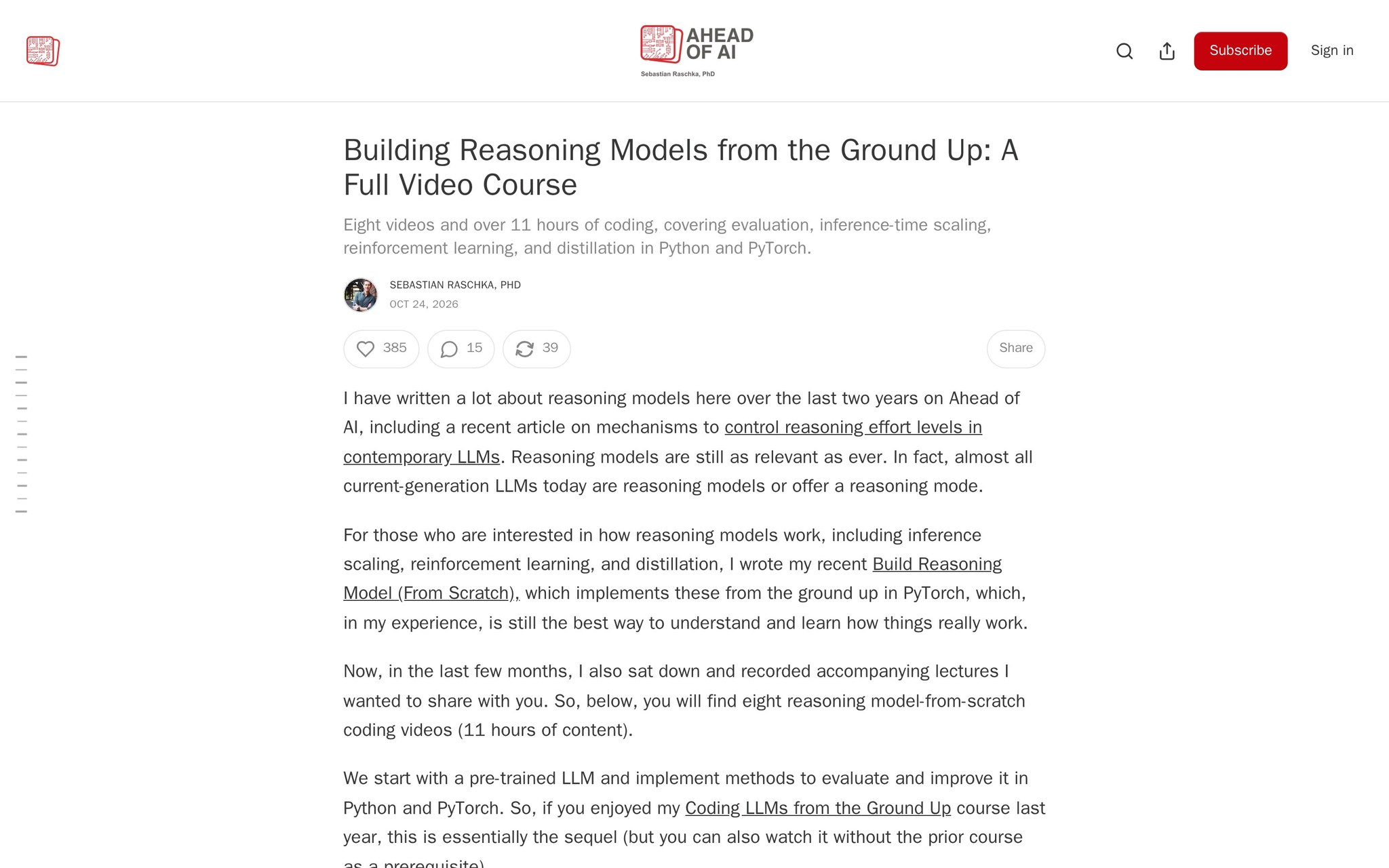
Sebastian Raschka’s video course shows how reasoning models work through hands-on Python and PyTorch coding. Across eight videos and more than 11 hours, it covers evaluation, inference-time scaling, reinforcement learning, and distillation—foundations for experimenting with reasoning behavior, not just consuming it.
Why It's Trending
The official course page is dated October 2026, presenting a full reasoning-from-scratch video series. Reasoning systems are becoming a distinct area of model engineering, and this course gives developers a concrete way to study the techniques behind them.
Key Learning Areas
- Evaluation — measure reasoning-model behavior with explicit assessment
- Inference-time scaling — explore how additional computation affects reasoning
- Reinforcement learning and distillation — implement two methods used to shape model behavior
Best For
- Developers experimenting with reasoning models in Python and PyTorch
- Students studying current model-training techniques through code
- AI professionals examining evaluation and inference-time tradeoffs
What Makes It Different
The course concentrates specifically on reasoning models and combines eight videos with more than 11 hours of coding. That focus is more targeted than a general deep-learning course. It assumes you want model-level experimentation, not an application-first agent curriculum.
Duration & Format
Self-paced, online — eight videos and more than 11 hours, with hands-on Python and PyTorch coding
Things to Consider
- Time commitment: the course runs for more than 11 hours before additional practice
- Practical component: coding uses Python and PyTorch across evaluation, scaling, reinforcement learning, and distillation
- Prerequisites: the format favors learners already comfortable with technical Python and model concepts
Our Verdict
A focused option for developers and AI professionals who want to experiment with reasoning-model techniques in PyTorch, provided they can commit to model-level work. It is not the efficient choice for someone whose priority is assembling an agent application quickly.
Course: https://magazine.sebastianraschka.com/p/building-reasoning-models
The decision is mostly about altitude. Pick Karpathy or Stanford for fundamentals. Choose ADK for Google-centered production agents.
The open curriculum works for a long independent path. Go with Raschka for hands-on reasoning-model work. The best course is the one whose technical layer matches the system you intend to build next.
Frequently asked questions
What does the course Neural Networks: Zero to Hero cover?
It teaches you to build neural networks from the ground up in Python, covering backpropagation and modern architectures like GPT.
What is the focus of the NLP with Deep Learning course?
The course explains how deep learning works for language, covering word vectors, RNNs, transformers, and large language models.
What is unique about AI Engineering from Scratch?
It offers a large AI-engineering learning path with 542 lessons across 20 phases, appealing to learners looking for a comprehensive education.