The initial phase of AI discussion and engagement was about entertainment, spectacle, and demonstration (examples: a chatbot that presented poems, memes, or code snippets that looked amazing on social media but had no real-life applicability). By 2026, all of this discussion will be obsolete.
Right now, there are already many people using the AI systems available to them as tools that provide them with operational leverage (developers & founders, analysts, marketers, enterprise teams and so on). The question has shifted from ‘will AI help me do my job?’ to ‘which of these AIs can improve my workflow while not causing me any issues at a later date?’
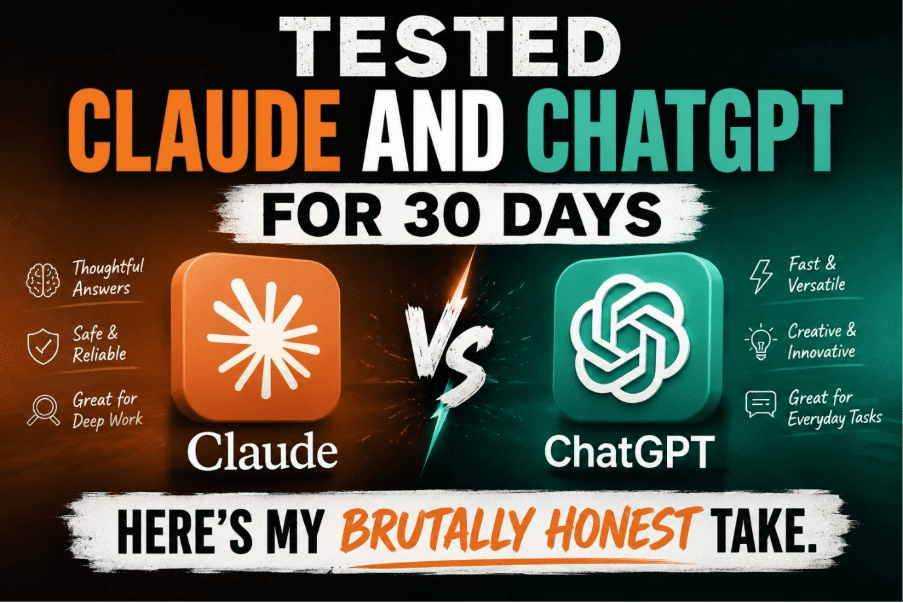
To answer that last question, I spent a month testing the two most popular AI ecosystems on the market: Anthropic (Claude) and OpenAI (ChatGPT).
This wasn’t an experimental benchmark experiment using hand-picked prompts. I used both platforms on real-world workloads involving long-form writing, debugging actual production code, analysing documentation, designing processes and workflows, researching, and solving multi-step reasoning problems across a large context.
The goal was not to compare which AI was more competent in demo mode, but rather to assess how well each AI performed as an effective tool in actual business operations.
At the end of the month, one AI emerged as the superior creative collaborator, while the other consistently proved to be the best operational machine. Results from this experiment were surprisingly detailed; they were not nearly as biased one way or another as we see in the data available on the internet.
How I Tested Claude and ChatGPT
To avoid the usual “one viral prompt decides everything” problem, I created identical test conditions for both systems across four weeks of daily usage.
The stack included:
- Long-form editorial writing
- Full-stack debugging assistance
- API documentation analysis
- Spreadsheet interpretation
- Design-system brainstorming
- Multi-document summarisation
- Strategic planning workflows
- Research synthesis
- Tone-sensitive rewriting
- Large-context memory retention tests
Each tool was evaluated on the same metrics.
|
Metric |
How It Was Measured |
|---|---|
|
Writing Quality |
Accuracy, tone consistency, originality, readability |
|
Coding Reliability |
Bug-fix accuracy, architecture reasoning, and maintainability |
|
Context Retention |
Ability to preserve logic across long sessions |
|
Research Depth |
Nuance, synthesis quality, hallucination resistance |
|
Workflow Friction |
Number of retries/prompts needed for usable output |
|
Creativity |
Originality and stylistic flexibility |
|
Speed Of Completion |
Time from prompt to deployable/useful result |
What became obvious within the first week was that Claude and ChatGPT are optimised for fundamentally different philosophies of intelligence.
One prioritises structure, reasoning, and stability. The other prioritises versatility, speed, and ecosystem integration.
That distinction changes everything.
ChatGPT – The Versatile Workhorse
Appearances aside, Claude seems to be extremely competent as a research analyst, while ChatGPT operates an elite generalist-type role and can almost seamlessly move in and out of workspaces it enters.
Based on 30 consecutive days of extended use, ChatGPT is hands down the quickest method to convert a vague concept into a usable workflow. Each occasion when I used ChatGPT to create editorial content, develop React components, analyse spreadsheets, or collaborate on developing a go-to-market plan, the transition from one discipline to another was incredibly smooth.
This type of versatility is much more significant than what the benchmark charts suggest; most work in the real world is “messy”. It could be that you have time between coding and writing, researching and preparing for a presentation, all in the same afternoon. ChatGPT thrives in this kind of environment because it functions less as a “narrow AI” and more as an operating layer across multiple disciplines. The best part is that ChatGPT has a great depth of ecosystem.
ChatGPT is exceptionally flexible and adaptable, due in great part to its incredibly simple integrations, ability to retain memory, ability to browse, ability to interact with multiple modes of input, and the many tools available to interact with ChatGPT. For example, if you upload a PDF and ask for a summary, you can then create a presentation based on your findings, reuse those insights as social media posts, and create SQL queries from that same discussion in the same conversation.
That level of continuity in the workflow significantly reduces friction and makes collaboration between people, whether down the hall or across the world, much more efficient.
Where ChatGPT Dominates?
The area in which ChatGPT excelled the most was the balance between being creative and operationally sound.
While many other AIs tend to be very analytical at the expense of being creative, or very creative but structured in an unreliable way, ChatGPT accomplishes both creative and operational tasks simultaneously. From a developer’s perspective, ChatGPT was particularly strong in the area of rapid prototyping.
When compared to Claude, ChatGPT produced frontend scaffolding, API route generation, database design, and workflow debugging much faster than Claude could generate these same artefacts, generally within shorter time frames. Additionally, ChatGPT’s ability to provide smooth transitions from React to Python, from SQL to DevOps-related tasks, allowed ChatGPT to maintain its conversational rhythm. The multimodal capabilities of ChatGPT created yet another significant productivity advantage.
In real terms, combined with providing rapid prototype execution, the ability for anyone to create a working context from any of the screenshots, UI mockups, charts, PDFs, handwritten notes, and diagrams created huge reductions in the number of hours spent explaining and the number of tasks performed through execution.
For content creators and business teams using ChatGPT, they repurposed the capabilities of ChatGPT into an environment inclusive of a strategist, an editor, a researcher, and a production assistant.
Where ChatGPT Struggles?
The lack of consistent results with ChatGPT was a trade-off for the wide range of potential applications it has.
While ChatGPT has been able to provide plausible-sounding answers to most technical questions, it has not always been able to provide precise answers. As a result, “architectural drift” started occurring with longer discussions involving a lot of technical detail.
Because of this drift, there were times that ChatGPT created unnecessary levels of abstraction, provided answers that contradicted previous implementations, or provided answers that were formatted in proper syntax but had logical errors in them. This issue became more apparent with longer debugging sessions.
The number of “loops” it took ChatGPT to correct the problem with deep nesting/complex service-to-service integrations and how quickly the looping happens was impressive; however, there were times when ChatGPT’s level of confidence was greater than the actual level of accuracy. Another issue that was noticed was the variability of tone in its responses.
As with the editorial responses, ChatGPT was capable of providing both extremely good and overly theatrical answers depending on how questions were structured. There were times when additional direction was required in order to keep ChatGPT from providing too many clichés and over-the-top marketing phrases.
However, once the flow of the prompts reached a more defined structure, ChatGPT became capable of consistently producing quality responses.
Claude – The Deep Reasoning Specialist
Claude possesses a unique style of thinking about intelligence. From the beginning, it will not do things to impress you and may rarely exhibit speed or flashiness in the first few days compared with ChatGPT. However, once you get accustomed to it, you cannot help but notice Claude’s advantages.
The one thing that makes Claude different from others is its ability to maintain coherence. It can maintain the consistency of longer conversations; large documents preserve their structure throughout, and multi-step chains of reasoning remain logically connected without drifting into conversational improvisation.
The consistency of Claude’s coherent thinking transformed experiences that involved doing lots of research. Analysing long reports, legal documents, architectural drawings, or editorial drafts that were greater than 10,000 words, Claude was able to maintain the discipline necessary to keep the context of the conversation as if it were an unusually human activity.
Not only did Claude summarise the information, but he was also able to keep track of all of the relational elements of the different concepts.
Where does Claude dominate?
Claude’s strengths in reasoning depth were the most visible indicator of its advantages.
When assessing coding process decisions, it was clear that Claude produced more organised architecture definitions, improved strict typing rules, and created more maintainable long-term design layouts than ChatGPT. Although ChatGPT outputs some initial designs faster than Claude, the overall cost associated with subsequent corrections for Claude’s output was less expensive than ChatGPT. The cost-effectiveness of these differences multiplies over time.
An initial draft taking slightly longer to complete will ultimately be less expensive when you avoid three subsequent rework cycles. Claude also had superior analytical writing skills.
The way Claude structured complex arguments was significantly superior (more organised, nuanced, and consistent) than ChatGPT. This provided higher levels of logical flow and clarity, rather than emphasising “readability sparkle”, which is common with magazine-length articles’ web-style content, strategic documents, and technical documentation. One additional significant advantage is the level of resistance to hallucinations.
No AI solution can guarantee zero hallucinations; however, Claude’s willingness to demonstrate some level of uncertainty is more trustworthy than ChatGPT’s tendency to assert false knowledge with high levels of confidence. When performing testing related to debugged code, Claude was exceptionally systematic in their approach.
Instead of generating fixes via random means, Claude would trace all of the related dependencies, identify potential root causes for problems, and describe the architectural ramifications of each fix before making any recommendation related to implementing a fix.
For senior technical and systems-based designers (engineers), the reasoning method utilised by Claude has been perceived as an extremely valuable attribute.
Where does Claude struggle?
Claude is not known for having operational flexibility. As it were, compared to Claude, ChatGPT is more of a highly specialised intelligence layer than a complete ecosystem.
The overall tool and technological environment is more limited than ChatGPT’s, and Claude did not seem to integrate well into rapidly changing functions/workflows compared to ChatGPT. Claude did best in sessions requiring great detail or concentration, but did not always have that same productivity level seen at work when transitioning quickly and/or adapting to a fast-changing workplace.
Claude is also much slower and uncoordinated when producing visuals or using more than one as an input.
As a data point: while ChatGPT did a better job with visual analysis, transition between workflows and using mixed media inputs than Claude did, Claude had a much stronger performance when analysing and resolving complex problems with text only than it did when dealing with dynamic multi-media workflows with text and/or visuals combined.
Another limitation of Claude is that it lacks flexibility with regard to adapting its style to fit its users’ personality or style.
Claude typically has a very restrained style of communication, which can provide better analytical accuracy but does not necessarily translate as well to high-energy marketing/advertising content, entertainment content, or emotionally styled/narrative creative writing.
To summarise, compared to ChatGPT, it seems that Claude has been engineered to primarily produce a high degree of accuracy and not as much to be entertaining or fun.
Quick Decision Guide
|
You Are |
Start With |
Add Later |
|---|---|---|
|
Solo creator |
ChatGPT |
Claude for deep review |
|
Startup founder |
ChatGPT |
Claude for architecture |
|
Senior engineer |
Claude |
ChatGPT for rapid prototyping |
|
Research analyst |
Claude |
ChatGPT for presentation workflows |
|
Agency Team |
ChatGP |
Claude for QA and refinement |
|
Enterprise organization |
Claude + ChatGPT |
Workflow-specific integrations |
Frequently Asked Questions
Q: Is Claude smarter than ChatGPT?
Not universally. Claude is generally stronger at long-context reasoning, structured analysis, and maintaining coherence across large tasks. ChatGPT is stronger at versatility, multimodal workflows, and rapid execution.
Q: Which AI is better for coding?
For fast prototyping and flexible iteration, Claude often gives good results. For maintainable architecture, debugging precision, and long-term code quality, Claude frequently performs better.
Q: Which AI hallucinates less?
In my testing, Claude appeared more cautious and less likely to invent information confidently. ChatGPT was more willing to generate speculative answers quickly, which can be useful creatively but riskier analytically.
Final Thoughts
The results after 30 days of testing show that each chatbot has exceptional capabilities but excels in different areas. ChatGPT has an advantage in versatility, speed, and multitasking, having been able to assist with all aspects of creation and research, allowing for a seamless transition from concept to execution. In contrast, Claude is especially useful when deeper levels of thought are required, retaining and building upon prior conversations or interactions; therefore, it would be ideal for complex projects and in-depth analysis.
The most appropriate choice for you will depend on the priorities you set for yourself. For example, if you desire a fast turnaround time when completing tasks and a large level of flexibility during project execution, then ChatGPT would not be easy to beat. On the other hand, if you prefer a more consistent, well-structured approach to problem-solving, Claude has a significant competitive edge. Moving into 2026 and beyond, an effective AI strategy may involve combining the strengths of both chatbots rather than choosing one over the other.
Frequently asked questions
What was the main purpose of testing Claude and ChatGPT?
The main purpose was to assess how well each AI performed as an effective tool in actual business operations.
How were Claude and ChatGPT evaluated during the test?
They were evaluated on metrics such as writing quality, coding reliability, context retention, research depth, workflow friction, creativity, and speed of completion.
What were the key differences between Claude and ChatGPT?
Claude prioritizes structure and reasoning, while ChatGPT focuses on versatility, speed, and ecosystem integration.