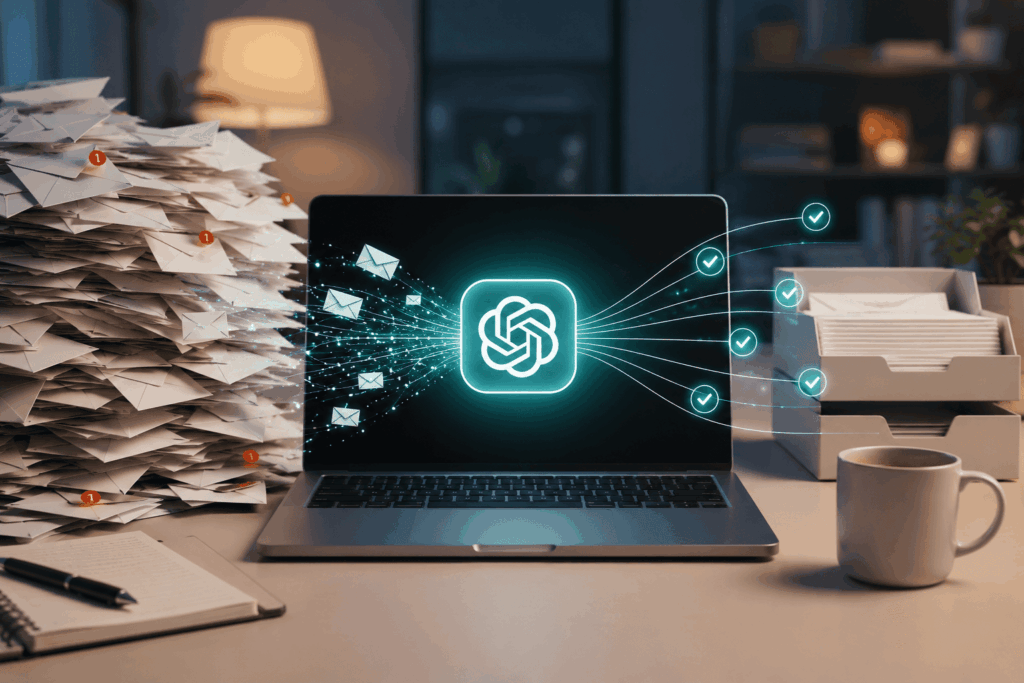

A tech journalist replaced their entire workflow with AI tools for 30 days. The result was surprising and thrilling that even the skeptics will raise interesting discernments about the future of work with AI.
I am not an AI skeptic. I cover technology for a living, I follow the model releases, I read the research papers. But like most people, I used AI the way most people use a gym membership in January that is great intentions and inconsistent follow-through. So, when my editor suggested I go all-in and employ AI for every task, every day, every deliverable delegated to or assisted by AI for an entire month. I said yes before I could talk myself out of it, but no one had prepared me for the experiment that required me to lose control and give technology created by someone else authority over my work. Thirty days later, I emerged with data, learning notes, a slightly bruised ego, and conclusions to refresh the way I work.
To make this exercise meaningful, I established clear ground rules:
- Every work task had to involve an AI tool at the point of creation — writing, research, scheduling, ideation, summarization, coding, communication.
- No AI-free drafts. I could edit AI output, but I could not start from scratch on my own.
- I tracked time spent on each task with and without AI using prior-month benchmarks as a baseline.
- I logged frustrations and wins daily in a voice memo, then had — yes — an AI transcribe and summarize them each week.
The tools in rotation: Claude (for reasoning), ChatGPT-4o (for quick lookups and brainstorming), Gemini Advanced (for Google Workspace integration), Perplexity (for real-time research), Notion AI (for document management), and GitHub Copilot (for the occasional script).
Week One: The Productivity Honeymoon
The first week felt like cheating.
Articles that used to take four hours to draft were taking ninety minutes. Emails I would have agonized over — the kind where you write three sentences, delete two, stare at the ceiling — were done in under five minutes. Research summaries that required an afternoon of tab-juggling were condensed into a single, well-structured prompt sequence.
My output nearly doubled. I filed three more pieces than my weekly average. I responded to every email the same day it arrived, which, if you know journalists, is essentially a superpower.
I felt, briefly, unstoppable.
What I didn’t notice: I was producing more, but I was reading less. I was skimming AI summaries instead of sitting with source material. The speed was real — but something quieter was already starting to erode.
Week Two: The Cracks Appear
By day ten, the shine had dulled.
The problem wasn’t that the AI was wrong — it was that it was almost right, constantly, in ways that required vigilance I hadn’t budgeted for. A statistic slightly off. A quote reconstructed rather than verified. A nuanced argument flattened into something technically accurate but rhetorically hollow.
I started spending more time fact-checking than I had saved in drafting. For research-heavy pieces, the productivity gains evaporated almost entirely. Worse, I noticed something uncomfortable: my own voice was getting harder to find in the work. I was editing AI prose into something that sounded like me, rather than writing prose that was mine from the start.
The communication tasks held up better. AI-drafted emails, once I built a library of tone-adjusted templates, remained a genuine time-saver. Meeting summaries from transcripts were excellent. Scheduling and administrative triage — genuinely transformed.
But the intellectual core of my job? The AI was a capable junior assistant, not a replacement for the editor in my own head.
Week Three: Adaptation and the Surprising Discovery
This is where the experiment got interesting.
Forced to confront the AI’s limits, I stopped trying to use it as a ghostwriter and started using it as a thinking partner. Instead of asking it to write the article, I asked it to argue against my thesis. Instead of asking it to summarize research, I asked it what questions the research failed to answer. Instead of asking it to draft the email, I described the interpersonal dynamic and asked what I might be missing.
Productivity recovered — and in some dimensions exceeded Week One — but the nature of the productivity had shifted. I was doing more thinking, not less. The AI was accelerating the thinking, not replacing it.
This reframe changed everything. Tasks where I used AI as a sparring partner produced better final work than tasks I’d done without AI entirely in the prior month. The quality bar moved up, not just the speed.
The unexpected discovery: AI made me a more rigorous thinker — but only after I stopped asking it to think for me.
Week Four: What Held Up, What Didn’t
By the final week, a clear taxonomy had emerged.
Where AI Delivered Genuine, Lasting Value
- First-draft acceleration for structured, templated content (briefs, summaries, newsletters, reports)
- Ideation and brainstorming — AI as a relentless “yes, and” collaborator who never gets tired
- Administrative communication — emails, scheduling, follow-ups, meeting prep
- Code and data tasks — scripts, regex, formula generation, basic automation
- Research synthesis — pulling signal from large volumes of text when I already knew what I was looking for
Where AI Consistently Fell Short
- Original reporting — AI cannot make a phone call, build a source relationship, or notice the thing the press release didn’t say
- Nuanced judgment — ethical calls, editorial decisions, knowing what not to publish
- Voice and style — AI prose is competent but centrist; it regresses to the mean of the internet
- Deep contextual understanding — the kind that comes from years of covering a beat, not from token prediction
- Accountability — AI does not care if it’s right. That burden stays entirely with the human.
The Numbers
The table results kept me up at night as number of viewers increased on content created with the help of AI tools. Expectedly, more articles were curated with faster turnaround but lower quality signal from the audience and more errors were caught in the content. The AI had tranquillized the process and quietly degraded the product, but the question arises did the viewers caught the change or it was transitory during the new process requiring substantial changes to either my workflow or models itself.
The Question Nobody Is Asking Loudly Enough
The mainstream conversation about AI and work is still largely framed as a binary: AI will either take your job or supercharge it. Both framings are too simple.
What thirty days taught me is that AI fundamentally changes what kind of work is worth doing by hand. Tasks that are high-volume, structured, and low stakes? Automate them without guilt. Tasks that are relational, contextual, and consequential? The human needs to stay in the loop — not as a quality checker, but as the primary driver working on the scope of work. The danger isn’t that AI makes workers obsolete. It’s the workers those are seduced by speed and volume will voluntarily step back from the parts of their job responsibility will notice sooner or later the quality has gradually decayed.
What I’m Doing Differently Now
I did not abandon AI after the experiment. I use it every day but with greater understanding and expectations. I made some changes to ensure I am managing my proprietary data while using AI assistance as my intellectual property and not the other way around. I use AI to pressure-test my argument to understand all facts and chose to have a narrative of my own and let AI tools handle everything administrative without apology. I treat AI summaries as a starting point for reading, not a substitute for my ideas.
Most importantly, I got serious about the question I now think every knowledge worker should ask before delegating a task to an AI: Is this a task of the process you are comfortable passing to technology? If no, keep it. If yes, hand it off to AI. As a human you will need to try, analysis, adjust and repeat. The goal was never to use AI more but to enrich my comprehension of the technology and AI tools for superior results. The goal was to work efficiently and innovate with evolving AI technology.
Takeaways from My Experience with AI
AI will not replace you from your work but grind along with you act as a force multiplier for the parts of your work you have already mastered and ruthlessly expose the parts you were doing on autopilot or those obviously needed adjustments. We all have tasks we have drifted through for years—standard reports, boilerplate emails, or surface-level strategy decks. When you ask an AI to do these things, and the output feels “generic” or “souless,” it’s often because the original process was generic to begin with. The AI succeeded in doing the task, but in doing so, it revealed exactly where the human element was missing. It forces a confrontation with your own value add.
Most of the popular AI tools we use are based on pre-trained models with their own motivations or data biases that should make us caution of how we use the tools and apply human consciousness during the process and outcome.
AI has taught me to expand my own capabilities and explore creativity by making my artistic taste value more than before, accepting that the quality of my output is capped by the quality of my curiosity. The realisation changed my approach of incorporating fast momentum technology – AI knows the mechanicians and reasons because I know the whys of my project, product and customers.
Frequently asked questions
What was the initial impact of using AI tools?
In the first week, the journalist experienced a significant boost in productivity, completing tasks much faster than usual.
What challenges arose during the experiment?
By the second week, the journalist found that while productivity increased, the AI's inaccuracies required more time spent on fact-checking.
What was the main conclusion about AI's role in work?
The experiment concluded that while AI can enhance productivity for structured tasks, human oversight is essential for complex and relational work.