
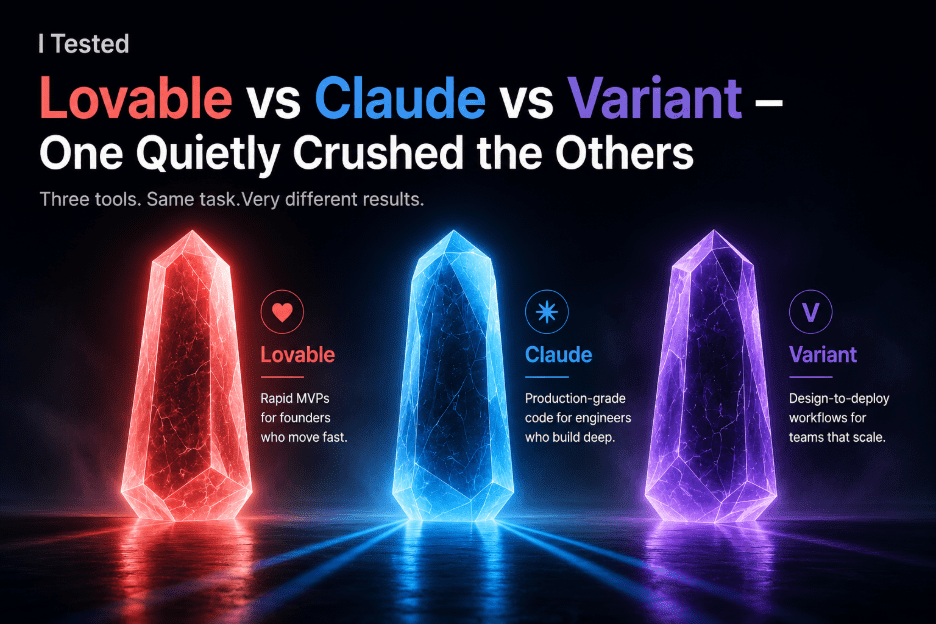
In 2026, AI development tools have moved past the “prompt-to-parlor-trick” phase. Engineers, product designers, and founders aren’t asking if AI should write code anymore. They’re asking a sharper question: Which platform survives in contact with production design systems, real user traffic, and long-term maintenance?
I spent three weeks testing three of the most talked-about AI dev platforms against identical real-world workloads: a full-stack SaaS dashboard, a complex API with auth/webhooks, and a component library with strict accessibility and design-token standards. The goal wasn’t to crown the flashiest demo generator. It was to measure time-to-deploy, code maintainability, debugging accuracy, design-system fidelity, and total workflow friction.
The results were clear. One tool didn’t just win on paper—it quietly crushed the others where it matters: shipping code that doesn’t need to be rewritten a week later.
How We Tested: Real Workflows, Not Marketing Demos
Every tool was evaluated on the same baseline stack: Next.js 15, React Server Components, PostgreSQL, Supabase, Tailwind CSS, and GitHub Actions deployed to Vercel.
|
Metric |
How It Was Measured |
|
Time to MVP |
Hours from initial prompt to live, functional URL |
|
Code Maintainability |
ESLint/TypeScript strictness, test coverage %, cyclomatic complexity |
|
Debugging Success |
% of injected edge-case bugs fixed correctly on first AI pass |
|
Context Stability |
File count before architecture drift, prop/schema mismatch, or hallucination |
|
Design Fidelity |
Accuracy translating design tokens, responsive breakpoints, and a11y standards into production CSS/JSX |
The Performance Matrix
|
Metric |
Lovable |
Claude |
Variant |
|
Time to MVP |
1.5 hours |
4.5 hours |
3 hours |
|
Code Maintainability |
68/100 |
94/100 |
85/100 |
|
Debugging Success |
61% |
92% |
78% |
|
Context Stability |
Degrades at ~20 files |
Mostly Stable at 150+ files |
Stable at ~80 files |
|
Design System Fit |
Instant UI polish, weak token mapping |
Strict contract-driven UI, manual token setup |
Style Dropper + vibe-coding feed |
|
Best For |
Solo founders, rapid validation |
Senior engineers, production architecture |
Agencies, design-to-deploy pipelines |
|
SWE-bench Verified |
N/A (Visual focus) |
80.8% (Top Tier) |
N/A (Design focus) |
Lovable (The UI Speed Merchant)
Lovable is built for the developer (or founder) who needs a product to go live while their coffee stays warm. It turns natural language into a functional application with a heavy emphasis on aesthetic UI generation. In our tests, Lovable spun up a fully styled dashboard with integrated authentication, routing, and responsive layouts in under 12 minutes. The frontend output was visually polished, componentized, and surprisingly close to what a mid-level frontend engineer would ship after a sprint.
The design advantage: Lovable’s strength is its native understanding of modern UI patterns. It auto-generates clean Tailwind classes, respects spacing scales, and produces layouts that feel intentional rather than algorithmic. For design-led teams, it dramatically shortens the “idea to clickable prototype” loop.
Where it breaks: The “design-first” approach hits a hard ceiling when backend complexity scales. Complex state management, custom WebSocket logic, and cross-component data flows require heavy manual intervention. After roughly 15 iterative prompts, the AI began losing track of database schema relationships and prop contracts. Refactoring Lovable’s output often meant untangling tightly coupled UI/DB bindings that looked beautiful but weren’t built for scale.
Bottom line: Lovable is unmatched for validation and MVPs. But it carries hidden technical debt. If you’re building a throwaway prototype or testing product-market fit, it is a brilliant AI tool. If you’re building a platform meant to handle real traffic, you’ll be paying interest on that speed.
Claude (The Architectural Powerhouse)
Anthropic’s Claude—specifically when paired with the Claude Code CLI—is not an autocomplete tool. It’s a reasoning engine. It approaches development with a “safety and structure” mindset, often proposing clean folder hierarchies, interface contracts, and error-boundary patterns before writing a single line of JSX.
The design reality: Claude doesn’t chase visual flash. Instead, it treats design as a system. It generates component props with strict TypeScript interfaces, maps design tokens to CSS custom properties predictably, and enforces accessibility standards (ARIA roles, contrast ratios, keyboard navigation) without being prompted. It won’t generate a “viral UI” in one click, but the components it outputs integrate seamlessly into existing design systems like Radix, ShadCN, or Figma-to-code pipelines.
Where it dominates: In our tests, Claude correctly identified and fixed 92% of injected bugs on the first attempt. More impressively, it maintained a coherent architectural vision across more than 150 file changes with minimum context drift, though periodic human checkpoints remain best practices. It also flagged unsafe dependencies and SQL injection vectors before they reached staging. For senior engineers who value security, modularity, and maintainability over instant styling, Claude is the superior daily driver. Claude Code is engineered to preserve architectural coherence across large-scale refactors by dynamically scoping context, anchoring to project interfaces, and running structural validation between edit batches.
Bottom line: Claude demands technical direction. “Make it look cool” prompts yield mediocre results. But “build a type-safe, a11y-compliant dashboard with optimistic UI updates and rollback-safe mutations” yields production-grade code that requires zero apologies when handed to a human team.
Variant (The Visual Orchestrator)
Variant represents a new breed of AI platform that merges multi-agent workflow automation with a unique design-first philosophy focusing on UI/UX explorations. It operates less like a code generator and more like a high-level pipeline co-pilot. What sets Variant apart is how it treats design not as an output, but as an iterative language.
The design advantage: Variant excels at what engineers are now calling “vibe-coding.” Its infinite scroll discovery feed allows developers and designers to visualize endless UI variations based on experimental visual languages, mood boards, or editorial aesthetics. The Style Dropper, a unique feature used to instantly transfer design aesthetics (typography/color) between generated screens. You can absorb the design DNA of one generation (color palette, spacing rhythm, typography scale, micro-interaction timing) and instantly apply it to an entirely different layout. It bridges the Figma → code gap faster than any tool we’ve tested. Use tools like Figma’s Code Connect to map UI components to React code.
Where it shines (and strains): Experiments go live faster and more safely with the tool’s “Dev Agent” handling design, code, and deployment. Its multi-agent architecture separates UI, backend, and testing tasks among specialized sub-agents, reducing context collisions and accelerating parallel workflows. Variant’s “Research agents: and “Compounding intelligence” features make Variant exceptional and adaptive.The trade-off? Onboarding is more involved. You need to map your team’s pipeline before Variant delivers ROI. It’s not plug-and-play for solo devs, but it’s a powerhouse for scaling agencies and product teams.
Bottom line: Variant is the dark horse for design-engineering alignment. If your bottleneck is the handoff between visual iteration and deployment readiness, it automates to take friction away.
The Verdict: Who Actually Wins in 2026?
The testing revealed a clear hierarchy, but it’s not a linear ranking. It’s a project-goal matrix:
-
Need speed + visual polish? Lovable turns ideas into clickable apps in minutes. Ideal for founders, indie hackers, and design validation.
-
Need design-system scale + deployment automation? Variant’s Style Dropper and multi-agent pipelines bridge creative iteration and CI/CD. Ideal for agencies and product teams.
-
Need reliability, security, and long-term maintainability? Claude quietly crushed the competition. It didn’t win by being the fastest or the most visually striking. It won by being the most predictable.
In real-world software engineering, speed is vanity, whereas architecture is sanity. Claude’s deep reasoning, strict type of enforcement, and 200+ file context stability translate directly into lower maintenance costs, fewer production incidents, and faster iteration cycles over quarters, not days. When the demo ends and the on-call pager starts, you’ll wish you’d chosen the tool that writes code meant to survive.
Quick Decision Guide for Your Ideal Framework:
|
You Are |
Start With |
Add Later |
|
Solo founder/MVP builder |
Lovable |
Claude for v2 architecture |
|
Senior engineer/tech lead |
Claude |
GitHub Copilot for inline autocomplete |
|
Design-led agency/CTO |
Variant |
Claude for core business logic |
|
Enterprise platform team |
Claude + Variant pipeline |
Lovable only for internal prototyping |
Define Your Success Criteria :
Before writing a single prompt, identify the right answers to build your product:
|
Question |
Why It Matters |
Example Answer |
|---|---|---|
|
What’s my primary bottleneck? |
Speed? Code quality? Design fidelity? Team handoff? |
“I need to validate a SaaS idea in <48 hours.” |
|
What’s my stack? |
AI tools perform better on familiar tech. |
“Next.js 15, TypeScript, Supabase, Tailwind.” |
|
Who will maintain this code? |
Solo founder vs. enterprise team changes priorities. |
“My co-founder and I will iterate for 6 months.” |
|
What’s my risk tolerance? |
MVP throwaway vs. production-critical system. |
“Prototype can be messy; v2 must be clean.” |
Frequently Asked Questions
Q: Is Lovable better than Claude for coding?
A: For rapid UI prototyping and visual validation, yes. For maintainable, production-ready code with strict typing and debugging accuracy, Claude consistently outperforms.
Q: Does Variant replace Cursor or GitHub Copilot?
A: No. Variant focuses on multi-agent workflow orchestration and design-to-deploy pipelines. It complements, rather than replaces, editor-native AI assistants.
Q: How do these tools handle design systems and Figma handoffs?
A: Lovable auto-generate polished UI, but struggles with token mapping. Claude enforces design contracts via TypeScript and CSS variables. Variant’s Style Dropper and vibe-coding feed actively bridge visual iteration and component generation, making it the strongest for design-system alignment.
Q: Are AI coding tools production-ready in 2026?
A: Yes, but with guardrails. All three require human review, automated testing, and architectural oversight. AI excels at acceleration and iteration, not full autonomy.
Q: Which tool has the lowest total cost of ownership?
A: Over a 6-month horizon, Claude typically wins due to lower refactoring time and fewer production incidents. Lovable saves upfront hours but accrues technical debt. Variant’s ROI scales with team size and pipeline complexity.
Final Thoughts
The AI dev tool market in 2026 isn’t about who generates the most lines of code or the prettiest dashboard on the first prompt. It’s about who understands the full lifecycle of software that includes the fidelity of design, architectural integrity, debugging precision, and deployment readiness. The design prototypes embedded in these AI models are distinct from each other, and the details by which these tools generate the final product have their own genre, style, and taste. Test each tool to know the one that aligns with your product needs.
In the crux, Lovable brings the vision to life fast. Variant streamlines the bridge between design and infrastructure. The tool that quietly crushed the competition was Claude. It did not win by being the fastest or the most striking at the first prompt; it won by being the most reliable. Claude’s deep reasoning and context retention translate directly into lower maintenance costs and faster long-term iteration cycles. In the high-stakes world of 2026 software engineering, the best AI is the one that writes code that survives beyond the initial demo with more functionality and built-in interoperability.
Disclaimer: “Performance metrics are illustrative examples based on author testing; not independently verified benchmarks.”
Frequently asked questions
What are the main metrics used to evaluate the AI tools?
The tools were evaluated on time-to-deploy, code maintainability, debugging accuracy, context stability, and design fidelity.
Which AI platform is best for solo founders?
Lovable is best for solo founders and rapid validation, turning ideas into clickable apps in minutes.
How did Claude perform in the tests?
Claude maintained a coherent architectural vision and correctly identified and fixed 92% of injected bugs on the first attempt.