
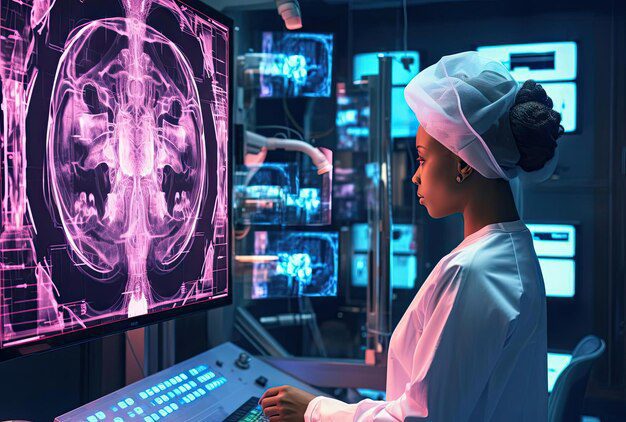
Researchers at Boston College have created an AI-assisted approach to significantly enhance the clarity of functional MRI (fMRI) brain scans by effectively removing noise. This development, recently published in Nature Methods, employs generative AI techniques to denoise fMRI data, enabling much clearer imaging of brain activity. The new method, called DeepCor, utilizes contrastive autoencoders—a form of generative artificial intelligence—to differentiate meaningful brain signals from unwanted interference within the scans. Reported results demonstrate over a 200% improvement in noise removal compared to previous techniques, which can often leave residual grainy distortions or blur important anatomical details.
This advance holds important implications for neuroscience and clinical practice because clearer fMRI images enhance the study of brain disorders and functional connectivity. Improved signal quality supports more accurate diagnosis, research into brain diseases, and evaluations of treatment effects. With this AI-powered denoising, researchers can obtain sharper, more reliable data from functional imaging, potentially accelerating discoveries about brain functionality and pathology.
The use of generative AI for image refinement exemplifies how artificial intelligence is transforming medical imaging by improving data quality and interpretability. Boston College’s breakthrough contributes to a growing trend in healthcare innovation where AI tools are integral to advancing diagnostic and research capabilities, ultimately driving better patient care and scientific understanding.
Frequently asked questions
What is the new method developed by Boston College researchers?
The new method, called DeepCor, utilizes contrastive autoencoders to effectively remove noise from functional MRI brain scans.
How much improvement in noise removal does DeepCor achieve?
DeepCor demonstrates over a 200% improvement in noise removal compared to previous techniques.
What are the implications of clearer fMRI images?
Clearer fMRI images enhance the study of brain disorders, support more accurate diagnosis, and improve evaluations of treatment effects.