Synthetic Intelligence: When AI Starts to Think for Itself
A machine not just executing commands, but genuinely “thinking” on its own—the Tesla Optimus robot moving with fluid, human-like grace, or AI painstakingly decoding ancient whale songs lost to time. This isn’t distant sci-fi dreaming; it’s the near-present, with synthetic intelligence advancements emerging as a new frontier of autonomous, internal reasoning in machines. But as AI steps beyond automation into cognition, the questions multiply: How do these changes shape society? Can artificial systems truly think? And how do we harness such power responsibly?
The world today finds itself at a remarkable crossroads. According to the Artificial Intelligence Index Report 2025 by AWS, 78% of organizations reported using AI last year—up sharply from 55% in 2023. Meanwhile, Forbes projects 378 million people will be using AI-powered tools regularly by 2025. Yet while businesses are pouring on average $1.9 million into generative AI, less than 30% of CEOs feel satisfied with the outcomes. This gap between adoption and confidence highlights a broader tension: we’re deploying AI rapidly, but we’re still wrestling with what it truly means when AI systems exhibit autonomous thinking.
Synthetic intelligence, as defined by Denis Newman-Griffis in a recent Royal Society Open Science paper, captures this leap beyond automated task-following. It refers to AI systems with autonomous reasoning capabilities—those capable of internally “mulling over” ambiguous scenarios, testing hypotheses, and self-correcting. Think of it as moving from a calculator that crunches numbers to a chess player who anticipates and reflects on strategy spontaneously. This shift isn’t just technical; it instigates a cultural and ethical reckoning. Voices from Bill Gates to futurists like Ray Kurzweil debate whether machines might cross thresholds of AI consciousness and cognition in coming years.
The stakes are high. Public trust in AI teeters at around 46% globally even as harmful AI incidents have surged over 56% since 2020. Deepfake videos have stirred election misinformation, and AI’s environmental footprint threatens to add 1.7 gigatons of CO2 emissions globally by 2030, per IMF projections. The landscape is one of exhilarating possibility and urgent caution.
From Automation to Autonomous Thought
Artificial intelligence began as a powerful tool—pattern recognition, task automation, and efficiency optimization. But synthetic intelligence technology unfolds a new narrative: machines exhibiting a form of internal dialogue or meta-cognition. Newman-Griffis’ AI Thinking framework breaks this evolution into stages of reflection, self-correction, and hypothesis testing, paralleling human-like ways of thinking.
Consider Tesla’s Optimus robot demonstration from late 2024. It wasn’t merely executing preprogrammed instructions; its fluid, context-aware movements suggested an internal deliberation, a subtle dance between perception and decision-making. Similarly, when AI systems decode the ambiguous patterns in ancient whale vocalizations—sounds scientists once struggled to interpret—these machines iterate through possibilities multiple times before settling on a conclusion. That repeated internal testing embodies autonomous AI decision-making at work—a kind of mechanical “thinking out loud” before the final output.
Recent studies, like those published in Science AAAS (2024), describe how language models incorporate internal reasoning processes in AI, rehearsing potential answers step-by-step to reduce errors or “hallucinations.” Halting confident but incorrect assertions has been a major hurdle in AI deployment and trustworthiness. Internal reasoning processes improve reliability but do not eliminate the challenges, requiring users to maintain critical thinking.
This progression from linear automation to layered, self-aware reasoning reflects a profound pivot in artificial intelligence’s nature. Machines begin to approximate a version of human thought—less rigid, more conditional, and adaptively reflective. Yet this progress inserts AI into uncharted ethical and social territory, where questions of control, transparency, and responsibility become urgent.
Adoption, Trust, and Tangible Impact
Widespread AI adoption across industries underscores its dual nature: immense potential marred by uncertainty. Gartner’s 2025 Hype Cycle reveals that although 78% of organizations use AI and invest heavily, only around 30% of CEOs view AI outcomes as meeting expectations. This disconnect illustrates that enthusiasm often outpaces tangible, scalable results.
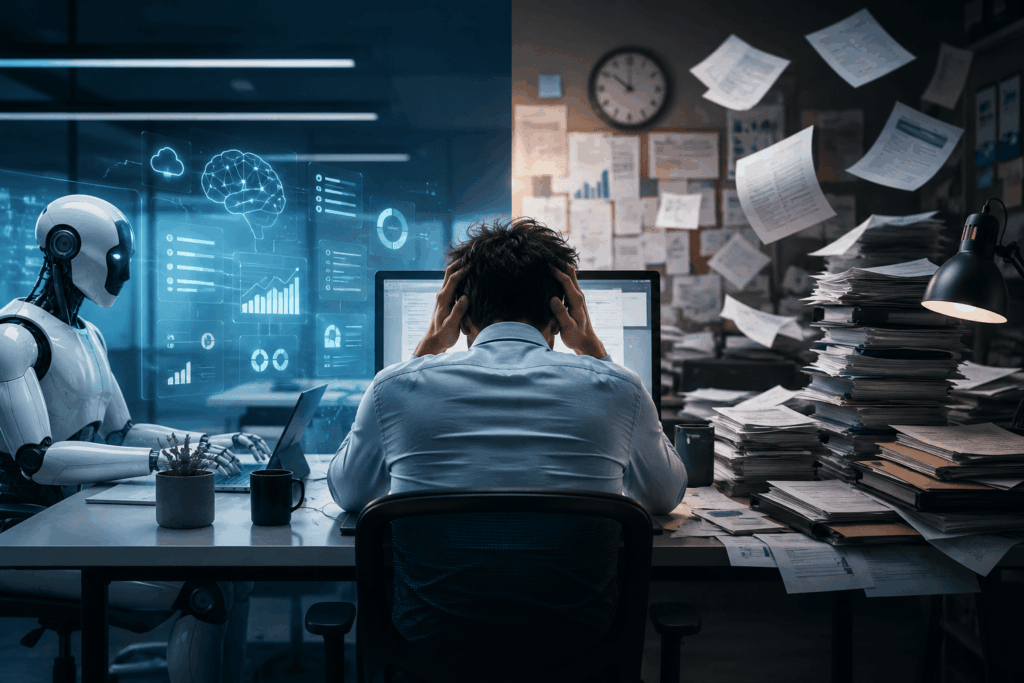
For workers, the disruption is equally tangible. Forbes reports that over half of white-collar jobs face transformation or disruption through AI-powered workplace automation. This dichotomy feeds workforce anxiety even as many enterprises enjoy a 60-70% reduction in workloads thanks to generative AI, documented in Deloitte’s 2024 report. The future workplace blends evolving human roles with AI support, requiring new skills and reskilling at an unprecedented pace.
Public trust remains fragile. Pew Research and Forbes studies converge on a sobering figure: less than half the global population trusts AI systems fully. This distrust correlates with a 56.4% rise in harmful AI incidents since 2020, from misinformation to privacy breaches. Deepfakes influencing 2024 elections, as NPR covered, amplify worries about the erosion of factual reality in democratic processes.
Adding environmental urgency, the IMF warns AI’s environmental impact could inject an additional 1.7 gigatons of CO2 between 2025 and 2030. This compels companies and nations to rethink AI development holistically—balancing innovation with sustainability.
On the regulatory front, frameworks evolve rapidly. Agencies in the U.S. enforce watermarking of synthetic content and AI impersonation restrictions, per the Future of Privacy Forum’s 2024 report. Yet these measures must keep pace with AI’s accelerating capabilities and ethical dilemmas.
Learning from the Frontlines: Case Studies in Synthetic Intelligence
Concrete examples provide a glimpse into how synthetic intelligence applications reshape industries and research:
- The Partnership on AI’s November 2024 report rolled out five case studies with partners including Meta and Microsoft, advocating transparency in managing synthetic media risks. Their Responsible Practices framework guides how AI-modified or fabricated content can be identified and responsibly handled, vital in an era awash with synthetic information.
- Deloitte’s research highlights real gains: enterprises report cutting 60-70% of employee workloads in domains like legal and marketing while boosting productivity—a testament to AI’s pragmatic value when thoughtfully deployed.
- RAND Corporation’s studies for the U.S. Space Force showcase AI’s strategic depth, enhancing space domain awareness through advanced machine learning models. This signals AI’s importance beyond commercial or consumer applications, shaping geopolitical and scientific frontiers.
- Innovations also blossom in research: AI’s capability to decrypt ancient texts and bioacoustic signals opens windows into mysteries long dormant, turning synthetic intelligence into a powerful partner for human inquiry.
Philosophical Questions: Does AI Truly “Think”?
What exactly is “thinking”? Neuroscience and computer science converge but diverge sharply here. Sussex University’s Centre for Consciousness Science — along with numerous thinkers — concede that while AI can simulate cognition, genuine consciousness remains undefinable and elusive.
Ray Kurzweil speculates that non-biological intelligence will surpass human capacity by around 2030, marking an inflection point in synthetic intelligence. This leap could redefine humanity’s role, raising profound moral and practical questions.
At the same time, responsibility becomes thorny. How do we hold synthetic intelligence accountable? The intertwining of AI outputs with human decisions complicates transparency, demanding new educational approaches to cultivate critical thinking in AI integration skills that can parse AI-generated knowledge safely.
The Tangible Ripple Effects on Society
The impact of synthetic intelligence runs deep and wide:
- Workforce transformation: PwC’s forecasts suggest AI could double productivity by 2025, transforming roles and business models. For small businesses, Synthesia reports 68% plan to leverage AI investments, particularly for marketing. But with half of white-collar jobs exposed to significant change, robust reskilling and social safety nets become indispensable.
- Business innovation: Generative AI accelerates content creation and reshapes customer engagement, enabling new creative dynamics and efficiencies.
- Social considerations: Heightened misinformation risks and election interference spotlight the need for regulatory oversight and improved public literacy about AI.
- Environmental concerns: AI’s substantial energy demands push urgent innovation for sustainable computational practices.
- Society’s evolution: The rise of autonomous AI models alters knowledge creation and decision-making frameworks, challenging traditional authorities and ethical norms.
A Look to the Horizon
The future of synthetic intelligence envisions:
- Increasingly autonomous AI with self-reflective AI capabilities personalized to users and enterprises.
- Governance frameworks embedding transparency, synthetic content labeling, and ethical mandates.
- A transformed workforce where human oversight collaborates symbiotically with AI automation.
- AI as an active participant in crafting knowledge and shaping decisions, not merely a tool.
Navigating this layered, complex future will demand vigilance, creativity, and cooperation across sectors and societies to ensure synthetic intelligence amplifies human flourishing rather than undermines shared values.
Synthetic intelligence is no longer the stuff of theoretical speculation but a dynamic reality unfolding across research labs, industries, and regulatory halls. As AI increasingly thinks for itself—processing, reflecting, and even questioning—it challenges humanity to define what it means to think, to trust, and to share agency with machines. The choices we make now will sculpt a future where synthetic intelligence either elevates human potential or complicates our collective existence. The journey demands clarity, courage, and a shared commitment to shaping technology that truly serves us all.
Frequently asked questions
What is synthetic intelligence?
Synthetic intelligence refers to AI systems with autonomous reasoning capabilities, allowing them to internally 'mull over' ambiguous scenarios and self-correct.
How is AI impacting public trust?
Public trust in AI remains fragile, with less than half the global population fully trusting AI systems, correlating with a rise in harmful AI incidents since 2020.
What are the potential benefits of AI in the workplace?
AI has the potential to double productivity by 2025, with many enterprises reporting a 60-70% reduction in workloads thanks to generative AI.