
Consider having an intelligent conversation with a machine that understands your questions and responds with coherent, relevant answers. This is the promise of modern AI models like ChatGPT. But what goes on behind the scenes when you type a question? Understanding this process not only demystifies AI but also empowers users and developers to harness its full potential.
Introduction
Artificial Intelligence (AI) has evolved dramatically over the past few years, with models like ChatGPT leading the charge in natural language processing (NLP). When users engage with these models, they often wonder about the underlying processes that enable such sophisticated interactions. As we navigate through this article, we will uncover the complexities of AI models, specifically focusing on what occurs when a question is posed to ChatGPT.
Understanding the mechanics of ChatGPT not only enriches our appreciation of AI but also equips developers and tech learners with the knowledge to create better applications. By examining the architecture, the data flow, and the model’s capabilities, we aim to provide a comprehensive overview that is both informative and engaging.
Background
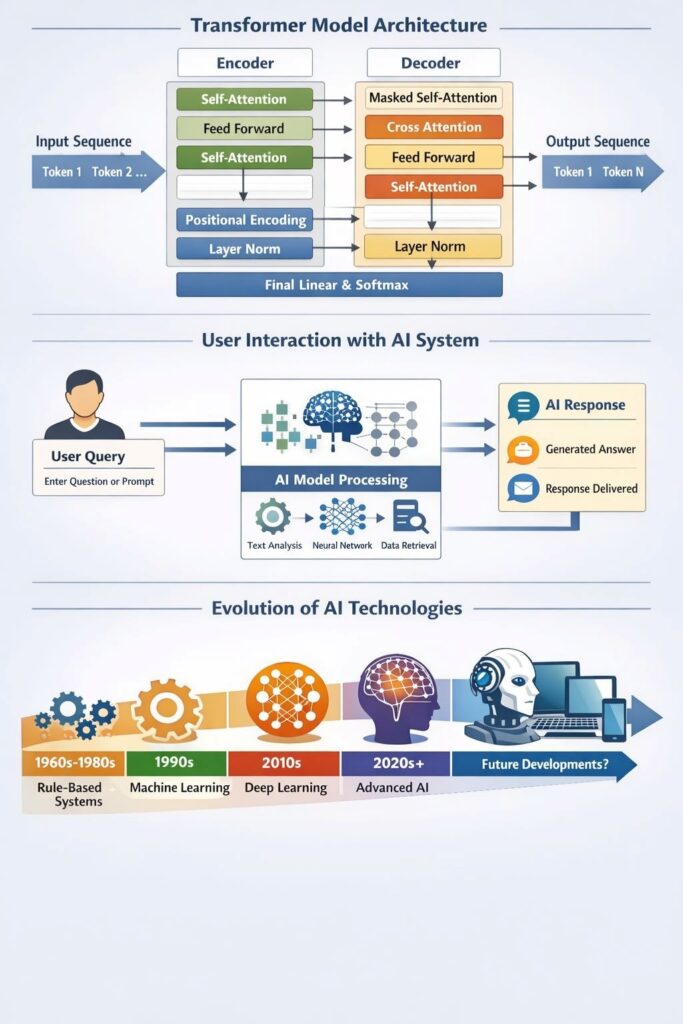
To understand ChatGPT, we need to start with the fundamentals of AI language models. At the core, these models are built on a type of neural network called a transformer. Introduced in 2017, the transformer architecture revolutionized natural language processing (NLP).
Transformers work by processing words in relation to all the other words in a sentence, rather than one at a time. This allows them to capture context and nuance better than previous models. And it’s this ability that gives ChatGPT its conversational flair.
What makes these models so powerful is their training. They’re fed vast amounts of text data from books, articles, and websites, learning to predict the next word in a sentence. The more data they consume, the better they get at understanding language.
Inside ChatGPT: From Input to Response
To illustrate the workings of ChatGPT in practice, an illustrative example involving a user interaction can be examined. Consider a scenario where a user asks, “What are the implications of quantum computing on cryptography?” Upon receiving this query, the model engages in a series of steps:
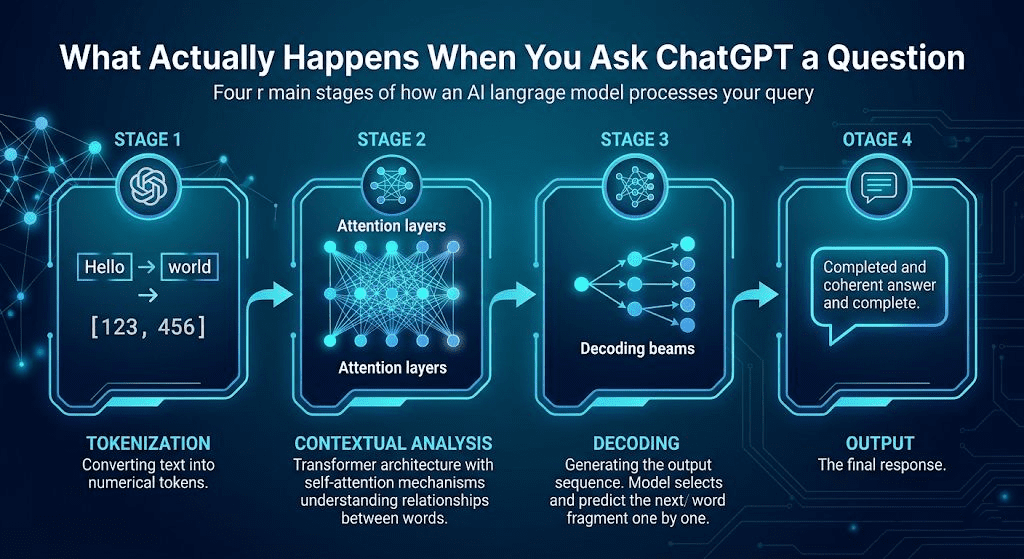
- Input Processing: The question is tokenized, converting the text into a format that the model can process. Each word is transformed into a numerical representation based on the model’s vocabulary.
- Contextual Analysis: Through the transformer architecture, the model analyzes the input tokens, utilizing self-attention mechanisms to assess the relationships between words. For instance, the model recognizes that “quantum computing” and “cryptography” are central concepts in the query.
- Response Generation: Based on its training data, ChatGPT generates a response by predicting the next sequence of tokens that logically follow the input. This is achieved through a process called decoding, which translates the numerical representations back into human-readable text.
- Output: The final output is delivered to the user, ideally providing a coherent and informative answer regarding the implications of quantum computing on cryptography.
This illustrates the complexity of interactions with ChatGPT and underscores the importance of understanding the processes that underpin these exchanges.
Dr. Fei-Fei Li, a prominent figure in the field of artificial intelligence, emphasizes the importance of transparency in AI technology: “As we integrate AI more deeply into our lives, we must ensure that these systems are interpretable and accountable. Users should understand not only what AI does but also how it arrives at its conclusions.” This perspective highlights the need for clear communication regarding the workings of AI models, particularly as they become more prevalent in user interactions.
Infographics
The challenges with ChatGPT
Despite the impressive capabilities of models like ChatGPT, challenges persist in ensuring accurate, relevant, and safe interactions. Issues such as bias in training data, the model’s propensity to generate plausible but incorrect information, and ethical considerations regarding user privacy and data security present significant hurdles. Furthermore, the lack of transparency regarding how models arrive at specific responses can engender mistrust among users.
As AI systems are integrated into more aspects of daily life, it becomes increasingly important to address these challenges. The implications of these issues extend beyond technical performance, influencing user satisfaction and the overall perception of AI technology.
How to solve the challenges with ChatGPT
To mitigate the challenges associated with conversational AI, several strategies can be employed. First, enhancing the training datasets with diverse and representative data can help reduce bias and improve the model’s understanding of different contexts. Additionally, implementing robust evaluation frameworks that assess the quality of responses can aid in identifying areas for improvement.
Moreover, transparency initiatives, such as providing users with explanations of how responses are generated, can foster trust and understanding. Techniques like reinforcement learning from human feedback (RLHF) have also been utilized to refine model outputs, ensuring that responses align more closely with user expectations.