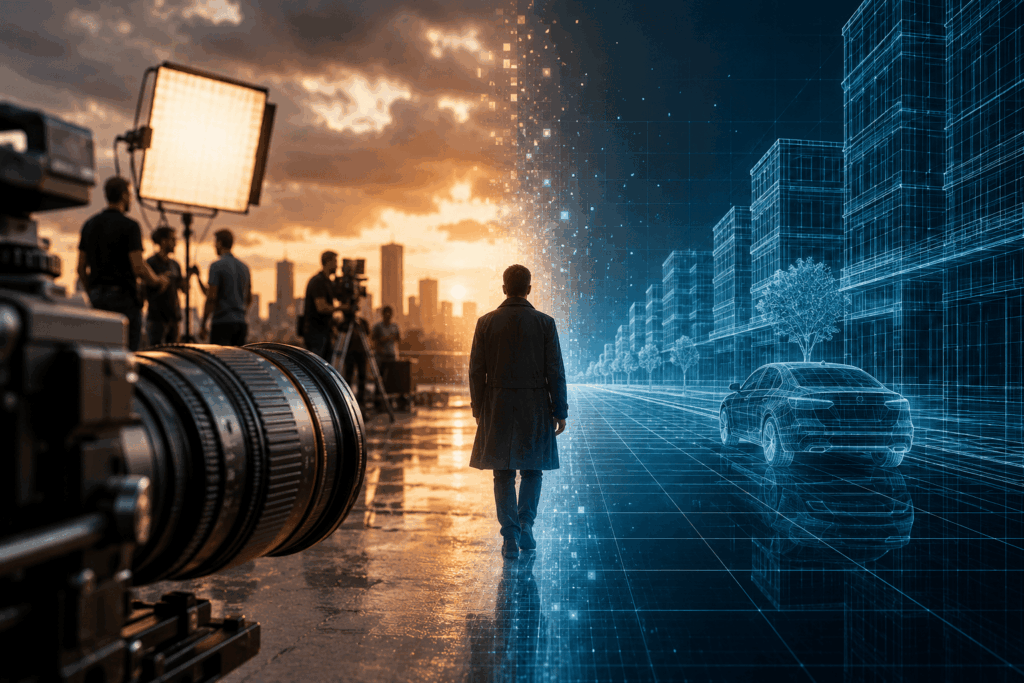
In the past, an AI-generated video may have been able to trick a viewer into believing it was legitimate for a short amount of time. However, nowadays, it has become possible to even doubt the fact that they saw a camera recording.
A person can stroll along a perfectly lit street, speak naturally to the camera, and pick up something while the surroundings around him change. The cars seem to drive, the clothes react to movements, the speech matches the lip movements, and the sound of the background makes the scene feel alive. What used to be seen as a digital frailty is becoming more and more like professionally produced films.
What has changed the most is not just a visually appealing AI video. It is the improved capability of AI models to comprehend the relationships between characters, objects, movements, sounds, and the environment. New innovative video generation tools such as Veo from Google, Gen-4 from Runway, and the Sora ensemble from OpenAI have moved the process from a short visual experiment to controllable production.
That begs an interesting—and somewhat uncharted—issue: if an AI can produce a realistic video of an imagined situation, what does it mean for a video to be “real”?
Figuring this out is difficult, and this is perplexing for researchers. AI-generated visual content is taking over the advertising and filmmaking industry as well as social media and creative production, while scholars are doing their best to understand the limits of visual realism.
From Unknown Faces to Virtual Reality
The original AI video technologies had a problem called temporal consistency. While image-generating software only needs to generate a convincing image, video generation calls for making dozens or even hundreds of frames that should fit together.
This is a tough job.
A face must continue looking the same all the time. Clothes must be the same. The background must not change. An item placed on the table should not start changing into something else. Shadows must change reasonably together with the movements, and the camera must make sense in the context of the environment.
OpenAI’s Sora project is a good example of overcoming the problem, and it describes how visual material from several frames can be used in the model even when the objects are out of sight.
The most recent developments can be considered a continuation of this issue. Modern video generation models are involved in making videos that will look like a perfect video instead of a series of pictures.
Physics becomes an element of illusion.
One of the major advancements is physical plausibility.
According to Google, Veo 3 has been created with realism and fidelity in mind, from the point of view of physics and sound technologies. Similarly, OpenAI has characterised Sora 2, saying that it significantly makes improvements in physics, the aspect of realism, and sound synchronisation, as well as steerability, compared to the previous models.
This is important because the audience notices any error in physics very easily.
If the person throws the ball, he or she intuitively understands where it will move. If the person is walking on the wet floor, he or she expects the reflection and movement to take the respective form. If the person drops the glass from the table, gravity, speed and force have to determine what will occur next.
AI does not have to understand physics properly but rather has to give its audience a visually appealing model.
The Importance of Sound Revolution
In the field of artificial intelligence-generated video, one of the most underrated components is audio.
Previous versions of AI-generated videos tended to be visually stunning but sounded artificial, requiring creators to add the audio to the video themselves. New models of video generation develop faster and better and can create any desired sound or audio effects together with the visuals.
The introduction of new audio features such as the native audio feature in Google’s Veo 3 highlights the importance of audio technology in video-generating models and its improvement.
It is the determination of the degree of realism in a video.
Let us imagine a video showing a woman walking through a crowded train station. In terms of realism, the visual part of the video is only half of the impression. People expect to hear footsteps, announcements, talk of passers-by, the hustle and bustle of traffic, and any other sounds typical for such an environment.
As soon as the sound fits with the visuals in a natural way, the viewer is ready to accept the reality as convincing.
The opposite working principle plays its part in this case. If a video is made
Dialogue makes the distinction very clear.
Right now, Veo’s prompt guidance is oriented towards visuals, actions, surroundings, dialogue and sounds.
Therefore, creators are capable of describing not only the looks of a character but also messages they are going to say and the sounds surrounding the filming.
Lastly, it brings AI video creation much closer to film directing than image generation.
Character Consistency: A New Era for Creatives
One of the biggest drawbacks of early AI videos was identity drift.
A creator could create a great character in one scene, but when asking the system to put that same character into another scene, there may be a change in face, clothing, hair or age.
This made long-form storytelling impossible.
However, Runway Gen-4 is designed to solve this problem. Its technology can maintain consistent characters, locations, and objects across different scenarios thanks to visual reference methods. Runway claims that one reference image can be used to bring a character alive in multiple situations and under different lighting.
This is revolutionary for the film industry.
The director no longer needs to generate every scene on its own and hope the character will look the same. The reference image creation allows you to create a single identity from a visual perspective that can be applied during multiple video shoots.
It is important to make the distinction.
Indeed, one must also point out that having an amazing AI-generated six-second clip is not shocking now.
What is much more difficult is to develop:
-
Shot 1, where the character comes into a room
-
Shot 2 showing the same character from a different perspective
-
Shot 3 showing the character using an object
-
Shot 4 with the character being outside
-
Shot 5 brings the character back to the starting point
The character, place, objects and lighting must remain consistent throughout the video.
Recent studies prove just how difficult it is. FilmBench – which is a film industry benchmark created by specialists in the movie industry in 2026 – supports the conclusion that AI video generation technologies show lower performance in multi-shot challenges than in creating an individual shot.
Real-World Example: The Wild Hare
A clear example of the movement of AI video technology into the mainstream is The Wild Hare Group, a ready-meal brand based in the UK. The firm sought to devise a marketing narrative centred around its mascot hare character, but its budget was tight and time was of the essence. According to a Google case study, the whole project was set to cost £20,000 and involve concept creation, production, social media strategy, posting, and analysis, all to be done within a period of two weeks before opening shops in 53 supermarkets of the Tesco chain. To implement their ideas, the creative team created an illustration of the hare, developed a full-length picture, and then applied Veo 3 to animate the pictures.
Consequently, the project allowed the company to eliminate the need for traditional shooting and realisation of the animation project according to the standard workflow of this process. The company reported that the production cost has not exceeded 10% of the expenses connected to the production of a commercial animation project in the usual way. Ben Malbon from Google has pointed out that Veo 3 can work with long instructions and keep the character consistent while executing all of its tasks.
This instance is significant since the technology does not serve the sole purpose of instigating a viral experiment. On the contrary, it finds application in resolving an actual marketing challenge in compliance with both financial and time restrictions.
AI Video Is Already Making Its Way Into Advertising
Advertising is possibly one of the first sectors where the distinction will become economically relevant.
Traditional commercials need locations, actors, cinematographers, lighting crews, production equipment, post-production, and weeks of organisation before the launch.
This is where AI changes the economics.
According to Runway, its technology is being used by agencies, brands, and studios in real campaigns and projects, noting cooperation in projects involving Lionsgate, Salomon, and other production partners.
In India, this process is already underway.
An advertising agency called Schbang has created six AI commercials using Google Veo 3 for Pyng, an expert-discovery platform focusing on the professional audience in Bangalore. The marketing campaign used AI-generated creatives as part of an extended performance marketing strategy.
There has also been experimentation by Indian companies and creators in AI video advertising, such as attempts to motivate creators to use Veo 3 for the production of promotional ads. In 2025, for instance, BoAt and Google launched the Veo 3 video-ad challenge intended to enable AI-generated advertising to become a part of the Indian brand storytelling practice.
These examples show the shift from “Can AI create a video?” to “Can AI help us
An AI advertising campaign that underwent $2,000
One of the most outstanding instances is that of a filmmaker named PJ Accetturo, whose AI production studio became particularly active after the launch of the Veo 3.
Recently, Business Insider reported that Accetturo created a pharmaceutical parody commercial by means of the Veo 3, which served to assist in producing an ad for a betting platform, Kalshi, during the NBA finals. The ad itself reached 18 million impressions within 48 hours, while Accetturo estimated that the AI-generated commercial cost around $2,000.
Of course, the main element which is noteworthy here is not that AI can substitute for Hollywood production.
The point is that now even a small group of creatives can work on visual concepts which used to require much more money and time.
This will have an impact on the advertising field.
Of course, large companies will still spend huge sums on advertisements, but small firms will be able to try creating a film without spending a fortune on recreating the shooting process.
Experts’ Insights: AI Is Expected to Improve Filmmaking Processes Instead of Simply Diminishing the Role of Filmmakers
CEO and co-founder of Runway Cristóbal Valenzuela claims that artificial intelligence is likely to transform creative jobs instead of just wiping them out. The Financial Times presented an interview in which Valenzuela stresses the possibilities that AI offers to filmmakers, game developers, and visual storytellers and emphasises tools aimed at artists and producers.
This point of view is worth mentioning since the best video workflows that utilise AI are rarely just “type your request and publish”.
A traditional workflow can be presented as follows:
Idea → Script → Storyboard → Reference Images → Video → Selection → Image Editing → Sound → Colour → Review Process
The Technology Still Has a Reality Problem
Essentially, the technology is good at generating short clips with a sense of reality, while it fails to successfully preserve complex relationships over long periods of time.
A recent study revealed “the Perception-Prediction Gap” in connection with the capacity of certain video generators to generate quite reasonable dynamics despite the absence of sufficient causal reasoning skills.
Researchers also mentioned audio-visual mismatch and limitations of actual-world reasoning.
It is important to bear the difference in mind.
The video can appear to be correct while it is not logically right.
This means that while an AI can produce quite realistic content of a person opening the door, it may face difficulties when asked to perform a long sequence of actions involving several objects.
Hands may behave ineffectively in relation to the other objects. A person’s reflection may not coincide with him or her. An object may vanish. The character’s outfit may suddenly change.
The instances of shortcomings have decreased immensely, but they are still present in the production of
The Uncanny Valley is Advancing
The earlier version of the uncanny valley was easily detected.
The generated faces appeared different from real faces.
The hands were depicted as having many fingers.
The facial expressions were also not natural.
Unlike those obviously wrong cases, nowadays these failures can be dubbed as less common. Thus, the uncanny valley now advances toward more inconspicuous features.
The audience may notice:
-
Slightly unnatural movements of the eyes
-
Odd distribution of weight
-
Incorrect reflection
-
Strange physics
-
Inconsistent shadows
-
Unrealistic movements of the fabrics
-
Lip sync failures
Gradual change of shape of the objects
Insight from the experts: Realism is not enough.
Fashion provides a valuable lesson.
According to Vogue, companies that utilise AI to create their promotional content have received varying responses. Some campaigns were criticised for their perceived lack of genuineness, and others earned praise when the AI was deployed properly and honestly.
Thus, it shows that realism is not the only thing needed for a championship AI video.
A technically perfect advertisement may fail if clients do not like the idea behind it.
Clients appreciate:
-
The story
-
The emotions
-
The brand
-
Genuineness
-
Cultural context
-
Transparency
Although AI can generate a realistic person in a perfectly well-lit space, it does not guarantee a sensible reason for that person to be there.
The Emergence of AI-Native Filmmaking
The most interesting future may not be AI merely replicating what traditional filmmaking has done.
Instead, it may lie in the invention of an entirely new visual language.
AI gives filmmakers the ability to create scenarios that would either be extremely expensive or impossible to create in real life. A director may make an entirely new city change its architecture during the same shot, a character that travels through different epochs, or an advertisement showcasing a product that alters reality around it.
Runway’s Gen-4 research focuses on the importance of consistent characters, items, locations, and film elements from various viewpoints, thus allowing the creation of entirely new visual worlds with the help of AI.
This may lead to the emergence of the new genre of AI-native cinema, where filmmakers will no longer be limited by the traditional aspects of filming.
The Most Significant Innovation May Be Speed
Maybe the most crucial progression is not authenticity itself, but iteration speed. In traditional processes, days or weeks may be needed to try out different versions. Thanks to a sequence of activities with AI, creative people can create many alternatives and assess them in a very short time.
Brands can try out:
-
Characters
-
Plots
-
Presentations of a good
-
Camera movements
-
Storylines
-
Visual effects
Thus, trials become less costly.
Moreover, the cheaper it is to experiment, the more risks creative professionals are able to take.
The New Production Workflow
As a result, the new hybrid workflow could be referred to not merely as “AI takes the place of the camera,” but rather something along the lines of “AI becomes part of the system.”
The creative director creates the idea. The scriptwriter turns the idea into a story. The AI machine generates images. The video graphics designer takes footage of videos. The editors create the best material. The sound designers process the audio. The human reviewers ensure that the sequence and realism exist.
The output is likely to consist of a blend of AI-produced, traditional footage and human input.
Trust Will Become as Important as Realism
Another problem that arises with increasing realism of AI-generated video is the loss of the ability to trust what one sees.
Provenance features such as C2PA metadata or visible/hidden markers are used by OpenAI’s Sora to help determine the nature of the AI-generated content.
Adobe also follows the same path using Content Credentials, which provide data on how the digital content was created or edited. It also highlights the commercially safe use of its Firefly models with a combination of licensed/public domain training material for its first Firefly model.
That will be increasingly important in journalism, politics, advertising and social media.
Once AI video is realistic enough that regular viewers cannot reliably tell it apart from the camera footage, provenance becomes a part of the media ecosystem.
The question is no longer:
“Is this video looking real?”
but rather:
“Can we prove the origin of this video?”
But the Gap Between Faked Video and Reality Is Not Disappearing
It is shifting.
Modern AI video generation software can now generate images of the kind that we would call impossible just a couple of years ago. These include plausible environments, character consistency from frame to frame, believable camera motion, and synchronisation with the sound.
Commercial real-world examples confirm the fact that AI video technologies are applied in practice even by advertisers. Runway provides examples of production use, whereas Google describes how Veo 3 helped to generate a campaign in the case of The Wild Hare despite time and budget restrictions.
However, the gap between simulation and reality has not been erased yet.
Complex sequences, complicated physical interactions, continuity, and causality still pose a problem. Further research reveals discrepancies between visually plausible results and actual understanding of these visuals.
But it might be exactly the most intriguing thing.
The industry is no longer wondering about the ability of AI video technologies to generate impressive footage for just a few seconds.
It is about their ability to sustain this visual world throughout the whole story.
Conclusion: AI Video Is Turning into a Production Medium
The major development in AI video is not the ability of machines to create impressive visuals.
AI video is turning into a production medium.
Veo is getting more realistic, with physics and native audio. Runway works on consistent characters, objects and worlds. Sora 2 showed progress in realism, physics, audio and controllability; however, the Sora product by OpenAI was discontinued on April 26, 2026.
At the same time, real brands and creative teams have already started using AI-generated advertisements instead of treating the technology as an academic curiosity.
The last problem is not making the visual part more realistic.
It is about making the story, the characters, physics, sound and continuity fit into each other.
This is what AI video is approaching now.
Once the technology develops enough to create an entire fictional universe, not just an outstanding scene, the difference between production and AI-generated video will get blurry.
The future of video will not be either completely synthetic or completely real.
It will be a mixture of human imagination, AI-made worlds and professional filmmaking skills.
Frequently asked questions
What advancements have been made in AI video tools?
AI video tools have improved in realism, character consistency, and audio technology, allowing for more lifelike and coherent video production.
How does audio impact AI-generated videos?
Audio technology enhances the realism of AI-generated videos by ensuring that sound effects match the visuals, creating a convincing experience for viewers.
What is the significance of character consistency in AI video production?
Character consistency allows for coherent storytelling across multiple scenes, as seen with Runway Gen-4, which maintains the same character appearance throughout different scenarios.