
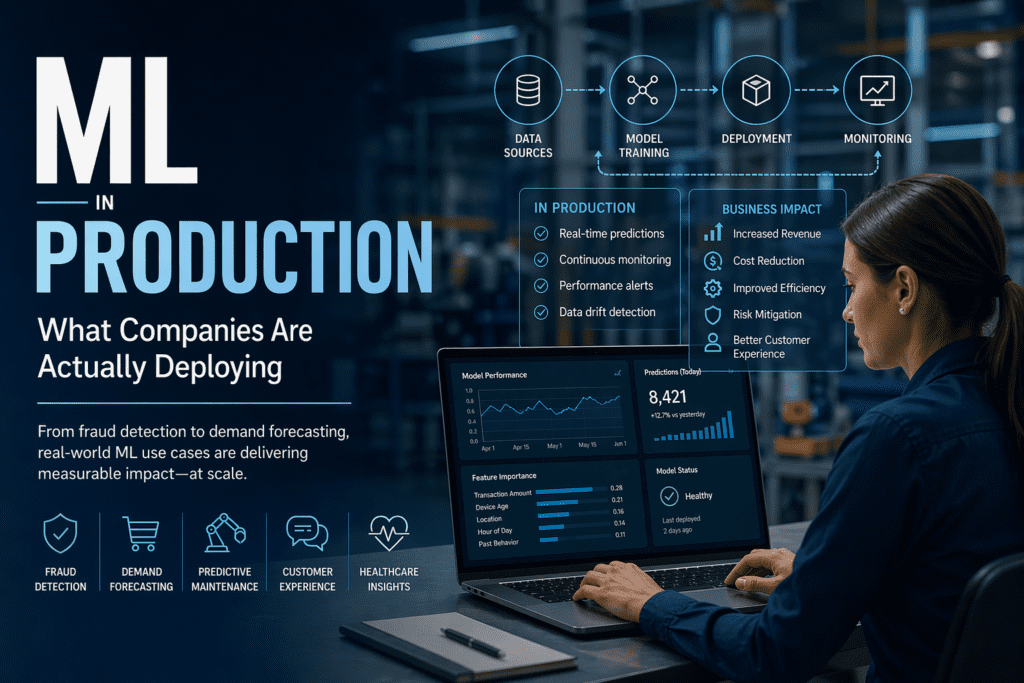
The gap between “we’re exploring AI” and “we ship models to clients for millions of daily users” never been more pronounced. We cut through the noise to examine ML in production actually looks like for enterprises right now. There is a tempting story the tech industry tells itself about machine learning: that it is always just around the corner, perpetually promising but not yet ready for the realities of production. That story is now obsolete in 2026. Over the past recent years, the center of gravity for enterprise AI has shifted decisively from experimentation to operationalization — from Jupyter notebooks to Kubernetes clusters, from proof-of-concept decks to ML pipelines that serve millions of predictions a day.
Yet for every company genuinely running ML at scale, there are many more stuck in a familiar loop — model built, pilot launched, then quietly shelved. Understanding what separates the two groups is the most important question in applied machine learning today. This article examines where production ML is actually being deployed, the sectors finding ML models successful, favorite MLOps frameworks and puzzling broken patterns most ML failed project post-mortems rarely mention.
The Production Gap: Why Most Models Don’t Ship
By 2025, more than 78% of large enterprises worldwide actively deploy machine learning models in production environments — up from less than 35% just five years ago.”
Before celebrating adoption numbers, it is worth naming the uncomfortable counterweight: Industry practitioners widely estimate that the majority of ML models never leave the pilot phase. The reasons are structural, not algorithmic. ML models even achieving 94% accuracy in a notebook has become research artifacts due to operational incompatibilities, data drifts, error in scoping project. Getting that same model to serve predictions under 50ms of latency, handle schema drift as upstream data pipelines evolve, satisfy legal for regulatory sign-off, and remain auditable months later these are engineering discipline most organizations are still building.
The production gap of deploying ML models into business processes shows up quietly. Few reasons being a ML model is retrained, but downstream consumers are unaware, a feature changes is applied to ML model but its lineage is unclear or an audit request arrives, and no single team can reconstruct how a specific prediction was produced. These are not edge cases; they are the default failure mode of disconnected ML tooling at scale.
Where Production ML Deployments Are Concentrated
Not all sectors are created equal when it comes to ML in production. The industries driving the highest adoption share a common trait: they generate enormous volumes of structured, labeled data and have clear, measurable outcomes that make model evaluation tractable.
🏦 Financial Services
Fraud Detection & Risk Scoring
The most mature production ML domain by volume. Major institutions evaluate millions of transactions per day against ensemble models that combine behavioral biometrics, device fingerprinting, and graph-based anomaly detection. Large US banks (e.g., JPMorgan Chase) commonly use Gradient Boosting, Random Forest ML methods and Neural Networks for 90-99% accuracy to reduce false positives by up to 50% and enabling millisecond decisions via ML architectures.
🛒 Retail & E-Commerce
Recommendation & Demand Forecasting
Retailer recommendation engines now combine collaborative filtering with real-time contextual signals — session behavior, inventory levels, margin targets. Separately, demand forecasting models have largely replaced spreadsheet-based planning for SKU-level inventory across large logistics networks.
🏥 Healthcare
Diagnostic Assistance & Clinical NLP
Clinical NLP pipelines that extract structured data from unstructured physician notes are now running in production at major health systems. Computer vision models assist radiology workflows, flagging candidate findings for clinician review — augmenting rather than replacing human judgment.
🏭 Manufacturing
Predictive Maintenance & Quality Control
Sensor fusion models on factory equipment now predict failure windows with enough lead time to schedule maintenance proactively. Computer vision models inspect production lines at throughput speeds no human team could match, catching defects with documented accuracy above 90%.
The Six Use Cases That Have Actually Cleared Production
Talk to enough ML engineers and a clear set of archetypes emerge — the categories where teams have repeatedly shipped working systems and built operational confidence around them. These are not necessarily the flashiest applications, but they share properties that make production viable: stable data schemas, measurable ground truth, and tolerant failure modes.
1. Real-Time Fraud Detection
This is arguably the most battle-hardened production ML category in existence. The systems running at financial institutions evaluate behavioral patterns — transaction velocity, device consistency, geographic anomalies, spending deviations from historical baselines — in milliseconds. The most sophisticated deployments combine supervised learning (trained on labeled fraud outcomes) with unsupervised anomaly detection to catch novel attack patterns that labeled data hasn’t seen. Production systems also use graph-based approaches, modeling users, devices, and transactions as interconnected nodes to surface coordinated fraud rings that transactional models miss.
Financial technological companies like PayPal and Square are deploying real-time fraud detection that processes millions of transactions per second. These systems use online learning to adapt to new fraud patterns within minutes. The operational sophistication her is high: models are retrained continuously, A/B tested against shadow models, and monitored for calibration drift. A global payment processor that reduced false positives by 60% through MLOps discipline points to what is achievable when the full lifecycle of ML model is engineered.
2. Recommendation Systems
From streaming platforms to e-commerce search ranking, recommendation systems are among the most economically significant deployed ML workloads in the world. What has changed recently is the convergence of traditional collaborative filtering with large language model embeddings, allowing recommendations to incorporate semantic understanding of content alongside behavioral signal. The architecture challenge is serving these systems at sub-100ms latency under concurrent load — a problem that has generated a mature ecosystem of approximate nearest-neighbor search, feature stores, and tiered caching strategies. Netflix is advancing on deep learning to predict customer’s aesthetic preferences and dynamically generate thumbnails and tailored trailers.
3. Predictive Maintenance
Across aerospace, automotive, manufacturing, and utilities, sensor data from industrial equipment now feeds time-series models that output remaining useful life estimates and failure probability windows. What has matured is not the modeling (gradient boosting and LSTM networks have been doing this for years) but the deployment infrastructure: edge ML deployments that run inference locally on equipment, removing latency and connectivity dependencies that cloud-only architectures cannot tolerate. General Electric and Siemens are using IoT-embedded sensors on gas turbines and factory lines. ML models predict the Remaining Useful Life (RUL) of parts, triggering maintenance orders before a failure occurs.
4. Clinical and Document Intelligence
Enterprise NLP has finally arrived in regulated industries. Healthcare, insurance, and legal services are running production models that extract structured entities from unstructured text — diagnostic codes from clinical notes, clauses from contracts, key terms from filings. These deployments required solving problems beyond model accuracy: explainability frameworks, human-in-the-loop review workflows, and audit trails that satisfy compliance requirements.
5. Dynamic Pricing and Demand Forecasting
Ride-sharing, e-commerce, hospitality, and logistics have converged on ML-driven pricing and inventory optimization as a production staple. These systems typically combine gradient boosting models with time-series components and business constraint layers that enforce pricing floors, margins, and competitive bounds. They are updated continuously as demand signals shift, making robust retraining orchestration a first-class operational concern.
6. Computer Vision in Operations
Beyond the consumer-facing applications, production computer vision has found durable footholds in inspection, safety monitoring, and logistics. Quality control cameras on manufacturing lines, camera-based inventory systems in retail, and incident detection on construction sites are shipping and generating ROI. Edge deployment is increasingly common — running inference on-device removes the round-trip to cloud infrastructure and enables deployment in environments with limited connectivity. High-resolution computer vision systems (like those from NVIDIA IGX) perform real-time defect detection on production lines, catching microscopic flaws in semiconductors or medical devices that human eyes miss.
The ML Infrastructure Stack Companies Are Actually Running
Production ML is as much a systems engineering challenge as a data science one. The tooling choices organizations make around model deployment, serving, monitoring, and governance determine whether models stay in production or quietly degrade and get turned off.
|
Layer |
Common Choices in Production |
What It Solves |
|---|---|---|
|
Training Orchestration |
Kubeflow Airflow SageMaker Pipelines |
Reproducible, scheduled retraining with dependency management |
|
Model Registry |
MLflow W&B Vertex AI |
Versioning, lineage tracking, approval workflows before promotion |
|
Feature Store |
Feast Tecton Databricks FS |
Consistent features between training and serving; reduces training-serving skew |
|
Model Serving |
BentoML Triton Seldon Core |
Low-latency inference, multi-framework support, GPU utilization |
|
Monitoring |
Evidently Arize Prometheus |
Drift detection, data quality alerts, performance degradation signals |
|
Governance |
DataRobot Fiddler Custom |
Audit trails, explainability, bias monitoring, regulatory documentation |
MLOps Maturity: Where the Industry Actually Stands
The MLOps market was valued at over $3 billion in 2025 and is projected to reach $73 billion by 2035 — growth that reflects not hype but genuine enterprise demand for operationalized ML infrastructure. North America leads adoption at 41% of global deployments, with Europe at 27% and Asia-Pacific — the fastest growing region — at 24%.
But raw adoption numbers obscure wide variation in maturity. The honest picture is that most organizations with “models in production” have achieved what practitioners call Level 1 MLOps — manual retraining triggered by human observation, models deployed but not actively monitored for drift, and no automated feedback loops connecting production performance back to model improvement. Only a minority have reached the automated, continuously improving systems that the term MLOps implies at full maturity.
⚠ ML in Production Reality Check
56% of organizations identify model governance as their single biggest challenge in bringing ML to production. Regulated sectors — finance, healthcare, pharma — face the additional constraint that every production model must generate audit-ready documentation satisfying frameworks like NIST AI RMF and the EU AI Act. Governance is not a post-deployment checkbox; it must be embedded in the development workflow from day one.
In-Demand Frameworks and Tools Businesses are deploying
In 2026, machine learning has moved far beyond experimental proofs of concept stage into times of proof of impact. Businesses are demanding scalable, compliant, energy efficient and real-time
AI systems with continuous monitoring and feedback loops those deliver measurable business value.
As a result, the modern ML stack has evolved into a structured ecosystem. The tools companies are deploying today fall into four major categories:
1. Enterprise AI Platforms: The Backbone of Production ML
Enterprise AI platforms serve as the foundation for end-to-end machine learning operations, covering everything from data ingestion to model deployment and monitoring.
A leading unified platform offering model development, deployment, and MLOps in one place—ideal for teams seeking streamlined workflows.
Widely adopted by enterprises for its seamless integration with existing Microsoft ecosystems and strong emphasis on responsible AI and governance.
Designed for regulated industries, it excels in compliance, auditability, and hybrid-cloud deployments.
A top choice for AWS-native teams, known for low-code model building, scalability, and high-performance training.
2. Deployment & MLOps Frameworks: From Models to Living Systems
MLOps has matured into a critical discipline. In 2026, companies are not just deploying models—they are managing continuous, sophisticated, self-improving ML systems.
Now the industry favorite, offering flexibility and speed for experimentation and production alike.
Remains the gold standard for large-scale, production-grade systems, especially for mobile and edge deployments via TensorFlow Lite.
Acts as a universal interoperability layer, enabling models to run across different frameworks and hardware environments with faster, high-performance inference runtime.
The backbone of modern NLP applications, widely used for fine-tuning and deploying customer-facing AI solutions.
The Emerging Frontier: What’s Entering Production In 2026
The current generation of production ML is not just doing more of the same — it represents genuine architectural shifts in how models are built, deployed, and composed.
1. Retrieval-Augmented Generation (RAG)
RAG has moved from research novelty to production workhorse with remarkable speed. By grounding generative models in enterprise document corpora, organizations are shipping knowledge assistants, contract analysis tools, and internal search systems that would have required years of fine-tuning under previous paradigms. The production challenges are real — vector database maintenance, retrieval quality monitoring, and hallucination detection at scale — but the ROI case is proving out in legal, financial services, and professional services firms.
2. Smaller, Domain-Tuned Models
The economics of inference are reshaping model selection. Organizations that rushed toward the largest foundation models are increasingly pivoting to smaller, domain-specific models that offer predictable latency, lower per-inference cost, and suitability for on-premise or edge deployment — critical in regulated environments where data sovereignty precludes cloud processing. The shift is being driven by both necessity (GPU availability and cost) and the recognition that a well-tuned 7B-parameter model can outperform a 70B model on a narrow domain task.
3. Agentic AI Pipelines
The most significant and most contested frontier. Projections suggest that up to 40% of enterprise applications will incorporate task-specific AI agents by 2026 — autonomous systems that plan, use tools, and execute multi-step workflows without human intervention for each step. The counter-signal is equally stark: over 40% of agentic AI projects are expected to be canceled by 2027 due to escalating costs, unclear business value, or inadequate risk controls. Agentic AI only becomes viable in production when permission boundaries, confidence thresholds, tool access control, and escalation paths are built into the architecture from the start. Platforms like LangChain and IBM’s watsonx Orchestrate and Bob are enabling AI teammates that can autonomously execute multi-step workflows, not just respond to prompts.
4. Edge ML Tools
Critical for industries like manufacturing and healthcare, where real-time inference happens directly on devices such as sensors and cameras. Edge ML has transitioned from “cloud-lite” experimentation to high-performance, autonomous infrastructure. The focus is now on ultra-low latency and energy-efficient inference at the site of data generation. Latest releases of Edge ML products include NVIDIA IGX & DLAP-IGX Series and Intel Edge AI Stack.
Enterprise ML Adoption by Domains
ML models adoption rates across core production domains, based on aggregated enterprise survey data from 2025:
What Separates Deployments That Last
Across the organizations that have built durable ML production systems, a few patterns appear consistently — and their absence predicts failure just as reliably.
The first is that monitoring is treated as a first-class concern from day one, not retrofitted after the first crisis. Models deployed without drift detection, performance baselines, and alert thresholds will silently degrade. The second is that data contracts between upstream producers and model pipelines are explicit and versioned — a schema change that breaks a feature computation should trigger a build failure, not a mysterious drop in model accuracy three weeks later. The third, and perhaps most underrated, is organizational: the teams that succeed in production have blurred the boundary between data science and engineering. The romantic notion of the lone data scientist handing a model over a wall to an engineering team for “productionization” is a pattern that produces exactly the gap between research accuracy and production performance that makes stakeholders lose faith in ML projects. By 2026, enterprises will not be differentiated by who uses ML but the differentiation will come from who can operate ML systems responsibly, efficiently, and at scale as ML systems become more autonomous, adaptive and production ready.
The Candid Reality
Machine learning in production is real, widespread, and generating measurable economic value across a growing range of sectors. It is also harder than it looks from the outside — a discipline that demands engineering rigor equal to the statistical sophistication it is built on. The companies that treat production deployment as a second-class problem compared to model development will continue to contribute to the 90% of models that never ship. The ones investing in the full lifecycle — data pipelines, feature stores, CI/CD for models, drift monitoring, and governance frameworks — are building moats that compound over time. The value of an ML tool is judged by its ability to operationalize models in live environments leading to success is determined not by the size of the ML model, but the reliability of ML pipeline and infrastructure. MLOps 2.0 pipelines supporting most of these systems now feature automatic rollbacks if a model begins to drift or exhibit bias in a live environment.
The next wave, from RAG-powered knowledge systems to governed agentic pipelines, will raise the operational bar further. The organizations best positioned for it are not necessarily the ones with the most sophisticated models. They are the ones that have learned to treat ML as production infrastructure — built for reliability, observable, and designed to be maintained by humans who have clear accountability for what it does.
Frequently asked questions
What is the current state of ML in production for enterprises?
The state of ML in production for enterprises has shifted from experimentation to operationalization, with a significant increase in deployment rates.
Why do most ML models fail to move beyond the pilot phase?
Most ML models fail to move beyond the pilot phase due to structural issues, such as operational incompatibilities and data drifts.
Which sectors are successfully deploying ML models?
Sectors like financial services, retail, healthcare, and manufacturing are successfully deploying ML models due to their ability to generate large volumes of structured data.