A slash command library changed what it means to plan, write, and manage software. Anthropic pioneered autonomous command architecture to execute the heavy-lifting tasks like code analysis and implementations. Now every major platform is racing to catch up with the methodical, easy-to-use built-in commands.
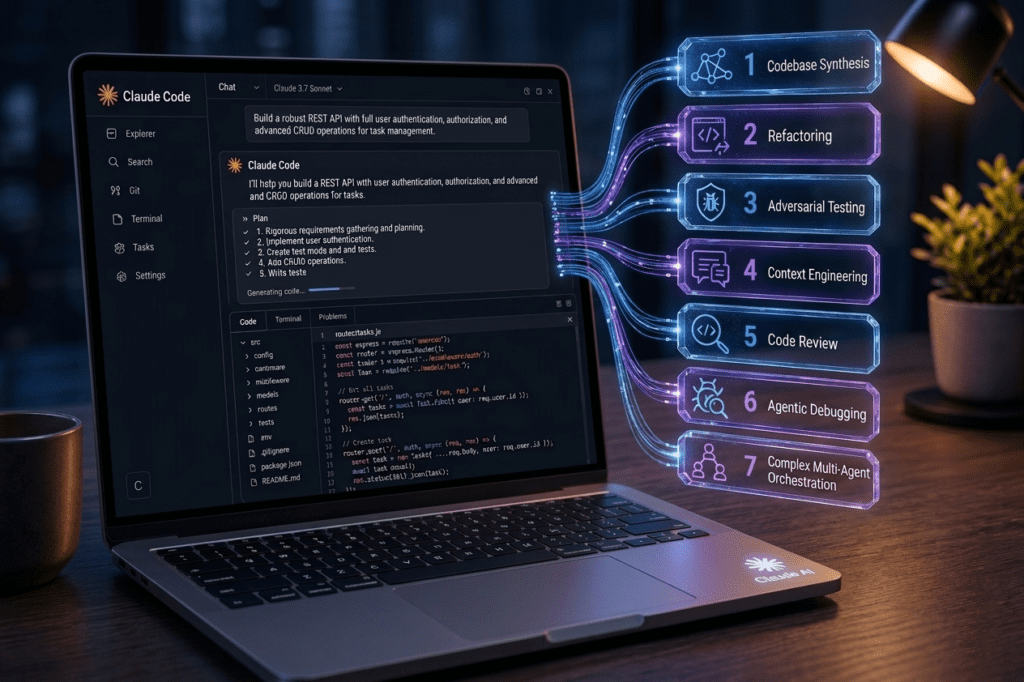
Claude Code is Anthropic’s coding-focused agentic model with a set of autonomous commands. These are technically referred to as slash commands, which are structured directives that instruct the agent to plan, execute shell operations, test suites, review output, and iterate across a codebase. Anthropic does not use “tools” as the user-facing term here; that label is reserved for the internal execution primitives (Bash, Read, Edit) the model calls at the system level. What developers interact with are slash commands, and the distinction matters: a slash command delegates an entire workflow, not a single action. These capabilities allow the model to take multi-step actions with minimal human prompting, enabling workflows that previously required complex orchestration and dedicated tooling. The result is a measurable upgrade in developer expectations, team roles, and software lifecycle practices across startups and large enterprises; now developers can use Claude Code like a proactive collaborator that manages fundamentals of the engineering workflow from end to end.
The company’s business trajectory reflects the architectural impact Claude Code’s commands have created for Anthropic. Claude Code launched in February 2025 as a limited research preview, reaching general engineering capabilities in May. Engineers at Spotify stopped writing code manually in December 2025. Today, Anthropic engineers on average ship 8x as much code per quarter as they did from 2021-2025. By May 2026, Anthropic’s own engineers had automated 80 percent of the code they shipped.
The Autonomous Command Architecture
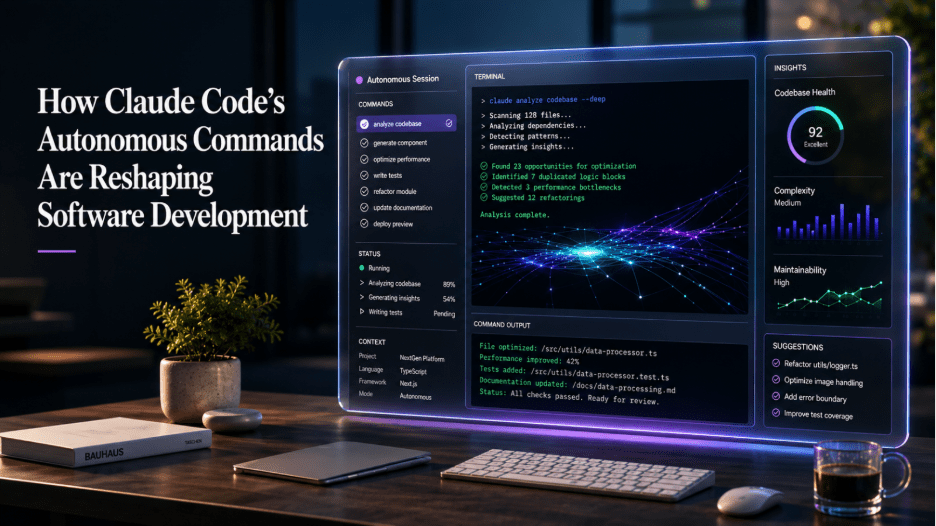
Autonomous commands let a coding assistant perform sequences of related tasks on its own, based on a single, high-level instruction. Instead of asking the model to generate a function and then manually integrate, test, and refine it, developers can instruct Claude Code to implement a feature, run unit tests, fix failing cases, and propose deployment steps. The Anthropic team insists on not being “AI assistant” but “junior engineer who needs clear instructions, a project brief, and appropriate guardrails.”
Teams gain speed on repetitive, well-defined engineering tasks while freeing human developers to focus on design, architecture, and high-leverage problem-solving. For organizations adopting continuous integration and continuous delivery through pipelines, autonomous commands can reduce friction between coding and validation, enabling more frequent safe changes.
Claude Code’s command library makes faster, smarter, and transparent product delivery possible at scale. This enables shipping with a set of slash commands that are not cosmetic in addition to a chat interface. They are control surfaces for 2026’s autonomous system. The difference between using Claude Code as a fast editor and using it as an engineering partner is a question of whether you understand these commands’ abilities and ways they delegate.
Command Library: Autonomous And Agentic execution
Verified against CLI v2.1.166, June 2026
|
Command |
Functions |
|
claude agents |
Opens Agent View: a terminal dashboard for dispatching and monitoring multiple parallel Claude sessions simultaneously. Fix a bug in service A, review a PR in B, investigate logs in C — all at once, from one screen. |
|
/workflows |
Triggers Dynamic Workflows (Opus 4.8 research preview): one orchestrator agent plans the task, fans out into hundreds of parallel subagents, then merges results in a single session. The command behind the Bun-from-Zig-to-Rust-in-six-days story. |
|
/ultrareview |
Simultaneous adversarial code review across correctness, security, and style — in one pass, across multiple files. Not a lint wrapper. An opinionated multi-lens critique that catches what single-axis review misses. |
|
/effort xhigh |
Sets maximum reasoning depth on Opus 4.8 for the hardest tasks. The other levels (low, high, max) let you trade quality for speed and cost on simpler work — critical when running ten agents in parallel. |
|
/code-review –fix |
Runs the full review pass, then applies the corrections automatically. No approval gate per change. The loop closes without a human in the middle. |
|
/loop 5m /cmd |
Runs any slash command on a defined interval inside the current session. Enables polling-style automation for monitoring, test-watching, and scheduled tasks without leaving the terminal. |
|
/recap |
Summarizes the session’s decisions, context, and pending tasks. Essential for long autonomous runs while handing off to a new session, or a second developer needs a clear thread. |
|
/mcp add |
Connects an MCP server mid-session. Claude gains live access to GitHub, Postgres, Jira, Slack, or any external service in one command. Anthropic’s open MCP standard is now adopted across the entire category. |
|
/plugin |
Installs a versioned plugin bundle — slash commands, skills, hooks, and MCP definitions — from the Anthropic marketplace or any public Git repo. The community skill library is what keeps Claude Code relevant for non-developers. |
|
PreToolUse hook |
Intercepts every tool call before execution. Used to enforce security policies, block dangerous bash patterns, auto-format code, or write audit logs without touching the developer’s workflow. The hook system is how enterprises encode their standards into Claude’s behavior. |
Auto Mode, released March 24, 2026, is the command-level feature that ties the library together for autonomous software engineer use. In standard mode, Claude Code requests approval before executing shell commands or modifying files. Auto Mode shifts many of those decisions to an automated permission system, allowing Claude to continue working without requiring constant developer intervention.
Every action is reviewed by a dedicated classifier before execution. Routine operations can proceed automatically, while actions that appear destructive, exceed the user’s intent, target untrusted infrastructure, or show signs of prompt injection are blocked or escalated for review. This allows developers to run large refactoring projects, repository-wide migrations, and extended testing workflows with far fewer interruptions.
Architecture Note
Auto Mode occupies the middle ground between standard permissions and the –dangerously-skip-permissions option. Standard mode requires approval for sensitive actions, while –dangerously-skip-permissions removes permission checks entirely. Auto Mode introduces an automated safety layer that evaluates actions before they run, seeking to preserve developer oversight without sacrificing autonomy.
Anthropic launched Auto Mode as a research preview and cautions that it does not eliminate risk. The company recommends maintaining human review for sensitive operations and treating the feature as an additional safeguard rather than a complete replacement for oversight.
Opus 4.8 – The Default Model That Runs Latest Commands
Every command in Claude Code executes on an underlying model, and the model tier defines what the commands can accomplish. On May 28, 2026, Anthropic shipped Claude Opus 4.8 as the new default for Claude Code. The price held at $5 per million input tokens and $25 per million output tokens, unchanged from Opus 4.7. Four changes underneath that stable price point materially altered what production agentic work looks like.
Dynamic Workflows, the flagship capability, lets one agent plan a task, fan out hundreds of parallel subagents within a single session, and synthesize the results. Effort Control gives developers four selectable reasoning depths, including the new /effort xhigh for the most demanding tasks, with lower tiers preserving model quality at reduced cost for simpler work. Fast Mode, now three times cheaper than it was for Opus 4.7, runs at 2.5 times standard speed for throughput-constrained workloads. The one-million-token context window is now on by default, meaning Claude can hold an entire large codebase in working memory while executing. Anthropic’s internal data shows that Claude-authored code reached rough parity with average human-written code quality by mid-2026, with expectations to surpass it before year-end.
The Personal Software Movement
The commands and model improvements would have remained an engineering story if not for something that happened in parallel: the product spread well beyond professional developers. A Retool survey found that 35 percent of companies had already replaced at least one SaaS tool with software they built themselves, and 78 percent expected to build more in 2026. Claude Code, no longer restricted to the terminal and now accessible through a browser tab or smartphone, was the primary reason that made it economically viable without a full engineering bench.
Andrej Karpathy, founding research scientist at OpenAI, called Claude Code “the biggest change to my basic coding workflow in two decades. Inspired by Karpathy’s observations, developer and founder of multica-ai, Forrest Chang transformed those lessons into a four-principle CLAUDE.md configuration file that accumulated more than 109,000 GitHub stars by mid-2026, becoming one of the fastest-growing AI-development repositories on GitHub.
Anthropic’s own 2026 Agentic Coding Trends Report documented a lawyer with no coding background using Claude Code to build self-service legal triage tools. Graphic designers discovered Figma-to-code workflows that shipped front-end components without a developer’s handoff. Marketers built brand-monitoring agents that scraped Reddit and Hacker News and delivered weekly reports. Claude Code’s skill system, which packages workflows into reusable community assets that install with a single /plugin command, let practitioners share what they built and compound each other’s work. A marketing team’s brand-monitoring skill became the foundation for a sales team’s prospect-research skills. The community is not merely adopting the platform; it was building the library of applications, autonomous workflows that demonstrated Claude’s range of capabilities to non-technical professions who would never have found the explicit, exclusive ways to do it themselves.
Security, Governance And Safe Adoption
Autonomous code modification is a major attack surface. Models can introduce vulnerabilities by applying unsafe patterns, misusing libraries, or misconfiguring access—especially when agents run in parallel across large codebases without human review. Fast-moving organizations have paired rapid adoption with strict governance: limiting write permissions to trusted contexts, sandboxing runs, logging all changes, and maintaining immutable audit trails for incident response.
Tiered Permission Model is a durable pattern from early enterprise deployments is a tiered model. Repositories default to read-only access for autonomous commands, with write privileges granted incrementally to lower-risk paths first. High-risk changes like security configs, public APIs, and data access layers that require explicit human signoff, regardless of model confidence. Tools like PreToolUse hooks and Auto Mode’s safety classifier provide initial enforcement, but relying solely on them has led to regressions caught by stricter review policies.
The Competitive Response: Agentic Command Architectures By Platform
The clearest sign of Claude Code’s influence is its growth in adoption and technical advancements, but also its reflection on major platforms rebuilding around the similar autonomous, multi-agent command architecture, hook-driven execution that Claude Code established. In early 2025, autocomplete-style assistance dominated the category. By mid-2026, every serious player had shipped a parallel-agent execution layer, or adopted Anthropic’s Model Context Protocol (MCP), or both.
OpenAI Codex
/plan, /exec , Goal Mode
Cloud-sandboxed agent that clones repos, runs tests, and opens PRs autonomously. Goal Mode reached general availability in May 2026, sustaining multi-hour sessions. OpenAI demonstrated 1,000 sequential tool calls without human intervention on GPT-5.5. Codex CLI adopted Anthropic’s MCP standard as its external integration layer.
GitHub Copilot
Agent Mode, /fleet, Agent HQ
Evolved from single-file autocomplete to a full multi-agent platform. Agent HQ runs multiple agents side-by-side. The agentic load was severe enough that GitHub paused new individual sign-ups in Q2 2026 to manage compute demand. The model picker now includes Claude Opus 4.7 alongside GPT models, a direct acknowledgment of Claude Code’s model quality.
Google Antigravity
Dynamic Subagents, Antigravity CLI
Google retired Gemini CLI entirely on June 18, 2026, and replaced it with Antigravity, a Go-based CLI with dynamic subagents, scheduled background tasks, a public SDK, and 1M-token Gemini 3.5 Flash context. The product mirrors the Claude Code architecture at nearly every level, including hook-based automation and MCP server compatibility.
Cursor
Background Agents, Built in Parallel
Background Agents run on cloud VMs with full desktop and browser access. Built in Parallel dispatches up to eight agents simultaneously, each with its own isolated environment. Cursor v3 shipped a desktop-environment-per-agent upgrade in February 2026. The product leads on visual IDE integration, where Claude Code leads on terminal depth.
Every major response followed the same structural blueprint: a planning layer to scope the task, a parallel execution layer to distribute it, a review loop to validate output, and a hook or policy system to enforce standards without requiring manual sign-off at each step. Claude Code assembled that four-layer architecture first, in mid-2025, and made each layer available as a discrete slash command from the terminal. By the time competitors mapped out their own versions, Anthropic’s MCP protocol had already become the de facto integration standard — adopted by OpenAI as the external layer for Codex CLI, a technical concession that defined the category’s interoperability norms. Google concluded the gap was unbridgeable by iteration and scrapped its CLI entirely. GitHub’s parallel-agent infrastructure strained hard enough under demand to force a pause on new individual sign-ups.
Conclusion: From Authorship to Orchestrators
Boris Cherny, who created Claude Code inside Anthropic’s experimental division and hasn’t manually edited code since November 2025, told Y Combinator’s Lightcone podcast that AI has “practically solved” coding and that the software engineering job title will begin to “go away” in 2026, shifting engineers toward review, architecture, and direction rather than authorship. Dario Amodei put a sharper timeline at Davos in January: “We might be six to twelve months away from when the model is doing most, maybe all, of what software engineers do end-to-end.”
Real-world proof is undeniable. A startup founder told Business Insider in early 2026 that every line of code in his company was written by agents—operationally impossible twelve months earlier. A Utah pilot across 40+ development teams found 77% of developers saw measurable value within the first hour of using Claude Code, while 30% reported output velocity improvements exceeding 30% within four weeks.
What remains uncertain is the speed of second-order effects. The critical questions center around hiring pipelines, what junior developers learn first, and how much of the architecture layer stays human once the execution layer is fully delegated. Andrej Karpathy, who watched his manual coding ability “atrophy” as Claude Code absorbed his workflow, framed it most personally: “The ground is shifting under the profession in real time.”
Claude Code isn’t just accelerating coding; it is redefining what software engineering means in 2026. The future belongs to engineers who can orchestrate autonomous systems, not just understand coding.
Frequently asked questions
What are autonomous commands in Claude Code?
Autonomous commands are structured directives that instruct the agent to plan, execute shell operations, test suites, review output, and iterate across a codebase.
How has Claude Code impacted software development?
Claude Code has measurably upgraded developer expectations and software lifecycle practices, allowing developers to use it like a proactive collaborator.
What is Auto Mode in Claude Code?
Auto Mode is a command-level feature that allows Claude to continue working without requiring constant developer intervention, reviewing every action before execution.