As of May 2026, Hugging Face continues to dominate the AI landscape, offering a suite of pre-trained models that cater to diverse applications in machine learning. Developers and researchers are increasingly turning to these models for their proven versatility and efficiency, which can significantly enhance productivity and innovation in AI projects. Understanding the top Hugging Face models is crucial for anyone looking to leverage cutting-edge technology in their work.
Latest Trends in Hugging Face Models (2026)
| Model Name | Use Case | Key Features |
|---|---|---|
| BERT | Text Classification | Bidirectional, Contextual Embeddings |
| GPT-3 | Text Generation | Large Scale, Few-Shot Learning |
| T5 | Text-to-Text Tasks | Unified Framework, Versatile |
| DistilBERT | Resource-Efficient NLP | Smaller, Faster, Retains Performance |
In 2026, the Hugging Face community has seen a surge in the development of models tailored for specific industries, such as healthcare and finance. These advancements reflect the growing demand for specialized AI solutions that can address unique challenges, further solidifying Hugging Face’s role as a leader in open-source AI.
Hugging Face has transformed the landscape of artificial intelligence since its inception. Founded in 2016, this platform has become synonymous with open-source AI, providing developers and researchers with the tools they need to create, share, and implement machine learning models. Fast forward to May 2026, and Hugging Face remains at the forefront, with numerous models gaining traction for their effectiveness and versatility.
But why should you care about Hugging Face models? If you’re working on a project that involves AI, understanding which models are currently popular can help inform your choices. After all, the right model can be the difference between a mediocre outcome and something truly spectacular.
How Hugging Face Became a Leader in AI
Hugging Face’s journey began with a chatbot application, but it quickly pivoted towards becoming an AI platform. The introduction of the Transformers library made it easier for developers to work on natural language processing tasks. Over the years, Hugging Face has expanded its offerings to include models for various domains, such as computer vision and multimodal tasks.
In recent years, the platform has attracted a large community of developers and researchers, fostering collaboration and knowledge sharing. This community-driven approach has led to a vast repository of models that cater to numerous applications, making it easier for users to find what they need.
Top Hugging Face Models in May 2026
1. BLOOM
An open-access multilingual huge language model trained on 46 languages with 176 billion parameters.
Examples of Use:
- Generation and translation of multilingual text
- Summarising papers in several languages.
- Research in academia and NLP experiments
- Creation of chatbots for worldwide audiences
- Answers based cross-lingual inquiries
🔗 Link: https://huggingface.co/bigscience/bloom
2. Qwen3.5-27B- Claude
A multimodal artificial intelligence model able to concurrently reason across images and words.
Applications:
- Photo captioning and pictorial narrative
- Document analysis including graphs and schematics
- Visual question answering (VQA)
- Assistance with the analysis of medical pictures
- E-commerce Product Description from pictures
Link: https://huggingface.co/Qwen/Qwen2.5-VL-7B-Instruct
3. Minej/bert-base-personality
From written text, a BERT-based model predicts Big Five personality traits (OCEAN).
Application:
- HR screening and candidate personality insights
- Analysis of social media personalities
- Mental health research instruments
- User profile for tailored applications
- Research in academic psychology
Link: https://huggingface.co/Minej/bert-base-personality
4. smolagents: computer-use agent
Plain natural language instructions help an AI agent to automate desktop and browser chores.
Application:
- Automation of repeating computer processes
- Automated Web scraping and data entry
- Forms are filled automatically.
- Software testing automation and quality assurance
- Personal production help
Link: https://huggingface.co/smolagents
5. Kortix/FastApply
Intended to swiftly and accurately maintain software codebases and apply changes, a code-focused artificial intelligence model.
Applications:
- Automated code refactoring
- Fixing of bugs over extensive codebases
- Code review and recommended use
- Software migration support
- Developer buddy programming tool
🔗 Link: https://huggingface.co/Kortix/FastApply-7B-v1.0
6. OpenAI GPT-3
A 175 billion-parameter autoregressive language model well-known for producing human-like text spanning a range of activities.
Application:
- Blog post and content writing
- Chatbots for customer assistance
- Code generation and clarification
- Compiling and writing emails
- Creative writing and narration
Link: https://huggingface.co/openai-community/gpt2
7. DistilBERT
40% smaller and 60% faster, a distilled, lightweight variant of BERT retains 97% of BERT’s accuracy.
Applications:
- Real-time sentiment analysis
- Mobile and edge device natural language processing
- Large-scale quick text categorization
- Identifying named entities, NER
- Low- latency search rank
Link: https://huggingface.co/distilbert/distilbert-base-uncased
8. T5 (Text- to-Text Transfer Transformer)
Every NLP task is framed as a text-to-text challenge for integrated learning using a flexible transformer model.
Applications:
- Summarizing text
- language interpretation
- Systems for answering questions
- Categorization and labeling of text
- Grammar correction software
🔗 Link: https://huggingface.co/google-t5/t5-base
9. CLIP: Contrastive Language–Image Pretraining
Using natural language, an OpenAI model learns visual ideas and semantically links images to text.
Applications:
- Engines for visual searching
- Content moderation: finding objectionable images
- Zero-shot image categorization
- Search for goods driven by artificial intelligence in e-commerce
- Automatic labeling and image tagging
🔗 Link: https://huggingface.co/openai/clip-vit-base-patch32
10. DALL- E
OpenAI’s generative artificial intelligence model generates original photos from text descriptions with astounding inventiveness.
Applications:
- Marketing and advertisement visual elements
- Game design concept art
- Book for children with pictures
- Product sketches and prototyping
- Generating content for social media
Link: https://huggingface.co/dalle-mini
Limitations of Hugging Face in Production
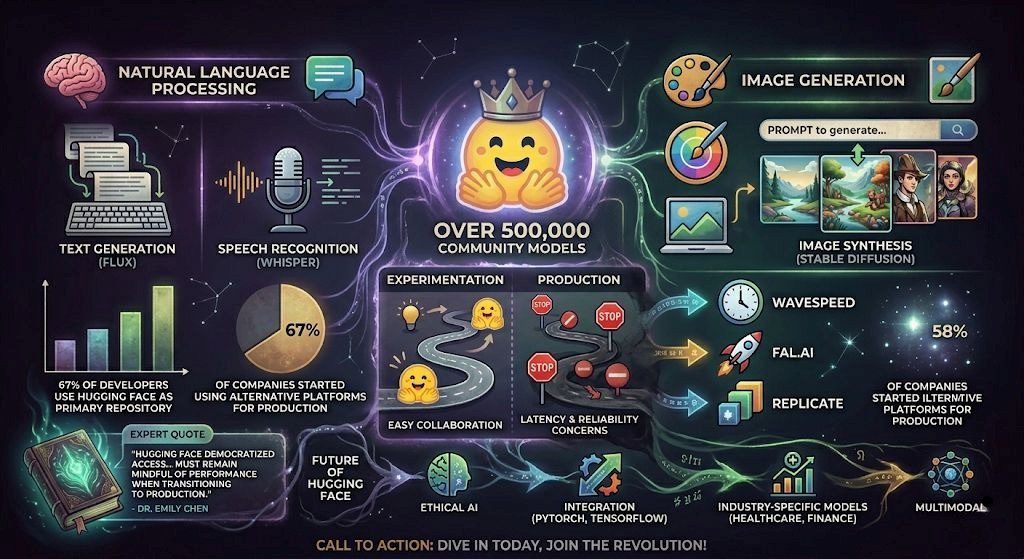
As organizations increasingly adopt AI solutions, the need for reliable, high-performance models becomes paramount. While Hugging Face excels in providing a vast array of models for experimentation, its Inference API has notable limitations, including:
- Variable Latency: Response times can range from 200ms to 2 seconds, which can be problematic for applications requiring real-time performance.
- Rate Limits: The community tier has strict limitations, making it less suitable for high-volume production workloads.
- Lack of Exclusive Models: Many proprietary models are unavailable on Hugging Face, limiting options for organizations seeking specialized tools.
These challenges have prompted many developers to explore alternatives while still leveraging the best Hugging Face models for their unique capabilities.
To address these challenges, several alternatives have emerged that promise better reliability and performance for production workloads. Platforms like WaveSpeed, Fal.ai, and Replicate offer similar models to those found on Hugging Face but with enhanced reliability and lower latency.
For instance, WaveSpeed boasts a 99.9% uptime SLA and consistently low latency, making it a strong contender for critical applications. Meanwhile, Fal.ai claims to offer the fastest inference times in the market. These alternatives allow teams to leverage the extensive models available on Hugging Face while ensuring that their applications run smoothly in production.
How Hugging Face Models Perform in Real Applications
Let’s take a closer look at a real-world example of Hugging Face models in action. A leading e-commerce company utilized Hugging Face’s FLUX model for generating product descriptions. The results were impressive; not only did the model save time, but it also improved the overall quality of the descriptions.
However, as the company scaled, it faced challenges with the model’s latency during peak traffic times. To mitigate this, they explored WaveSpeed for their production needs. By migrating their implementation to this platform, they reduced response times significantly, enhancing the user experience on their site.
This illustrates the importance of choosing the right model for the right context. While Hugging Face is excellent for initial development and experimentation, understanding when to transition to a more robust solution is crucial.
Dr. Emily Chen, an AI researcher at a leading tech firm, shared her insights on the current landscape: “Hugging Face has democratized access to powerful models, but organizations must remain mindful of performance when transitioning to production. The right model and platform can empower teams to deliver better products faster.”
What the Data Shows
To illustrate how Hugging Face remains relevant in 2026, let’s delve into some compelling statistics:
- Model Variety: Hugging Face now hosts over 1 million models, a substantial increase from previous years. This vast selection allows for greater experimentation and use across various fields.
- Community Growth: The Hugging Face community has expanded to over 2 million users, showcasing the platform’s popularity and the growing interest in AI development.
- Industry Adoption: A recent survey revealed that 70% of businesses are integrating Hugging Face models into their workflows, indicating a significant shift toward leveraging AI for operational efficiency.
These statistics reinforce the notion that Hugging Face is not just a transient trend; it has solidified its position as a staple in the AI landscape.
Frequently asked questions
What is Hugging Face?
Hugging Face is an AI platform that provides developers and researchers with tools to create, share, and implement machine learning models.
Why should I care about Hugging Face models?
Understanding which models are currently popular can help inform your choices, as the right model can significantly impact project outcomes.