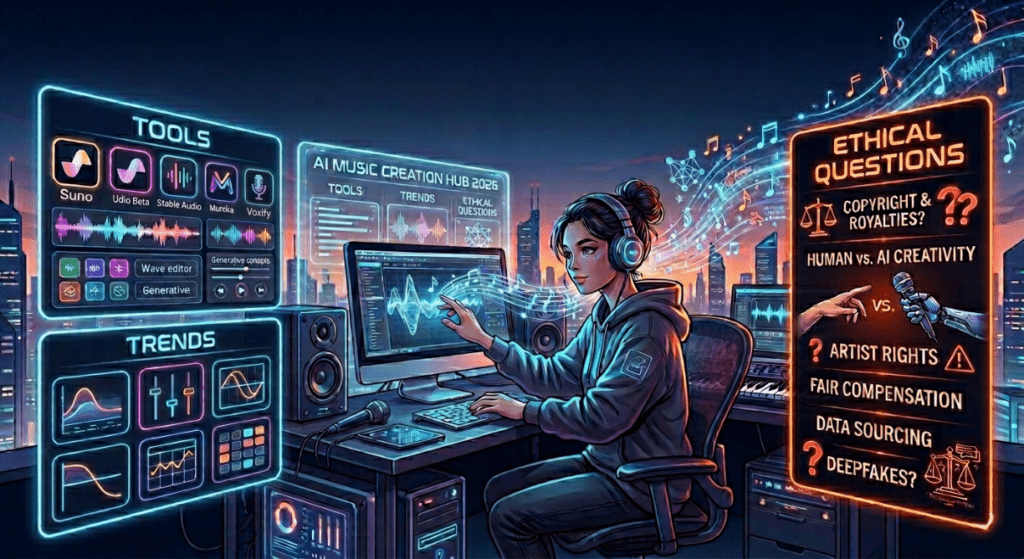
From bedroom producers to Hollywood studios, AI music generation has moved from novelty to necessity. But at what cost to human creativity, fair compensation and the soul of music itself?
In late 2025, an AI-composed track bypassed the hype and quietly hit the Top 40 on three major streaming platforms and today YouTube is filled with AI-generated music to suit different genres and moods. This marked the definitive shift of AI music from a tech curiosity to core creative infrastructure. AI tools can generate studio-quality audio from simple text, effectively dismantling traditional industry barriers with professional editing capabilities. As the technology moves from novelty to necessity, the conversation has shifted: it is no longer about whether AI can create, but about who owns the output, who profits, culture and creators thrive in this new era. This article explores the cutting-edge tools, emerging trends, and critical ethical dilemmas defining the music industry in 2026.
2026 AI Music Generators That Have Evolved Everything In Music Industry
A new generation of AI music platforms has matured dramatically since the early, clunky prototypes of 2023. Today’s AI tools don’t just generate music loops but acts as an instrument self-composing full arrangement, mix stems, match mood to lyrics and clone vocal styles with unnerving precision. Here are AI platforms you must try in 2026 to unleash musicking skills:
1. Suno
Suno efficiently provide tools to create AI music with trending methods like ‘Text-to-song’ with full lyrical and instrumental generation. Suno studio now supports DAW functionality such as multi-genre blending and 4K audio output with stem separation baked in and give artist ability to steer creativity with granular sound attributes.
Core feature: Best in class Chat → Full Song
2. Udio Beta
Favored by professional composers Udio studio democratizes music creation with high-quality, prompt-based AI generation. Pro version has DAW-native plugin that integrates directly with Ableton and Logic Pro X.
Core feature: Pro Studio
3. Stable Audio
Stable Audio has AI’s flagship music model, open-weight and commercially licensable. The platform provides tool and guide to use those tools to create ideas into reality. The platform dominates indie developer use cases and game audio pipelines.
Core Feature: Open Source
4. Mureka
Mureka has full pipeline of music creation with customization and commercial rights. Specializes in different cultural specific music genres like —Afrobeats, K-pop, Bollywood with astonishing regional authenticity. The MusiCoT technology for techniques like MIDI and stem separation.
Core Feature: Global Genres
5. Voxify
It is versatile AI platforms to generate audios in any language. The platform facilitates vocal cloning and transfer platform. Users can generate song covers in the voice of any registered artist who has opted in their licensing contract.
Core Feature: Voice Cloning
Common advantages of these tools are speed and scalability. A track that once required days of studio work can now be prototyped in minutes. For advertising agencies, game studios and podcast producers, this is transformative. For session musicians and soundtrack composers, it is existentially unsettling but open door for great opportunities.
AI Music Trends Reshaping Industry
1. The rise of the “AI-augmented” artist
Rather than replacing human musicians entirely, the most commercially successful deployment of AI music tools in 2026 is augmentation. Artists like Grimes, Holly Herndonanda new wave of experimental producers are using AI as a creative accelerant. Grimes has gone further than most, releasing an open AI model of her voice and inviting fans to co-create using it, with revenue sharing built in.
Major labels are now explicitly signing “AI-augmented” artists and musicians who use generative tools as part of their workflow but the ones retaining creative authenticity. This is, arguably, different from how every producer since the 1970s has used technology: the synthesizer didn’t kill acoustic music; Pro Tools didn’t kill the guitar and AI is innovation in technology require transformation.
Key trend to watch: Spotify’s “AI Mix” feature launched in Q1 2026 uses real-time generative audio to create personalized transitions between songs. Early reports suggest it is increasing listening session lengths by an average of 23 minutes. The music is created live by AI that is not attributed to any artist. The royalty implications are yet to be resolved.
2. Streaming economics under pressure
The per-stream royalty model, already under siege from the sheer volume of uploaded content, is cracking under the weight of AI-generated music. Major platforms reported in early 2026 that AI-generated tracks now account for approximately 14 million new uploads per month — a figure that has effectively diluted the royalty pool for human artists. Spotify, Apple Music and Tidal have all announced tiered systems that attempt to distinguish “verified human” recordings from AI output, though enforcement remains inconsistent.
3. The live music renaissance
Counterintuitively, the AI music surge has driven a boom in live performance attendance. Concert ticket sales in 2025 set a new all-time record and early 2026 data suggest the trend is accelerating. When music becomes infinitely reproducible and instantaneous, the irreplaceable nature of a live human performance becomes more, not less, valuable.
The AI Music Ethical Minefield
No serious discussion of AI music in 2026 can avoid the ethical arguments and they are profound. Three interlocking debates are now playing out simultaneously across courtrooms, music studios and legislative chambers worldwide.
1. Copyright and training data
The most consequential legal battle of the decade concerns what data AI music models were trained on. Class action lawsuits filed by the Recording Industry Association of America against four major AI music platforms are working through U.S. federal courts. The central allegation: that these models ingested copyrighted recordings without consent or compensation to train their systems, effectively laundering the creative labor of generations of musicians into a commercial product.
The AI companies’ defense — that training on data constitutes fair use — may not survive the legal scrutiny it is now receiving. The European Union’s AI Act, which took full effect in late 2025, imposes stricter transparency requirements on training data and several platforms have already withdrawn from EU markets rather than comply with disclosure mandates.
2. Deepfake voices and artist identity
Perhaps the most viscerally disturbing development has been the explosion of unauthorized AI voice cloning. Despite platform policies against it, songs impersonating the voices of Drake, Taylor Swift and dozens of other artists circulate freely on social media. In some cases, these clones have been weaponized — used to spread fake statements, endorse products without consent, or generate revenue for bad actors.
Several U.S. states have now passed “Vocal Identity Protection” laws modeled on Tennessee’s pioneering ELVIS Act of 2024. A federal equivalent — the NO FAKES Act — is currently stalled in the Senate, opposed by tech industry lobbying groups who argue it could criminalize legitimate artistic parody and transformative use.
3. The ghost producer problem
There is a quieter, more systemic issue beneath the headline battles: the quiet erasure of the “invisible workforce” of music. Ghostwriters, session musicians, jingle composers and production library artists are people who never became famous but earned modest, stable livings from their craft are finding their work categories simply evaporated. AI can now produce high-quality production music for sync licensing at essentially zero marginal cost. The human beings who previously filled that niche have no recourse, no union protection and often no legal standing to claim any of the value their training data contributed.
Policy spotlight: The proposed AI Music Transparency and Compensation Act, circulating in draft form in Washington D.C., would require AI music platforms to register with a centralized clearinghouse, disclose training data sources and contribute to a compensation fund for affected artists. Supporters say it’s a starting point to a conclusion for critics on both sides.
What to Expect Next
Predicting the future of a technology moving at this pace is hazardous. But several trajectories seem clear. AI music tools will not become less capable, but AI tools will become more dramatically and refine. The gap between a skilled human composer and AI systems will narrow in near future as the produced music differences may either be effectively imperceptible to the casual listener or AI music will become a new genre. New genres and forms of musical creativity native to the human-AI collaboration space will almost certainly emerge that we cannot ignore.
The music industry’s response will likely mirror its response to every prior disruption: initial denial, legal resistance, grudging negotiation and eventual adaptation. Labels will find new revenue models and artists who understand AI tools will have a competitive advantage over those who don’t. The transition with AI popularity is not painless. The musicians, producers, and music educators who occupy the middle of the market and not famous enough fear technology’s quality of irreplaceability.
A number of songs generated by AI cracks next year’s top 40 next year or a 19-year-old in her bedroom in Lagos, using AI tools as freely and naturally as her predecessors used a guitar or a Roland 808. Both outcomes are possible and has their own beauty. How we evolve with the transformation and new possibilities depends on our own choices, culture and regulations. Music, at its core, has always been about human existence. It will be interesting to experience us formulating to flourish with change when making music have been thoroughly democratized, commodified, and automated all at once.
Frequently asked questions
What are the main tools for AI music generation in 2026?
Key tools include Suno, Udio Beta, Stable Audio, Mureka, and Voxify, each offering unique features for music creation.
How is AI affecting live music performances?
The AI music surge has driven a boom in live performance attendance, making human performances more valuable.
What ethical issues are associated with AI music?
Ethical debates include copyright and training data, unauthorized AI voice cloning, and the erasure of the 'invisible workforce' in music.