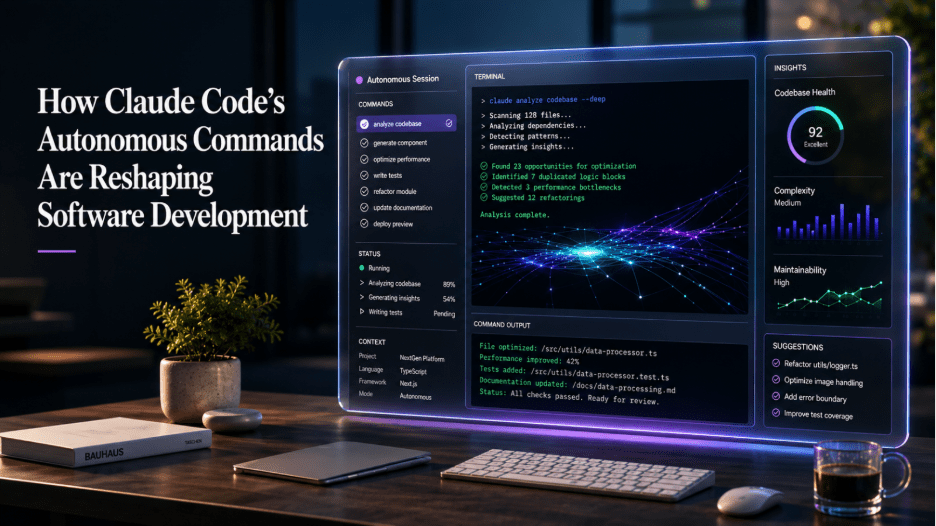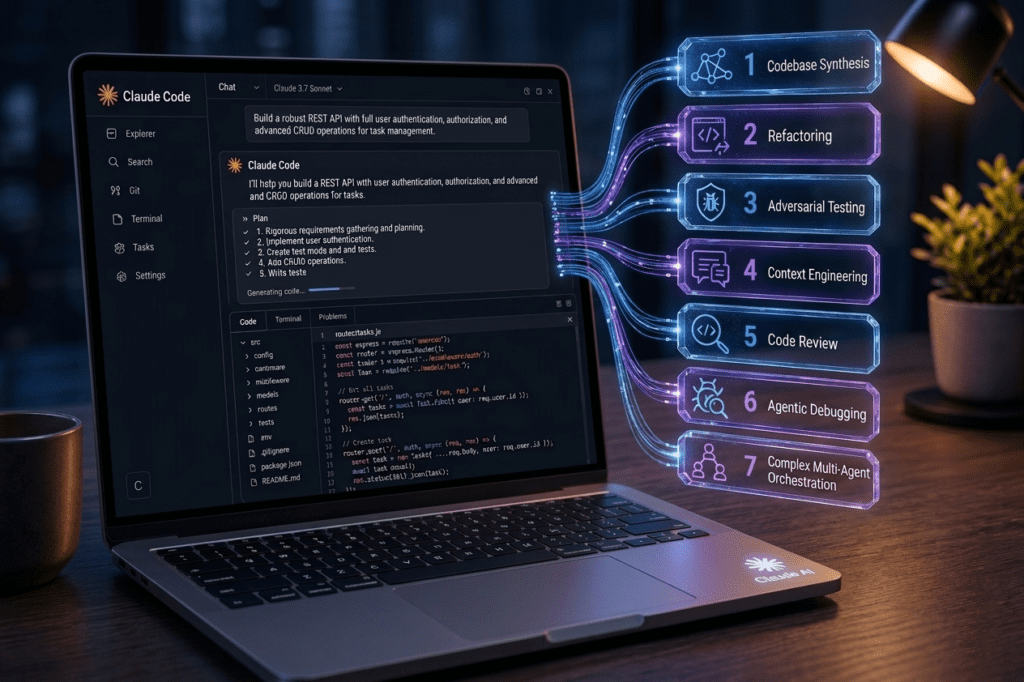
Claude code is an agentic coding assistant that reads your codebase, edits files, runs commands and can be integrated with your development tools. It excels at handling tedious tasks like writing tests, fixing lint issues, documenting developmemts or resolving merge conflicts. Top AI/ML teams use it not just interactively, but in creative automated workflows. This article uncovers seven techniques to use constructing with Claude code, each with examples. We cover sequential scripts, orchestrator agents, parallel processing, multi-agent teams, fully headless runs, scheduled routines, and chat/CI integration.
1. Repo-Wide Context Synthesis at Session Start
Most developers use Claude code against individual files, however that slows down the abstraction. Power users load the entire repository into context and ask architectural questions during project onboarding. Claude code performs recursive directory traversal, resolves dependency graphs from package.json or go.mod and infers inter-module relationships from imported chains including the file content.
At 1 million tokens of usable context, Claude code can hold thousands of source files, entire monorepos and full documentation sets simultaneously. Its agentic search uses glob and grep to navigate the repository just-in-time rather than preloading everything and bypassing the stale-indexing problem that plagues RAG-based tools indexing method.
A principal engineer at a payment’s startup uses this for every new product inventory and runs a successful structured session producing service boundary diagram, a ranked list of critical files, primary data models with foreign key relationships and local dev commands extracted directly from their repository. Time to complete set of tasks reduced from five days to one.
2. Phased Refactoring Contracts Across Hundreds of Files
Unbounded refactoring prompts fail for a specific technical reason: without an explicit scope map, Claude code will miss files that reference the target pattern through dynamic imports, transitive re-exports or runtime injection while silently leaving the codebase in a half-migrated state. The engineers working with Claude code solved this with a three-phase steps: audit, dry-run, expand.
Phase one is a pure static analysis that enumerate every call site, categorize usage type (direct instantiation, DI container, test double, type-only import), flag non-standard patterns. These reveals engineering the ground truth to proceed. Phase two is a single-file dry run that produces a unified diff for human review before any patch is applied. Phase three expands to the full scope from the audit, committing each file separately with structured messages.
Stripe’s Scala-to-Java migration is the canonical example at scale where ten engineer working on 10,000 ‘s code lines with four days of estimated manual effort. Upon using Claude code team’s staff engineer migrated 140 Express.js route handlers to Fastify in one afternoon with zero production regressions because he never asked Claude code to change code it hadn’t fully audited first.
3. Adversarial Test Generation via Threat Modeling
Standard AI test generation produces coverage theater: high branch percentages, zero bugs caught. The structural failure of a model asked to optimizes written code where Claude highlights existing happy paths, not unknown failure surfaces because you never asked the system exact result you are trying to preform with the query, The fix is a prompt frame inversion: ask Claude code to attack the code first, then write tests for every vector it surfaces.
Claude code produces a threat model with boundary conditions (MAX_SAFE_INTEGER off-by-one, empty collections where length > 0 is assumed), invalid type coercions, concurrent mutation race conditions and inter-test state corruption from mutable module-level singletons. Tests are then written per threat vector, each with a failure message describing business impact.
A QA lead ran adversarial generation against a payment processing module. Coverage went from 34% to 91% in one session. Two tests failed immediately exposing a missing null check on an optional billing field and a race condition in retry logic that would have produced duplicate charges under concurrent load. That’s two failure incidents prevented.
4. Context engineering claude.md as a Living Architectural Contract
Claude code assembles its context window from multiple ordered sources at session start. Claude.md files are loaded into context up front from the working directory, then parent directories, then a user-level global file at ~/.claude/claude.md. Crucially, claude.md instructions are delivered as user context, not system prompt making working into probabilistic compliance task rather than deterministic enforcement. This means it works best for conventions and architectural norms not similar to hard safety gates.
What engineers actually encode: architectural constraints (“all DB access through the Repository layer — direct ORM calls in controllers are a CI failure”), error handling contracts (“errors are values; use AppError, never throw from services”), TypeScript strictness requirements, commit message schemas. Repeated review comments stop being repeated because Claude code already knows.
5. Diff-Piped Pre-PR Review in Under Two Minutes
The code review bottleneck is rarely the hard stuff — architectural tradeoffs, product decisions, subtle logic. It’s the mechanical scan: missing error handling, unchecked promise rejections, unauthenticated endpoints, PR descriptions that say “various improvements.” Skilled engineers burning review budget on things that should be caught programmatically.
Piping a raw git diff to Claude code returns a structured pre-review: logic errors with file-and-line references, unhandled rejection paths, missing timeout guards on external I/O, new branches with no test coverage delta, security flags near query construction, and a generated PR description. Anthropic added a native multi-agent code review tool in March 2026 — one subagent checks logic, another checks style, another checks security — formalizing what engineers had been doing manually with diff piping.
Enterprise pilot programs report 30% faster pull request turnaround times. Teams running this in CI tell the same story: human reviewers arrive at diffs with the mechanical layer already cleared, going straight to the decisions that actually need judgment.
6. Autonomous Fault Isolation via the TAOR Loop
This is what makes Claude code categorically different: it invokes shell commands as actual tool calls. Real subprocess execution like exit codes, stdout, stderr returned as structured context feeding the next reasoning step. The TAOR loop that is,” Think-Act-Observe-Repeat” is a simple while-loop at its core acting as an agentic debugger. Only 1.6% of Claude code’s codebase is AI decision logic. The other 98.4% is deterministic infrastructure having permission gates, context compaction, tool routing and recovery logic. The agent loop is the incomplete without the intelligence surrounds it.
How it works: Each bash invocation returns {exitCode, stdout, stderr} as context for the next reasoning step. The loop reads relevant source → runs the failing test → parses the stack trace → forms a hypothesis → applies a patch → re-runs → observes → iterates. Scope is controlled via –allowedTools permiting test runners while blocking deployment scripts and network calls. Set this explicitly in any environment adjacent to production data.
In practice: a race condition in a Node.js session had stored in the bug tracker for six weeks — failing one in five CI runs having no consistent stack trace. The engineer scoped Claude code’s tool access to the test runner and file editor, described the symptom and stepped away. Twenty-five minutes later, Claude presented well passing suite, one-line fix.
7. Agent Teams with Git Worktrees for Parallel Throughput
The most underused Claude code capability in 2026 is multi-agent orchestration. A lead agent coordinates work, assigns subtasks to specialized subagents and merges results. Subagents are defined in .claude/agents/ as markdown files specifying model, allowed tools and its role instructions. A security-reviewer subagent runs Opus 4.6 with Read/Grep/Glob/Bash tools. A style-checker runs Sonnet 4.6 with Read/Edit. Each subagent runs in its own isolated context window with neither contaminating the other’s reasonings.
The practical pattern: git worktrees paired with parallel Claude code sessions. Each worktree is a separate working directory on the same repository — different branch, isolated filesystem state, independent agent context. One agent writes the API layer. Another writes the test suite. A third handles documentation. A lead agent integrates and resolves conflicts at the end. Teams using this approach report 2× throughput on large codebases. As we moving beyond vibe coding to Claude code ability of agentic orchestration.
The New Architectural Truth
Claude code is a software engineer harness, a platform that wraps around with filesystem access, shell execution, layered memory and composable permissions, all inside a bounded autonomous loop governed by composable permissions. The developer’s job shifts from writing code to defining goals, scoping tool access, reviewing outcomes and updating the configuration that makes the next session smarter than the last. That’s the compounding effect developers should focus on as with every well-run session incrementally improves the configuration and that is powerful. The advantage isn’t just doing things faster but operating at a higher level, where ideas move quickly from concept to reality with fewer constraints.
As 2026 unfolds, the real differentiator will be how deeply AI tools are integrated into your workflow. The people getting ahead are those taking advantage of the technology by understanding and restructuring to work with AI and software engineering new proven techniques in changing time. This gives developers open opportunity to make their work more fluid, more automated and increasing clarity of thought over lacklustre tedious manual efforts.
Frequently asked questions
What is Claude code?
Claude code is an agentic coding assistant that reads your codebase, edits files, and runs commands, excelling at automating tedious tasks.
How does Claude code improve code review processes?
Claude code provides structured pre-reviews by scanning for logic errors and missing error handling, thus speeding up the review process.
What is the TAOR loop in Claude code?
The TAOR loop stands for Think-Act-Observe-Repeat, enabling Claude code to invoke shell commands and isolate faults autonomously.