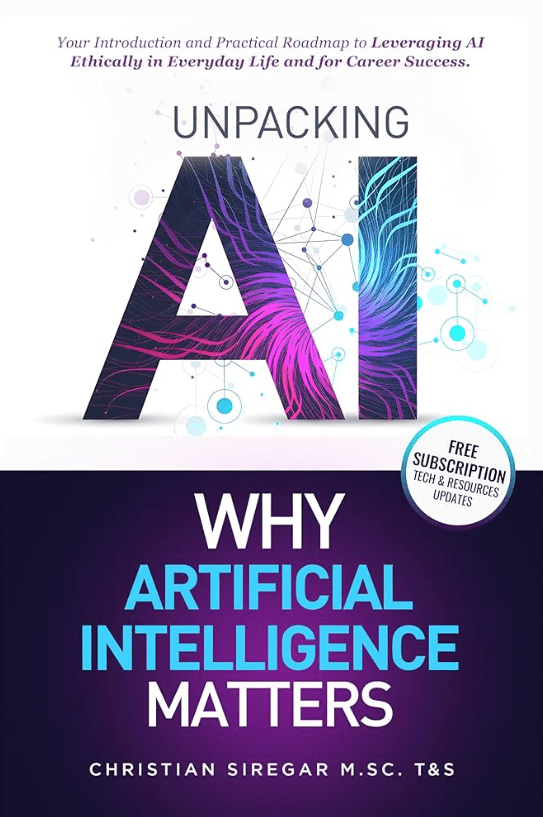
Unpacking AI – Why Artificial Intelligence Matters
– By Christian Siregar
AI continues to expand across sectors; reshaping industries, altering job markets, and influencing daily life; there is a growing need for accessible, trustworthy guidance on how to navigate this transformation. AI: Your Practical Guide to the Future by Christian Siregar responds to this need with clarity, structure, and practicality. Authored by a professional in AI governance with a master’s degree in technology & Society, the book sets out to demystify artificial intelligence and help readers apply it in both personal and professional contexts. At 323 pages, the Kindle edition is a detailed yet approachable roadmap for anyone who wants to understand what AI is, how it can be used, and how to do so ethically.
At Tech AI Magazine, we often highlight resources that bridge the gap between theory and application and this guide is especially valuable for those exploring real-world use cases, from writing effective AI prompts to understanding foundational concepts in AI engineering.
Unlike many publications that either sensationalize AI’s potential or warn of its existential dangers, Siregar’s approach is intentionally grounded. The book offers a clear, incremental structure: it introduces AI fundamentals, explores real-world applications, provides strategies for professional advancement, and concludes with a thoughtful examination of AI’s ethical and societal implications. Each section is organized to maximize comprehension without sacrificing depth, offering readers the tools to understand, utilize, and evaluate AI in practical terms.
Why It Matters
The importance of this book lies in its timing and relevance. As AI technologies like ChatGPT, DALL·E, autonomous agents, and algorithmic decision-making become integrated into everything from healthcare to marketing, individuals face increasing pressure to adapt. However, public understanding of AI often suffers from extremes either techno-optimistic hype promising unlimited productivity or dystopian narratives predicting widespread job loss and ethical collapse.
Siregar directly addresses this polarity by charting a middle course. His book neither dismisses the risks of AI nor inflates its capabilities. Instead, it emphasizes functional literacy, helping readers recognize what AI can do today, where it is headed, and how to use it wisely. This approach is critical for three reasons.
First, it empowers non-technical individuals to participate in conversations and decisions that will shape the future of work, policy, and education. AI should not be the domain of technologists alone; it is a social and economic phenomenon that affects everyone.
Second, the book aligns with a broader movement toward responsible AI adoption. Governments, corporations, and institutions are increasingly advocating for ethical AI use. Understanding what responsible AI looks like both in theory and in practice is no longer optional. Siregar integrates this ethical lens throughout the book, offering a framework that aligns personal use with broader societal responsibility.
Third, the guide addresses the growing digital skills gap. As automation and machine learning take on more functions across industries, those without a foundational understanding of AI risk being left behind. This book helps close that gap by offering readers not just information, but actionable strategies to integrate AI into their workflows and life planning.
Helpfulness to the Audience
One of the book’s standout strengths is its audience-focused structure. It is explicitly designed for accessibility, making it especially useful for readers with limited technical backgrounds. The opening chapters provide clear, jargon-free explanations of AI concepts such as machine learning, neural networks, natural language processing, and automation. These sections are not oversimplified but intentionally crafted to build confidence in readers unfamiliar with the topic.
Siregar then moves from theory to practice. In the midsection of the book, readers are introduced to a wide range of AI applications. These are not abstract or hypothetical examples; they involve everyday use cases that help users see how AI can enhance creativity, productivity, communication, and decision-making. Examples include AI-powered tools for writing, image generation, task automation, data analysis, and digital organization. The author frames each use case around the idea of immediate relevance of what a reader can do now to benefit from AI.
Another critical area of value is the book’s sustained focus on ethics and governance. In the later chapters, Siregar shifts attention to the societal implications of AI use. Topics include data privacy, algorithmic bias, transparency, surveillance, and the digital divide. The discussions are informed by the author’s professional expertise in AI governance, offering a level of insight often missing from consumer-facing AI books. Importantly, ethical considerations are not confined to theory; they are tied to the practical decisions that readers might face as users or implementers of AI systems.
Throughout the text, Siregar brings a unique perspective informed by both professional practice and personal heritage. His references to family connections with AI pioneers, as well as his own experiences in AI governance, lend authenticity and depth to the narrative. Rather than presenting AI as a distant technological domain, he frames it as something readers can and should engage directly in.
Conclusion
AI: Your Practical Guide to the Future delivers a comprehensive, realistic, and actionable framework for engaging with artificial intelligence. Christian Siregar succeeds in creating a guide that is both technically sound and deeply human-centered. His writing avoids the extremes of hype and fear, offering instead a balanced view that encourages critical thinking, ethical reflection, and immediate application.
In a world increasingly defined by technological acceleration, this book stands out for its clarity, practicality, and ethical focus. It is not just about acquiring skills; it is about becoming a responsible participant in an AI-driven society. For those looking to move beyond superficial understanding and take meaningful steps toward AI fluency, this book provides an essential starting point.
Frequently asked questions
What is the main focus of 'AI: Your Practical Guide to the Future'?
'AI: Your Practical Guide to the Future' focuses on demystifying artificial intelligence and helping readers apply it in personal and professional contexts.
How does the book address ethical considerations in AI?
Siregar integrates an ethical lens throughout the book, offering a framework that aligns personal use with broader societal responsibility.