

If you're shipping software with AI, you need signal, not noise. That means knowing when a new model drops, which tools actually work, what broke in the latest release and where the research is heading before it hits the headlines.
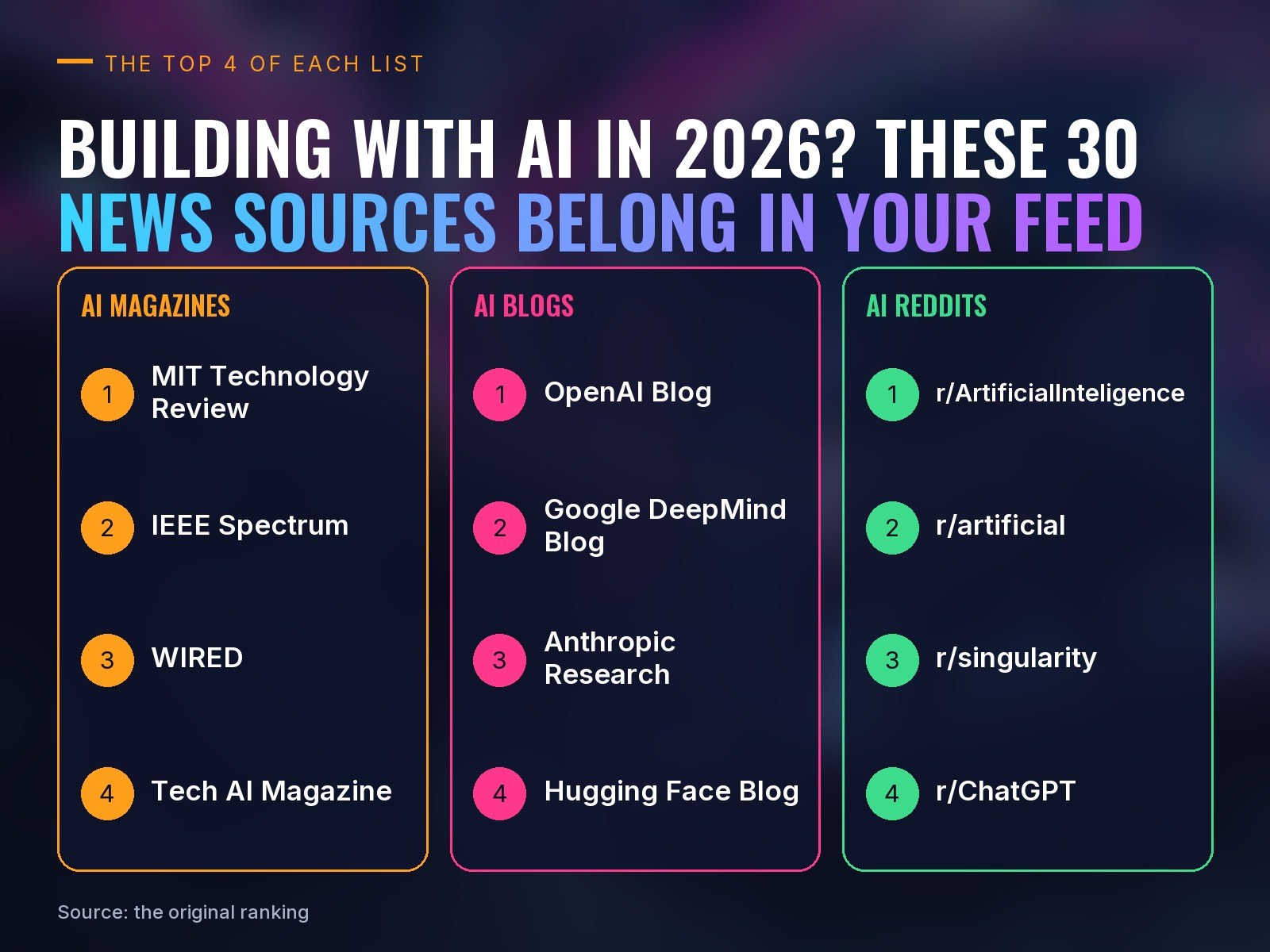
This list covers thirty sources split across three types: magazines that frame the big picture, blogs where companies and individuals publish what they've built, and Reddit communities where developers share what they're testing. Some lean academic, others focus on product updates, a few mix tutorials with benchmarks. What they have in common: they're where builders go to stay ahead.
AI Magazines
1. MIT Technology Review
MIT Technology Review publishes feature-length pieces on AI research, breakthroughs and the social implications of deployment. It's useful when you want context around a major announcement or need to explain why something matters beyond the technical spec sheet.
2. IEEE Spectrum
IEEE Spectrum focuses on the engineering side: robotics integration, computing architectures, hardware constraints. If you're working on edge deployment or trying to understand how a model scales in production, this is where the technical depth lives.
3. WIRED
WIRED covers AI through the lens of culture and business, tracking how models move from labs to products. It's less about implementation details, more about market dynamics and what companies are betting on.
4. Tech AI Magazine
Tech AI Magazine publishes news on model releases, open-source tools, developer frameworks and technical explainers. We focus on what ships and what you can use today, not just what's possible in theory.
5. Analytics Insight
Analytics Insight reports on machine learning research, data science workflows and AI adoption across industries. It's a good scan for understanding how different sectors are applying models and where investment is flowing.
6. The Gradient
The Gradient runs long-form analysis of AI research, often diving into the mechanics of specific papers or trends in model architecture. If you want to understand the theory behind a technique before you implement it, start here.
7. AI Business Magazine
AI Business Magazine tracks enterprise adoption, investment rounds, governance frameworks and strategy. It's aimed at decision-makers, but useful if you're trying to anticipate which tools will get budget and support.
8. Communications of the ACM
Communications of the ACM publishes peer-reviewed computing research, including AI developments and theoretical advances. It's academic in tone but surfaces ideas that eventually influence production systems.
9. Technology Magazine
Technology Magazine covers digital transformation and enterprise tech, including how organizations are integrating AI into existing infrastructure. It's helpful for understanding deployment constraints and organizational challenges.
10. Analytics India Magazine (AIM)
Analytics India Magazine is based in India and reports on AI research, data science and regional developments in machine learning. It's a window into a growing developer community and different regulatory contexts.
AI Blogs
1. OpenAI Blog
OpenAI Blog announces model releases, API updates, safety research and product features. If you're building on GPT-4 or o1, this is where you'll learn what's changed and what's coming.
2. Google DeepMind Blog
Google DeepMind Blog publishes frontier research, scientific breakthroughs and model announcements. It's where Gemini updates land, along with papers on reinforcement learning, protein folding and other long-term bets.
3. Anthropic Research
Anthropic Research covers Claude model updates, interpretability work and safety research. If you're using Claude or interested in mechanistic interpretability, this is the primary source for what the team is learning.
4. Hugging Face Blog
Hugging Face Blog is essential for anyone working with open-source models. It announces new releases, shares tutorials on fine-tuning and deployment, and explains how to use the latest transformers and diffusion models.
5. Simon Willison's Weblog
Simon Willison's Weblog documents hands-on experiments with AI tools, model launches and LLM capabilities. Willison tests things quickly, writes up what works and what doesn't, and links to the tools he's using.
6. MarkTechPost
MarkTechPost summarizes AI research papers, model releases and technical developments. It's a fast way to scan what's new in academia and industry without reading every preprint.
7. Towards Data Science
Towards Data Science runs tutorials, case studies and applied guides on machine learning and data science. The quality varies, but it's a good place to find walkthroughs of specific techniques or libraries.
8. KDnuggets
KDnuggets aggregates machine learning tutorials, analytics tools and industry news. It's been around for years and serves as a reliable index for what's trending in the data science community.
9. Machine Learning Mastery
Machine Learning Mastery publishes step-by-step implementation guides for common ML tasks. If you need a practical introduction to a technique or algorithm, this is a solid starting point.
10. Sebastian Raschka's Ahead of AI
Sebastian Raschka's Ahead of AI digs into LLM architectures, training methods and research trends. Raschka writes clearly about complex topics, making it easier to understand what's happening under the hood.
AI Reddits
1. r/ArtificialInteligence
r/ArtificialInteligence is a general discussion hub for AI news, product launches and industry commentary. It's broad in scope, so you'll see everything from research links to opinion threads.
2. r/artificial
r/artificial covers AI news, applications and societal impact. The community skews toward people interested in the big picture, not just the technical details.
3. r/singularity
r/singularity focuses on frontier AI, AGI speculation and major technology shifts. It's where people track the most ambitious predictions and debate timelines, often with strong opinions.
4. r/ChatGPT
r/ChatGPT discusses ChatGPT updates, use cases and experiments. It's a mix of casual users and developers sharing prompts, workflows and frustrations.
5. r/OpenAI
r/OpenAI tracks OpenAI products, API changes and model behavior. If you're building on the API, it's worth scanning for bug reports and feature requests from other developers.
6. r/MachineLearning
r/MachineLearning is where researchers and practitioners discuss papers, benchmarks and technical questions. The community expects rigor, and the signal-to-noise ratio is high.
7. r/LocalLLaMA
r/LocalLLaMA is the hub for open-source model deployment, quantization techniques and hardware setups. If you're running models locally or comparing open weights, this is where the detailed comparisons happen.
8. r/ClaudeAI
r/ClaudeAI focuses on Claude features, workflows and performance. Developers share prompts, test edge cases and report issues, making it a useful supplement to the official docs.
9. r/StableDiffusion
r/StableDiffusion is dedicated to image generation: model versions, training techniques, LoRAs and tooling. If you're working with diffusion models, this is where the community shares what's possible.
10. r/AI_Agents
r/AI_Agents covers agent frameworks, automation workflows and multi-step reasoning systems. It's newer than some of the other communities, but it's where developers discuss LangChain, AutoGPT and related tools.
No single source covers everything, which is why this list spans magazines, blogs and forums. The magazines provide framing and analysis. The blogs announce what's shipping. Reddit surfaces what developers are actually testing and where things break.
If you're short on time, prioritize the company blogs for the models you use, r/MachineLearning for research and r/LocalLLaMA for open-source deployment. The rest depends on what you're building and how deep you need to go.
Sources
Frequently asked questions
What types of sources are included in the list?
The list includes magazines that frame the big picture, blogs where companies and individuals publish their work, and Reddit communities for developers.
Why are these sources important for AI builders?
These sources help builders stay ahead by providing timely updates on model releases, tools, and research trends.