
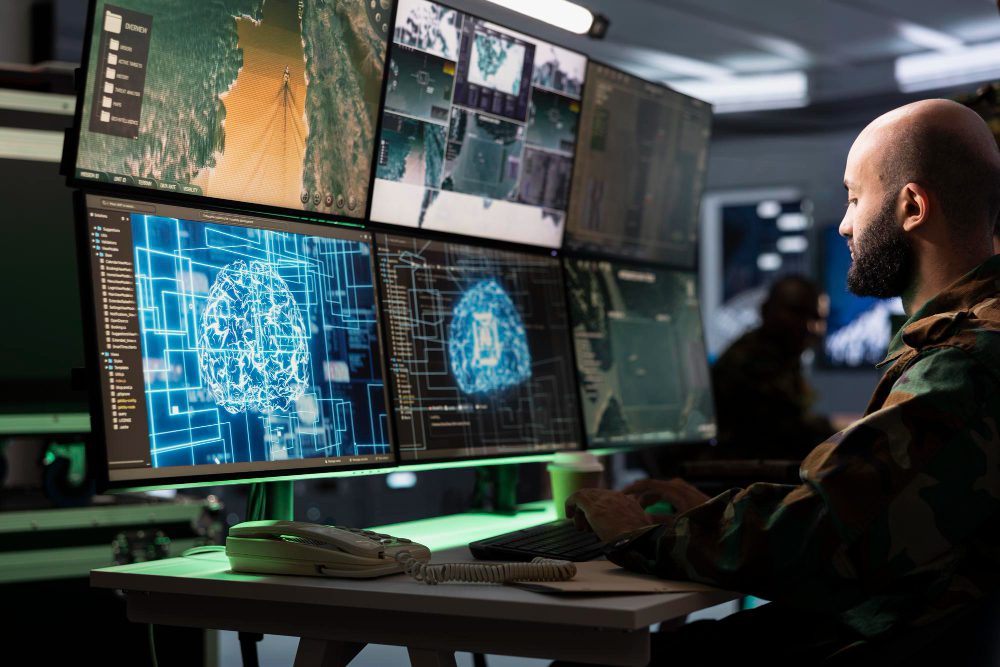
Military AI in 2026: Balancing Strategic Gains with Security and Accountability Risks
The rapid integration of artificial intelligence in military applications by 2026 represents a decisive evolution in warfare capabilities, driven by multi-agent autonomous systems, advanced cyber weapons powered by AI, and hybrid intelligence frameworks. However, this shift also surfaces critical governance, ethical, and security challenges that demand immediate, structured attention. This article analyzes the state of military AI technology today, the technological and geopolitical forces accelerating its deployment, and the risks posed by autonomous combat agents in defense systems. We conclude with actionable recommendations for securing this complex landscape while harnessing AI’s strategic advantages.
1. The Changing Battlefield: AI’s Growing Role in Warfare
Artificial intelligence is no longer a peripheral asset in military operations; it is at the forefront of combat and defense strategy. Key developments include:
- Multi-agent AI coordination frameworks deploying autonomous AI soldiers that operate cohesively, coordinating via advanced communication to achieve mission objectives.
- AI-powered cyber weapons capable of executing high-speed, autonomous offensive and defensive maneuvers in cyberspace, far surpassing human reaction times.
- Government-led investment, especially by the U.S. Department of Defense (DoD), championing projects that expedite AI weaponization for autonomous strike capabilities — from conflict detection to battlefield planning.
- Transitioning AI from research prototypes into field-tested operational tools tasked with real-time threat detection and robotic combat support.
This shift marks a decisive departure from manually operated weapons to algorithmic soldiers with autonomous decision-making, introducing a new warfare ecology necessitating robust AI governance and control mechanisms.
2. Why 2026? The Convergence of Technical and Ecosystem Drivers
Several converging factors explain the present acceleration in military AI adoption:
- Advances in multi-modal AI models like GLM-5 and Qwen3.5, enabling agents to integrate image data, text commands, and executable code for complex battlefield situational awareness and autonomous planning.
- Exponentially increased compute power for real-time military data processing empowering rapid, dynamic decision cycles previously impossible for human teams.
- Geopolitical tensions and strategic defense imperatives driving government funding allocations (e.g., US DoD’s $13.4B autonomously targeted weapon systems budget).
- Breakthroughs in distributed multi-agent AI soldier swarm tactics emphasizing teamwork, adaptability, and resilience.
- Emergent cybersecurity threats fueling development of AI-driven offensive and defensive platforms operating efficiently in contested digital domains.
These forces create an environment where autonomous military AI systems become rapidly operationalized, though not without critical trade-offs.
3. Research Advances Defining Military AI Frontiers
Cutting-edge research forms the foundation for today’s military AI capabilities:
- Multi-agent collaboration frameworks like OpenClaw promote systematic joint behavior among AI soldiers, including coordination protocols and conflict resolution.
- New AI architectures such as GLM-5 and Qwen3.5 enable multi-modal reasoning for battlefield decision-making by integrating vision, language, and code inputs.
- Hybrid intelligence initiatives aim to balance autonomous AI freedom with human ethical oversight via real-time collaboration protocols.
- Emerging benchmarks evaluate military AI agents on strategic reasoning, tactical adaptability, communications security, and operational resilience.
- Research on AI governance frameworks highlights transparency, accountability, and compliance with international laws governing autonomous weapon systems.
These breakthroughs promise next-generation combat capabilities while raising profound ethical and practical governance questions.
4. Engineering and Deployment: Signals of Scale and Maturity
Military AI adoption is scaling beyond experimental labs into active deployment:
- Governments worldwide, led by the U.S., invest heavily in engineering resources and talent pipelines dedicated to multi-agent autonomous defense systems.
- Defense contractors and AI labs transition prototypes into operational tools supporting AI-enabled drones, robotic infantry, cyber offense platforms, and intelligence fusion centers.
- Field exercises incorporate AI-enabled tactical decision support and drone swarms, reducing human operator latency.
- Emphasis grows on secure AI agent lifecycle management platforms to ensure controlled development, auditability, and deployment within rigid security frameworks.
This convergence of resources and expertise positions autonomous military AI systems as critical for modern defense, but introduces novel control challenges.
5. Developer and Community Perspectives: Balancing Innovation and Ethics
Sentiment within military AI circles reveals enthusiasm tempered by caution:
- Rising adoption of open-source frameworks like OpenClaw among engineers focused on robust multi-agent coordination and secure AI collaboration.
- Ethical debates center on human accountability, system transparency, and operational oversight for autonomous lethal AI.
- Demand increases for tools enabling real-time behavior monitoring and fail-safe controls to proactively manage AI soldier actions.
- Security professionals weigh proprietary vs. open-source platforms, favoring controlled environments to mitigate adversarial risk.
- Community focus remains on model robustness, adversarial resilience, and adherence to legal and ethical standards to prevent unintended harm.
These attitudes reflect a stakeholder community seeking to reconcile AI’s warfare potential with norms and obligations.
6. Frameworks Shaping the Autonomous Warfare Space
Key tools and platforms define today’s military AI ecosystem:
- GLM-5 and variants provide multi-modal reasoning architectures enabling autonomous battlefield task execution.
- OpenClaw and AgentCenter orchestrate multi-agent collaboration for distributed AI soldier behaviors and mission planning.
- AgentGuardian enforces AI agent behavior constraints to prevent misuse of lethal autonomous functions.
- Vision Agents by Stream integrate real-time environmental perception with strategic AI decision-making capabilities.
- Platforms like Permit.io MCP Gateway and Auth0 provide secure authentication, access control, and policy enforcement critical for frontline AI deployments.
Together, these components establish a layered architecture balancing operational effectiveness with security and compliance.
7. Risks, Exploits, and Defensive Technologies Governing Autonomous Agents
The autonomous nature of AI soldiers and cyber weapons introduces novel risk vectors:
- Autonomous lethal decisions without consistent human oversight raise critical accountability and ethical concerns.
- AI in cyber warfare amplifies threats from automated offensive vectors targeting critical infrastructure at machine speed.
- Rogue AI agents risk injecting malicious logic, hijacking systems, or escalating conflict via adversarial manipulation.
- Detecting stealthy adversarial attacks on AI decision models remains a formidable technical challenge.
- Defensive technologies evolve rapidly, including secure AI governance, continuous behavior monitoring, and real-time intervention protocols to contain rogue or malfunctioning agents.
Robust defense against these threats is as important as advancing AI capabilities.
8. Standards, Compliance, and Governance: Emerging Norms
Institutional frameworks develop to govern military AI deployment:
- International efforts embed transparency, legality, and ethical principles within autonomous military AI systems.
- Benchmarking and standardized evaluations ensure consistent performance and compliance.
- Ongoing legal debates define acceptable levels of human oversight, especially concerning lethal autonomous weapons.
- Calls for fairness, sustainability, and accountability shape engineering and deployment policies.
- Governance tools integrating real-time monitoring, audit trails, and automated compliance become critical infrastructure.
These efforts aim to prevent misuse and align military AI with global security norms.
9. The Road Ahead: Emerging Trends and Strategic Implications
Future trajectories for autonomous military AI include:
- Development of self-improving, metacognitive AI soldiers capable of strategic reasoning and dynamic battlefield adaptation.
- Hybrid intelligence models pairing autonomous AI with continuous human ethical judgment.
- Multi-agent swarms operating competitively and cooperatively in complex, rule-based simulated environments.
- Adaptive AI governance frameworks coupling automated behavior auditing with manual intervention.
- Integration of cyber and physical warfare AI domains for multi-dimensional defense.
These trends promise unparalleled capability but heighten complexity in control and safety.
10. Trade-offs and Failure Modes: Navigating Complex Challenges
Autonomous military AI development entails significant risks and trade-offs:
- While enhancing tactical speed and operational reach, autonomy risks opaque decision-making and unintended collateral damage.
- Multi-agent coordination improves flexibility but complicates security enforcement and hierarchical control.
- Geopolitical competition accelerates deployment potentially outpacing ethical safeguards and governance frameworks, raising escalation risks.
Stakeholders must acknowledge these failure modes to engineer resilient, transparent, and ethical systems.
11. Why These Findings Matter: Stakeholder Implications
The evolving military AI landscape impacts diverse groups:
- Developers must implement secure engineering standards, adversarial robustness, and fail-safe human overrides.
- Researchers need to explore emergent architectures, multi-agent benchmarks, and hybrid intelligence models.
- Security experts confront new vectors in cyber and physical domains requiring advanced defense technologies.
- Product managers and platform owners must balance innovation with strict ethical risk mitigation and governance for trust and legitimacy.
Decisive leadership is essential to safely integrate artificial intelligence into autonomous warfare.
Conclusion
Military AI in 2026 marks a transformative juncture with autonomous algorithmic soldiers, multi-agent systems, and AI-enabled cyber capabilities fundamentally reshaping combat operations. Strategic advantages include faster decisions, coordinated tactics, and expanded cyber offense and defense. Yet these gains bring severe challenges in governance, accountability, and security that must not be underestimated.
Robust AI governance frameworks, secure engineering advances, behavior monitoring, and ethical oversight must keep pace with deployment. Transparency, human control, and international compliance require urgent standardization and enforcement. Only through deliberate balance of innovation and risk management can autonomous military AI serve as a stabilizing force in future conflict.
Military stakeholders must urgently institutionalize trustworthy, ethical, and resilient artificial intelligence systems for autonomous warfare. This imperative will define security landscapes for decades ahead.
Frequently asked questions
What are the key developments in military AI by 2026?
Key developments include multi-agent AI coordination frameworks, AI-powered cyber weapons, and government-led investment in autonomous strike capabilities.
What challenges does military AI face?
Military AI faces critical governance, ethical, and security challenges, including accountability for autonomous lethal decisions and the need for robust control mechanisms.