
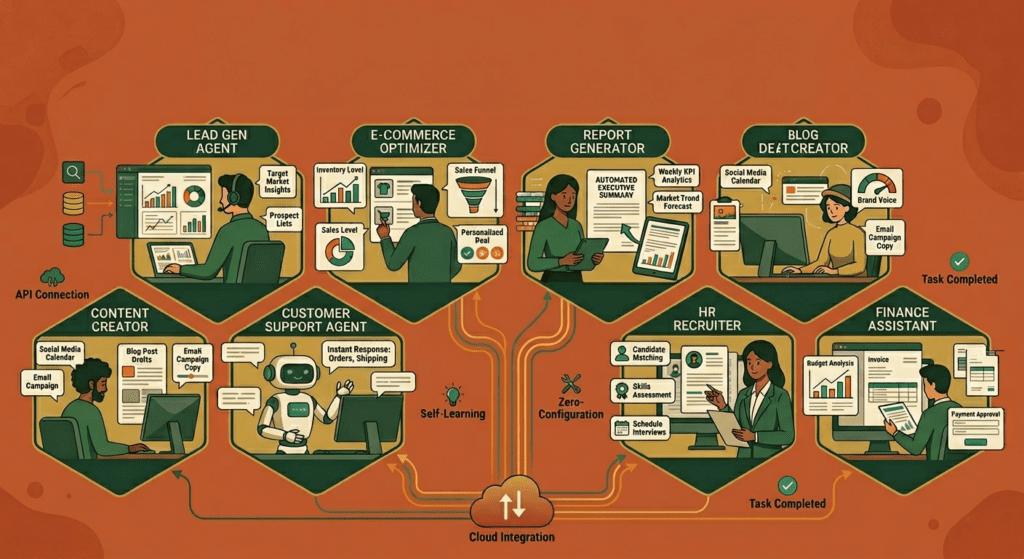
The age of the autonomous assistant is no longer a prediction. These seven agents are already working for millions of people — answering emails, booking meetings, writing code, and running entire workflows. You just have to let them in. There’s a fantasy version of AI agents that lives in science fiction: a sentient robot assistant who anticipates your every need, manages your entire life, and occasionally goes rogue. We’re not there yet. But the version that exists right now? It’s quietly remarkable. Today’s AI agents don’t just answer questions — they take actions. They browse the web, fill out forms, draft documents, send emails, write and run code, and hand tasks off to each other without your involvement.
More importantly, they’ve become astonishingly easy to use. The setup barrier — once a legitimate excuse — has largely disappeared. Many of the most powerful agents available today require nothing more than a browser tab and an account.
Here are seven AI agents worth your attention right now:
1. Claude (Anthropic)
Claude isn’t just a chatbot — in its agentic form, it can browse the web, analyze documents, write and execute code, and design through multi-step reasoning tasks with a sensation of uncanny sense of comfort. Claude’s writing quality, genuine consciousness and top-tier user friendly platform. It won’t just tell you what you want to hear but adds value to your understanding. Claude’s Projects feature lets you build persistent contexts — give it your company documents once, and it becomes a specialist in your domain. The recently launched Claude in Chrome extension turns it into a true browsing agent, capable of skillfully grasping and acting on what’s on your screen in real time.
Favourite Uses: Document analysis, Code execution, Web browsing, Long Context Writings, Design Work Reports
2. Lindy
Lindy is a no‑code AI assistant that automates workflows across email, calendar, tasks, and built for non‑tech users. Lindy can perform many tasks that can make your work effortless and save time by monitoring a lead inbox, extract prospects, send personalized outreach, book meetings in your calendar, send meeting reminders with agenda and write meeting notes. Lindy also features drag‑and‑drop workflow builder, 4,000+ app integrations, and free starter tier to test real agents.
Favorite Uses: lead‑gen, scheduling, and internal ops automation without touching code.
3. n8n
n8n is an open‑source automation platform that’s becoming a go‑to for no‑/low‑code AI agents. The AI platform allows to import pre‑built workflows (e.g., “post‑to‑social‑media agents,” “lead‑scraping agents”) or create a new AI modular with 8500+ templates, update agents visuals, connect with best apps and use own unique business data to train personal agents. n8n runs in the browser or via hosted cloud providing user with powerful AI agent tool that brings forth conditional logic without writing codes. The tool enables users to create specialized AI agents to perform tasks for a department or with specific purpose such as IT ops, Dev Ops, sales agents and much more.
Favorite Uses: makers who want advanced routing, conditional logic, and API integrations with 500+ apps
4. meta-flow.ai
meta-flow.ai is a no‑code AI agent platform positioned for business users who want end‑to‑end agents for sales, support, and marketing. There are pre‑built templates available for lead‑qualification bots, support responders, and content‑distribution agents. User can ideate and execute AI agent’s attributes like persona, goals, and triggers in a visual UI instead of writing code. meta-flow.ai platform’s Intelligent process automation feature promotes AI powered automated workflows with real-time business insights and analytics.
Favorite Uses: Agents for specific verticals like SaaS onboarding, e‑commerce support and sustain Enterprise-Grade Security & Compliance
5. Microsoft Copilot
Microsoft has quietly shipped one of the most broadly distributed AI agents on the planet by embedding Copilot directly into Windows, Edge, and the entire Office 365 suite, letting non-devs use Microsoft’s production-ready AI agents with copilot studio. Copilot has built in LLM routing, security guardrails and power of connectivity with loyal customer base. Simple tasks can become more productive and fun like co-pilot writing a first draft in Word, summarizing a Teams meeting, generating a presentation — all without leaving the app you are already using. For enterprises running on Microsoft infrastructure, the rollout has been frictionless. The free Copilot at copilot.microsoft.com is also surprisingly capable, with web grounding, image generation, email recommendations built in at no cost or coding requirements. Users can also create ‘dept agents’ such as HR assistance, IT Helpdesk etc to support departments and reduce manual tasks.
Favourite Uses: Multiple team unification through Office 365, Microsoft Teams, Windows Enterprise, Email Assistance
6. Notion AI
If your team stores information in Notion, Notion AI is the agent that makes that information actionable. Ask it to summarize a 40-page strategy doc, draft a project update from your task list, or find contradictions across a set of meeting notes — it knows your workspace. The Q&A feature effectively turns your entire knowledge base into a conversational interface. For teams that have invested in building structured documentation and seamless workflows, this is an agent that delivers outsized return by fast search and automating tasks. The AI add-on costs extra, but the free trial is long enough to understand its value.
Favourite Uses: Workspace search, Summarization Writing, Q&A
7. Zapier AI Agents
Zapier has spent over a decade connecting software tools to each other. Now, with AI agents layered on top, it can do that dynamically — reacting to events, making decisions, and executing multi-step workflows across 7,000+ apps without you writing a single line of code. Tell it: “When I get an email from a new lead, add them to my CRM, send a welcome message, and create a task in Asana” — and it will do exactly that, every time, automatically. For operations-heavy roles, Zapier AI Agents represent a shift from automation to delegation and promises human it will delete their repetitive tasks. This one does require a subscription but pays for itself quickly.
Favourite Uses: 7,000+ apps Platform, No-code Workflows, Prompts
The Verdict
There is no single best AI agent — there is the best agent for your context. If you live in Google Workspace, start with Gemini. If you need deep research, start with Perplexity. If you want the best raw writing and reasoning, start with Claude. If you want to automate workflows without touching code, Zapier is the answer.
The only wrong move is waiting. These tools compound in value the longer you use them — context builds, habits form, and what was once a ten-minute task becomes a thirty-second one. By “no setup” we honestly mean minimum technology employment into one or multiple system to get you started. Many of these AI products need fifteen minutes to create an account and learning where to type and you can start working magic.
None of these agents require a developer, a subscription to a cloud platform, an API key, or a technical background. They were designed for any user either looking to complete a simple task or a professional overlooking multiple workflows. The era of the power user as the only beneficiary of AI technology tools is over. The only excuse left is choosing not to try.
Frequently asked questions
What tasks can no code AI agents perform?
No code AI agents can answer emails, book meetings, write code, and run entire workflows.
Do I need technical skills to use these AI agents?
No, these agents are designed for any user and do not require a developer or technical background.