
From Instagram’s 13-employee company acquisition by Meta in 2012 to a Los Angeles Man generating $401 million in his first year by using his intelligence, determination, and AI. AI has compressed the economics of enterprise beyond anyone’s predicted timeline.
For most modern business history, billion-dollar companies require armies of engineers and product managers, sprawling offices, and years of work, learning, and investment. Instagram disrupted that assumption in 2012 when it sold to Facebook for roughly $1 billion with just 13 employees. Transition to the year 2026, where AI is pushing this reorientation even further. In April 2026, the New York Times reported that Matthew Gallagher, a 41-year-old self-taught developer from Los Angeles, online telehealth/ D2C business Medvi, which has generated $401 million in first-year sales with his brother, $20,000, and more than a dozen AI tools, and they are reportedly on track to achieve 1.8 billion target this year.
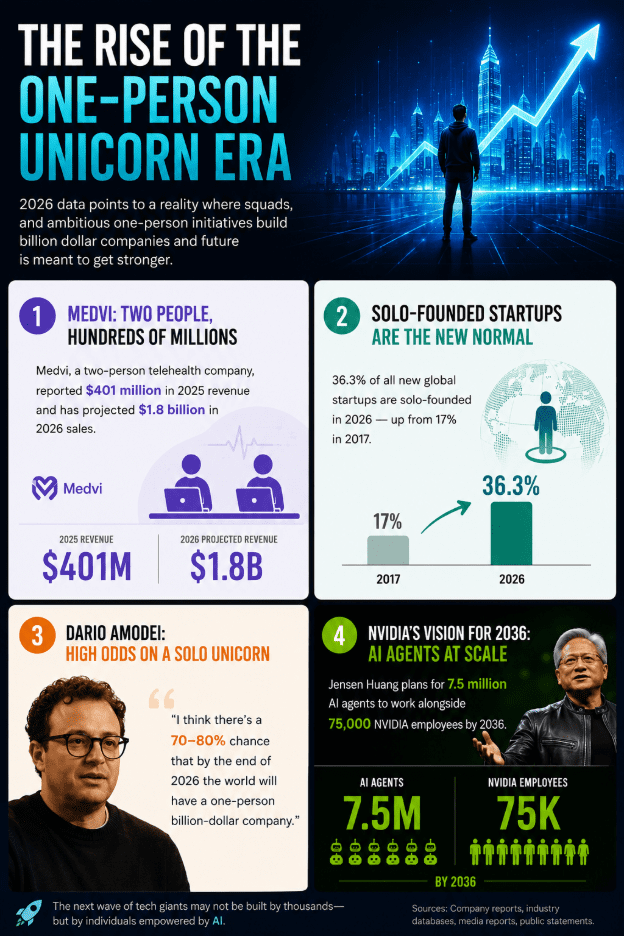
What happened in 2012 with Instagram and Medvi is not as simple as technological progress being a factor. It is a pivot to the requirement of “running a successful business.” Sam Altman has predicted that AI could enable the world’s first one-person billion-dollar company, saying there is already a betting pool among tech CEOs about when it will happen. Dario Amodei showed his confidence in the precedent. And Jensen Huang, standing on stage at GTC Taipei on June 1, 2026, declared that “useful AI has arrived” and that “AI is now a profit generator.”
Where We Know The Prediction Started and Timeline Showing Us Progression
The idea of a one-person billion-dollar company entered the mainstream in 2024 when Sam Altman revealed an ongoing debate among Silicon Valley leaders. Speaking with Alexis Ohanian, the OpenAI CEO said that a group chat of tech founders and executives was already placing bets on the year AI would enable a single individual to build a billion-dollar business. Most participants predicted 2028.
Less than two years later, the forecast became significantly more aggressive. Dario Amodei, CEO of Anthropic, was asked the same question at Anthropic’s Code with Claude developer conference in August 2025. His answer was — “2026” with 70 to 80% confidence, specifically naming proprietary trading, advanced developer tools, and automated customer service categorizes likely to make this happen.
The Prediction Timeline — From Speculation to Actions
Early 2024
The idea enters the mainstream when OpenAI CEO Sam Altman reveals that a group chat of technology leaders has an ongoing betting pool on the year the first one-person billion-dollar company will emerge. Most participants place their bets in 2028. Altman argues that such a company would have been unimaginable before AI but increasingly appears inevitable.
2024
As generative AI capabilities accelerate, entrepreneurs and investors begin exploring a new possibility: companies operating at scales once reserved for large organizations. The benchmark shifts from building lean startups to building enterprises that can leverage software and AI as force multipliers.
September 2024
Entrepreneur Matthew Gallagher launches Medvi with approximately $20,000 in startup capital and extensive use of AI-powered tools. The company begins scaling rapidly with minimal headcounts, becoming an early test case for AI-amplified entrepreneurship.
August 2025
At Anthropic’s Code with Claude developer conference, CEO Dario Amodei estimates a 70–80% probability that the world’s first one-person unicorn will emerge by the end of 2026. During the discussion, Instagram co-founder Mike Krieger reflects on how modern AI tools could dramatically reduce the team size required to build products comparable to earlier startup successes.
April 2026
A high-profile media profile of Medvi brings the story into public view. The company reports $401 million in 2025 revenue, approximately 250,000 customers, a 16.2% net profit margin, and only two employees, while projecting $1.8 billion in revenue for 2026. The story becomes one of the strongest real-world examples of AI-enabled operational leverage.
March 2026
At the GTC San Jose media Q&A session, Jensen Huang reportedly said: “In 10 years, we will hopefully have 75,000 employees. Those 75,000 employees will be working with 7.5 million agents.”
Two Founders, Two Blueprints, One Shared Logic
The debate about the solo unicorn would be entirely theoretical without real operational proof. Instead, we have two contrasting case studies — one that swung aggressively for nine-figure revenue in a single year, and one that built quietly across a portfolio of small bets until the money compounded beyond doubt. Both illuminate the same underlying truth: AI has collapsed the execution bottleneck that once made human headcount structurally non-negotiable.
Matthew Gallagher
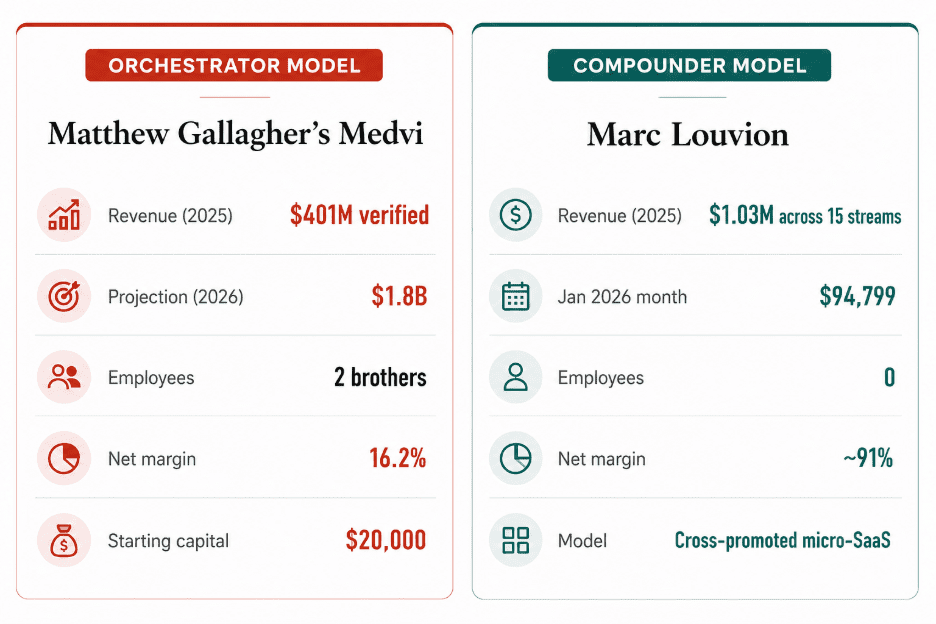
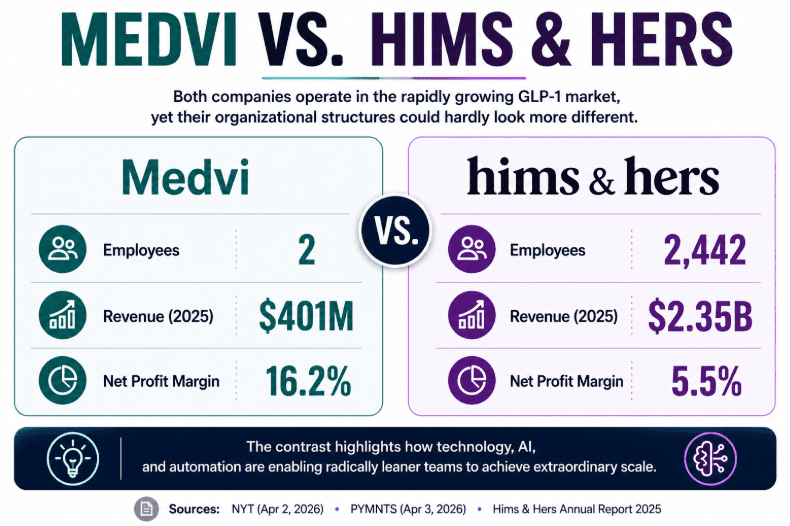
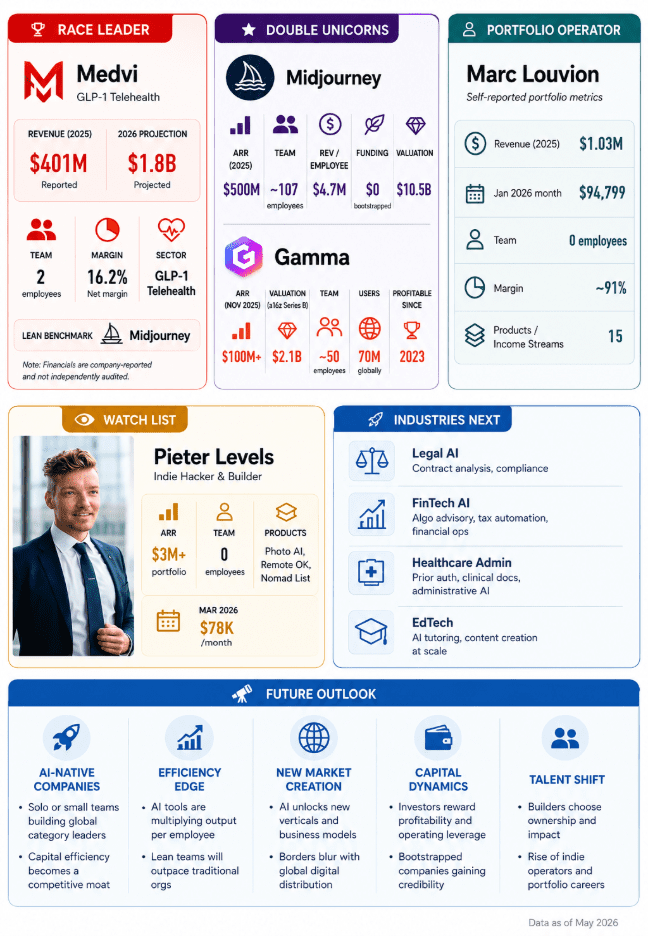
Gallagher is a self-taught developer whose early internet projects included a Weird Al Yankovic fan website. In September 2024, he launched Medvi from his Los Angeles apartment, targeting the exploding demand for GLP-1 weight-loss medications — a market where friction-heavy doctor’s visits were deterring millions of potential customers. He had no employees, no outside capital beyond $20,000 of his own, and a working theory that AI tools had become capable enough to replace a corporate infrastructure. Fourteen months later, that theory produced $401 million in first-year sales, verified by the New York Times, at a 16.2% net profit margin — nearly three times the margin of Hims & Hers, which runs in the same category with 2,442 employees.
His architecture followed a clear division of labour. ChatGPT, Claude, and Grok wrote every line of code. Midjourney and Runway generated ad creative. AI voice tools handled customer communications. The regulated layer — licensed physicians, prescription processing, pharmacy fulfillment, and compliance — was outsourced entirely to CareValidate and OpenLoop Health. Gallagher owned the customer relationship, the brand, and the acquisition flywheel. OpenLoop CEO Jon Lensing told the Times: “Matthew’s native tongue seems to be A.I.”
“It’s not an AI company, but I did it with A.I. Growth was insane.”
— Matthew Gallagher, Founder of Medvi
Marc Lou
Where Gallagher swung a single vertical at an extraordinary scale, Marc Louvion — known online as Marc Lou built something structurally different and arguably more durable. The 32-year-old French developer spent years living cheaply in Osaka, created his own ShipFast after a few failures in life: a Next.js boilerplate that lets developers launch startups in days rather than months. By the end of 2025, he had generated $1,032,000 across 15 income streams, with zero employees and net margins of approximately 91%. By January 2026, a single month generated $94,799 across ShipFast, CodeFast, DataFast, and TrustMRR (the tool he built in 24 hours that reached $25,000 MRR within days of launch).
The structural secrets are cross-promotion and attraction gained by social media. Every product in his portfolio shares a footer that links to every other product. The audience he built with ShipFast is foundational for his following launches. Marc Lou has not yet claimed the billion-dollar title, but he has built the operational proof of concept for something Medvi has not: a sustainable, defensible, zero-employee portfolio business having the trustable consumer base.
Companies Already Running At Extraordinary Efficiency
Medvi leads the race, but there are multiple active runners worth acknowledging. The businesses below have achieved structural efficiency ratios that were, until recently, considered theoretically impossible for their scale. Each represents a different model for how AI technologies can be deployed; each business can teach us bountifully how unconventional businesses are successful.
The DREAM Engine: Five Layers Every Solo Founder Must Master
Across the businesses succeeding in this space, consistent operational logic has emerged. The DREAM framework maps the five functional layers every founder must own or fully automate before meaningful scale becomes possible. Each layer is a support for the next. Skipping one of these could reflect the common reasons early-stage AI-enabled businesses collapse; even with impressive early numbers falls to a no sustainable floor beneath them.
D – DEMAND
Choose a market with urgent, recurring, proven needs. AI executes brilliantly — but it cannot manufacture demand that does not exist. GLP-1, developer tools, legal AI, financial automation.
R – Revenue
Model revenue mechanics before you build. Subscription, transactional, licensing. Your margin profile and defensibility are set here, not at launch. Marc Lou: 91% margin. Medvi: 16.2%. Both are deliberate.
E- Engine
Your AI agent stack is your operations team. Coding, design, support, analytics, and automation can be handled under $300–$500 per month. This is your leverage point. Your software instrument is your treasure.
A – Admin
Legal, compliance, and regulated infrastructure outsourced to specialist partners — the OpenLoop model. Own the customer relationship. Contract the back office. Never build what you can buy.
M- Marketing
Distribution is the moat, not the product. Build systems where each customer becomes a marketing asset before you spend a dollar on paid media. Marc Lou’s shared footer is the model.
The Founder’s Triangle And Code As A Moving Target
Every solo AI founder navigates a three-way constraint that experienced operators are calling the Founder’s Triangle. Speed determines how fast you capture a market before well-funded competitors replicate your model. Quality determines whether your product retains customers beyond the first acquisition wave. Control determines how much of the value chain you own versus outsource. Gallagher optimized speed and control, outsourcing quality in the clinical compliance layer. Marc Lou optimized for quality and control, accepting a slower speed in exchange for 91% margins and zero regulatory exposure. Defining your position in the triangle helps you determine your architecture from day one.
The code-as-moving target is the most underappreciated mechanism in this space. AI advancement is not linear, and the tools available in June 2026 are fundamentally different from those available when Gallagher launched in September 2024. Models improve fast enough that a product’s technical moat can erode within a single product cycle. Entrepreneurs, especially the solopreneur, need to consider the speed at which technology advances today; AI works while coding, competitors launch, and live market direction.
Why Solo Founders Are Both Advantaged and Vulnerable
Solo entrepreneurs benefit from unprecedented leverage. AI coding assistants let one person ship what previously required a team. You can iterate faster, pivot cheaper, and experiment more boldly than legacy competitors bogged down by technical debt and organizational inertia.
This advantage is double-edged. Your competitor isn’t just a well-funded startup with years of runway, but also new founders entering the market next month using improved technology, paying less for inference, newer training data, and a broader audience. The barrier to entry has shattered in the times of rapidly evolving, democratic technologies. Execution of precision and strategic awareness matters more than ever.
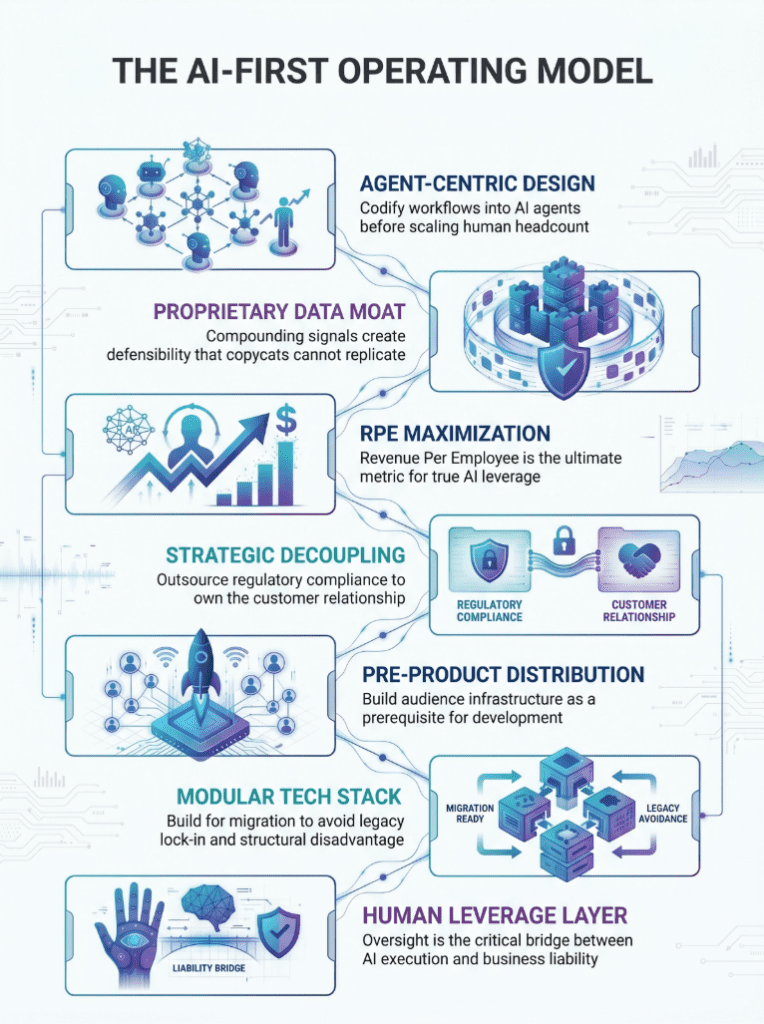
Seven Rules For Building A Native AI Company
A native AI company is not a traditional business that uses AI tools. It is a business whose entire operating logic, including the product, operations, marketing, and customer service, leverages AI technologies. The business is designed from the ground up assuming AI agents to handle execution. The distinction matters because retrofitting AI onto a traditional org chart produces efficiency gains. Building natively produces structural advantages that cannot be replicated by adding tools to an existing headcount model. Use these principles to differentiate demand for your business, your service, or product from the rest of the competitors. These seven rules apply equally to service businesses (consulting, legal, creative) and product businesses (Vertical AI, data tools, domain-specific AI, consumer-driven apps).
What Big Tech Thinks And How Solo Founders Attract Them
The world’s largest technology companies are not watching this shift from a distance; moreover, they are building infrastructure to support Solopreneurs and small businesses. At GTC Taipei, Jensen Huang declared “useful AI has arrived” and “AI is now a profit generator,” and showed optimism to run 7.5 million AI agents alongside 75,000 NVIDIA employees by 2036. He also introduced AI tokens as a compensation model: engineers receive a token budget on top of their base salary, effectively being paid to deploy agents as productivity multipliers.
Shopify CEO Tobi Lütke declared in April 2025 that “reflexive AI usage is now a baseline expectation at Shopify,” mandating that every request for a new human hire must first justify why the task cannot be done by AI instead.
The most significant institutional signal for solo founders arrived last month with Anthropic’s launch of ‘Claude for Small Business’; integrating Claude directly into QuickBooks, PayPal, HubSpot, Canva, DocuSign, Google Workspace, and Microsoft 365, with 15 ready-to-run agentic workflows spanning finance, operations, sales, and HR.
“Small businesses make up nearly half the American economy, but they’ve never had the resources of bigger companies. AI is the first technology that can finally close that gap.”
— Daniela Amodei, Co-Founder and President of Anthropic
Anthropic also joined the Workday Foundation Solopreneurship Accelerator Program, providing users with Claude credits and an AI-first entrepreneurship curriculum to inspire solo founders.
How to attract big tech as a solo-scale company
Generate Proprietary Data
Large companies want data assets that their platforms cannot generate alone. Medvi’s 250,000 GLP-1 patient relationships are valuable to OpenLoop, CareValidate, and any health platform seeking that distribution channel. Your data is your negotiating position.
Validate Their Platforms
When Gallagher’s business validates OpenLoop’s infrastructure at scale, OpenLoop has an incentive to promote the Medvi model to every future customer. Become the proof of concept for the platforms you run on — and those platforms become your sales force.
Demonstrate AI Sophistication
Microsoft and Google are integrating AI into every enterprise product. Solo founders who demonstrate sophisticated AI agent deployment — not just API usage, but orchestrated multi-agent systems — become reference customers worth investing in.
Stay on Open Standards
Microsoft, Google, Anthropic, and OpenAI joined forces under the Agentic AI Foundation, backed by the Linux Foundation, building open standards around MCP and Agents.md. Building on open standards — rather than proprietary lock-ins — keeps acquisition and partnership doors open.