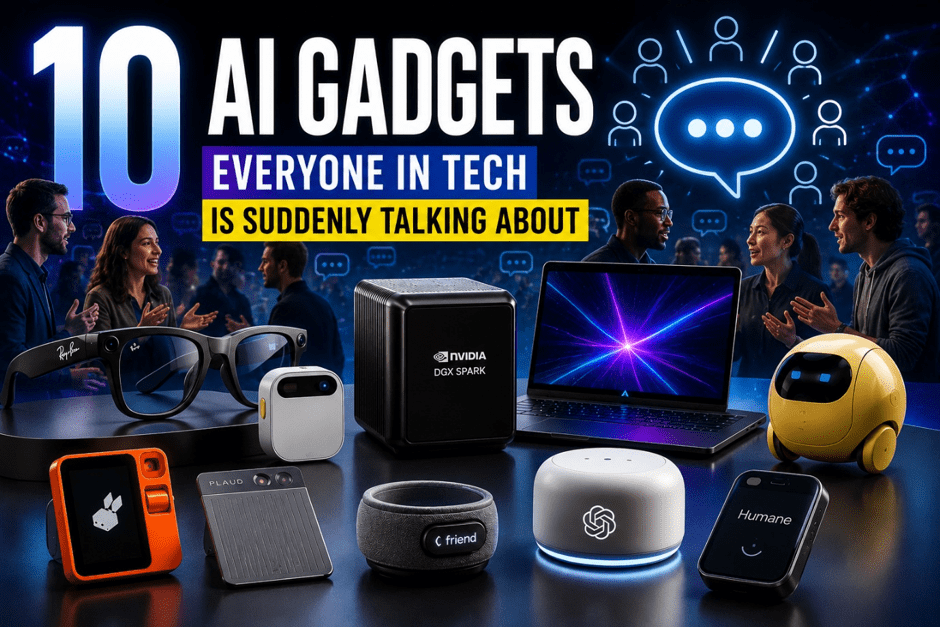
Artificial intelligence first transformed the software world through chatbots, AI search, content generation, and intelligent assistants. In 2026, however, attention is rapidly shifting toward AI-powered hardware. Thanks to breakthroughs in AI chips, neural processors, and on-device computing, a new generation of gadgets can understand natural language, adapt to user behaviour, and perform complex tasks without relying heavily on the cloud.
From smart glasses and AI companions to personal supercomputers and home robots, these devices are redefining how people interact with technology. As companies compete to lead this emerging market, consumers, developers, and investors alike are closely watching the gadgets shaping the next era of computing.
1. NVIDIA DGX Spark
Over at the developer and researcher circles, along with AI startups, the NVIDIA DGX Spark has really gotten folks excited. Often called a personal AI supercomputer, this thing packs an incredible amount of power into a desktop-sized unit – it literally can sit right on your desk.
Tailored for building, testing, and deploying sophisticated AI apps, the DGX Spark lets them work with large language models, multimodal systems, and AI agents all locally. No biggie if you need to dodge pricey cloud setups, too – which is great for places
juggling tonnes of confidential stuff or those who just want total command over their AI pipelines.
Its massive appeal lies in how it shifts AI dev practices. Traditionally, top-tier AI research needed data centre access and costly cloud services. But NVIDIA turned things around; they’re putting potent AI computing within reach of tinier teams, solo developers, and even startups. So yeah, exciting shift in the game!
Industry experts believe devices like DGX Spark could democratise AI innovation in much the same way personal computers democratised software development decades ago. As businesses increasingly seek customised AI solutions, personal AI supercomputers may soon become essential tools in technology departments worldwide.
Link: https://www.nvidia.com/en-in/products/workstations/dgx-spark/
2. NVIDIA RTX Spark AI PCs
The way personal computers are being transformed by artificial intelligence (AI) is happening with NVIDIA’s RTX Spark platform, which has just recently been launched as a new type of computing system that focuses on AI. The PCs running with these types of systems contain both high-performance Graphics Processing Units (GPUs) and customised AI accelerators, together with very large unified memory pools, so that they can handle the high-demand applications found in modern-day artificial intelligence software applications.
The biggest difference between the RTX Spark-based system and traditional laptop/desktop computers is that they will run these advanced AI models locally on the RTX Spark PC. This means that there will not need to be an upload of data to an external server so that you can:
• Create content
• Automate business process/workflow
Create new software
• Edit video
• Work with intelligent agents.
Technology professionals are particularly interested in RTX Spark systems because they bridge the gap between traditional productivity devices and professional AI workstations. Creative teams can generate graphics and videos more efficiently, developers can build and test AI applications locally, and enterprises can implement AI-driven workflows while maintaining greater control over sensitive information.
As AI becomes embedded into nearly every professional workflow, RTX Spark PCs are increasingly viewed as the blueprint for the next generation of personal computing.
Link: https://www.nvidia.com/en-in/products/rtx-spark/
3. Meta Ray-Ban Smart Glasses AI Edition
Smart glasses have been viewed throughout the years as one of the more promising areas in consumer technology—one that has not yet made it into the mainstream, however. This may all be changing thanks to the release of Meta’s AI-enhanced Ray-Ban Smart Glasses in 2026.
At first inspection, there isn’t much to differentiate between a pair of these smart glasses and a regular pair of glasses, but hidden inside the frames is a set of cameras, microphones, speakers, and sophisticated AI technology that enables the smart glasses to understand the surroundings of the wearer. You can ask the smart glasses to give you information about what you are looking at, as well as translate signs that are in a language you do not speak, identify landmarks, help you navigate, and take pictures or videos without the use of your hands.
Perhaps one of the most compelling features of the smartwatch is that it provides users with an information source while they never have to take out their smartphone; the interaction feels natural and unobtrusive, allowing for a more seamless integration of technology into everyday life.
Industry experts see these smart glasses as a bridge to the eventual establishment of widespread augmented reality technology. While we may still be several years away from widely adopted augmented reality glasses, smart glasses powered by AI are proving how contextual computing can enhance the quality of life in everyday occurrences.
Link: https://www.meta.com/in/ai-glasses/ray-ban-meta/
4. Halliday AI Glasses
Halliday AI Glasses have quickly become one of the most talked-about AI wearables in 2026. Designed to look like a regular pair of stylish glasses, they integrate advanced artificial intelligence capabilities into a lightweight form factor that users can comfortably wear throughout the day. Unlike many earlier smart glasses that appeared bulky or overly futuristic, Halliday focuses on blending AI assistance seamlessly into everyday life.
The glasses feature a discreet display system that delivers information directly into the user’s field of view without obstructing their surroundings. Powered by an AI assistant, the device can provide real-time translations, meeting summaries, navigation guidance, message notifications, and contextual information on demand. This allows users to access critical information instantly while remaining engaged with conversations, work, or their environment instead of constantly checking a smartphone.
What makes Halliday AI Glasses particularly significant is their vision of ambient computing, where technology becomes less visible but more useful. As concerns about screen fatigue and digital distraction continue to grow, Halliday offers an alternative
approach that prioritises convenience and natural interaction. The product has sparked widespread discussion among technology professionals, who view it as a glimpse into a future where AI assistance is available whenever needed without dominating users’ attention.
Link: https://hallidayglobal.com/pages/halliday-glasses
5. Rabbit R2
The new AI device from Rabbit is a hot new topic in the tech community, primarily because they’re working on an emerging field of study called “agentic AI”. The Rabbit R2 is built to take actions on your behalf instead of merely providing information like traditional digital assistants do.
The device can help coordinate your calendar, make reservations for you, conduct research, organise your information, and interact with several online services through natural language commands. Instead of opening several different apps and/or websites to do what you need to do, you simply tell Rabbit what you want accomplished.
This fits in with one of the bigger trends in artificial intelligence right now — the emergence of AI agents that can carry out complex workflows on their own. Many experts believe that agentic systems will be among the most significant advances in technology in the next few years.
The Rabbit R2 allows us to glimpse that future and what it may become by showing us that AI will eventually work less like a tool and more like a digital employee that can perform routine tasks independently of you.
Link: https://www.rabbit.tech/rabbit-r1
6. Lenovo ThinkBook AI PC Series
With recent focus on artificial intelligence powering personal computing, Lenovo is positioned at the forefront of the movement. The new ThinkBook series incorporates advanced AI-optimisation technologies and dedicated Neural Processing Units (NPUs), allowing users to run intelligent applications on their devices.
The newly developed ThinkBook AI PCs from Lenovo are garnering a great deal of interest this year due to their combination of both cloud-based (software) and device (hardware) powered artificial intelligence to provide a real personal computing assistant experience for customers.
These systems will be able to summarise various documents or help improve meetings, create new types of content and allow users to have a more effective working experience with their applications. In addition to enabling users to do this collaboration across their PC/notebook, smartphone, and tablet, Lenovo has created its Smart Connect program to assist customers’ needs/experiences. Each of the ThinkBook AI
PCs will feature a separate Neural Processing Unit (NPU), performing many of the AI functions even if the device is offline or without an internet connection, thus allowing these devices to provide quicker response times and achieve greater battery life and will protect customers’ private data since all of the information/users’ data would be stored on the device as opposed to an external cloud-based server.
The combination of the ability to be productive, to be secure, and to have intelligent connectivity has made Lenovo’s line of AI PCs one of the most popular AI business technology items this year.
The increasing acceptance and usage of AI PCs signify a larger shift in enterprise technology strategies. Companies are moving away from thinking about artificial intelligence as an isolated application and looking to integrate it as a primary building block into each of the devices used in their organisations.
Link: https://www.lenovo.com/in/en/c/laptops/thinkbook/thinkbook-series/
7. Plaud Note AI Recorder
While some AI devices provide futuristic experiences, Plaud Note AI Recorder attracted attention by addressing a practical problem. The small device records meetings/conversations/lectures/interviews and then automatically converts them into organised transcripts and summaries.
Professionals of different industries value the product because it solves one of the biggest time-consuming tasks in knowledge work – taking notes. Rather than dividing their concentration between listening and writing, the user can be completely focused on what is being said, while the AI takes care of the record-keeping.
This device can identify the most important points of the meeting, i.e., action items, decisions made, & what tasks need to be followed up on. This feature can benefit all types of knowledge workers but is especially helpful for executives, consultants, researchers, journalists, and students who deal with significant amounts of information.
The success of Plaud Note illustrates that the most successful AI products may not be the most innovative. Often, the greatest benefit from an AI product is through automating repetitive work/tasks, freeing up time to focus on higher-order thinking.
Link: https://www.plaud.ai/products/plaud-note-ai-voice-recorder
8. Samsung Ballie AI Robot
For a long time, technology companies have talked about creating intelligent robots that can function in the home. Samsung’s Ballie is one of the first instances of this vision becoming a reality.
Ballie is a small, round robot that can roll through the home and act as a mobile AI assistant. The Ballie can monitor the environment, control smart devices, remind you of things you need to do, provide information and have natural interactions with people in the household.
What is especially interesting about the Ballie is that it can go wherever it is needed for assistance. This makes it much more dynamic than a stationary smart speaker and is an opportunity for an enhanced level of personalisation, as it can accompany the user throughout their home.
While consumer robotics is still relatively new, Ballie has generated a lot of interest because it shows how AI, robotics and smart home technology can work together to improve the quality of life. Many experts are touting that household robots will have large market potential in a decade, and Ballie has received considerable attention as a fundamental example of this future opportunity.
Link: https://news.samsung.com/us/tag/ballie/
9. Friend AI Wearable
The Friend AI Wearable is one of the most divisive pieces of technology today and has sparked much discussion about what role technology should play in our daily lives. The Friend is not just about productivity; rather, it serves as a virtual friend for users throughout their day.
With time, the friend becomes familiar with how users take care of themselves, communicate, behave, and interact with others. The Friend is then capable of providing a variety of feedback regarding its interactions with users, including reminders, encouragement, comments on observed behaviours, and recommendations based on the context of previous interactions.
Those who endorse the Friend believe that it represents an organic progression of AI technology, progressing from purely transactional interactions to ongoing, customised relationships. However, there are some critics of the Friend, including concerns over emotional dependence on the Friend and the ramifications of having an AI as a confidant.
Either way, the Friend has created a dialogue regarding traditional beliefs about how technology is used in our day-to-day lives.
Link: https://friend.com/
10. OpenAI and Jony Ive’s AI Device
It could be argued that there is no other AI gadget in existence generating the same level of speculation and interest as the mystery hardware project created by OpenAI and the tech product designer, Jony Ive. To this point, only a small amount of information about the unknown product has been made available to the public. However, it has quickly gained recognition as one of the largest advancements in consumer technology to date.
This new partnership brings together the artificial intelligence skills of OpenAI and the highly regarded design talents of Jony Ive. The buzz in the industry is that the new device could be created around natural, non-traditional interfaces rather than just the conventional screen.
Speculation also suggests that this mysterious device could be created in many forms, from wearables to desktop virtual assistants, or possibly in yet-to-be-defined alternative product categories. The level of secrecy surrounding the project has heightened the excitement and curiosity of investors, analysts, developers, and consumers alike.
A few analysts are equating the excitement around the product with the excitement before the start of the smartphone age. Although expectations for the final product are off the charts, the collaboration between OpenAI and Jony Ive illustrates the belief that for AI to operate effectively in the modern world, it will require an entirely new style of hardware experience and should not simply be added to existing technology like all the other gadgets.
Link: https://www.businessinsider.com/openai-cfo-ai-device-jony-ive-2026-6
Frequently asked questions
What is the NVIDIA DGX Spark?
The NVIDIA DGX Spark is often called a personal AI supercomputer, designed for building, testing, and deploying sophisticated AI applications locally.
How do RTX Spark PCs differ from traditional computers?
RTX Spark PCs run advanced AI models locally, eliminating the need to upload data to external servers for tasks like content creation and automation.